| Record Information |
|---|
| Version | 2.0 |
|---|
| Created at | 2025-11-05 02:14:38 UTC |
|---|
| Updated at | 2025-12-20 01:35:12 UTC |
|---|
| NP-MRD ID | NP0351726 |
|---|
| Natural Product DOI | https://doi.org/10.57994/4796 |
|---|
| Secondary Accession Numbers | None |
|---|
| Natural Product Identification |
|---|
| Common Name | Norlichexanthone |
|---|
| Description | Norlichexanthone is a secondary metabolite. Secondary metabolites are metabolically or physiologically non-essential metabolites that may serve a role as defense or signalling molecules. In some cases they are simply molecules that arise from the incomplete metabolism of other secondary metabolites. Norlichexanthone was first documented in 2007 (PMID: 17917241). Based on a literature review a significant number of articles have been published on norlichexanthone (PMID: 19670161) (PMID: 21741249) (PMID: 22061662) (PMID: 28196973) (PMID: 28409637) (PMID: 31003403). |
|---|
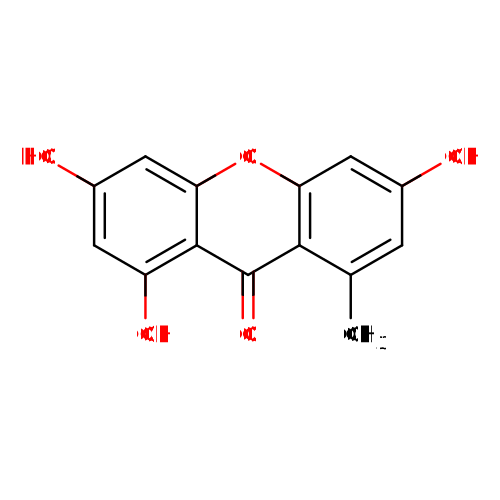
| Structure | [H]OC1=C([H])C2=C(C(=O)C3=C(C([H])=C(O[H])C([H])=C3O2)C([H])([H])[H])C(O[H])=C1[H] InChI=1S/C14H10O5/c1-6-2-7(15)4-10-12(6)14(18)13-9(17)3-8(16)5-11(13)19-10/h2-5,15-17H,1H3 |
|---|
| Synonyms | | Value | Source |
|---|
| 1,3,6-Trihydroxy-8-methyl-9H-xanthen-9-one | ChEBI |
|
|---|
| Chemical Formula | C14H10O5 |
|---|
| Average Mass | 258.2290 Da |
|---|
| Monoisotopic Mass | 258.05282 Da |
|---|
| IUPAC Name | 1,3,6-trihydroxy-8-methyl-9H-xanthen-9-one |
|---|
| Traditional Name | norlichexanthone |
|---|
| CAS Registry Number | Not Available |
|---|
| SMILES | [H]OC1=C([H])C2=C(C(=O)C3=C(C([H])=C(O[H])C([H])=C3O2)C([H])([H])[H])C(O[H])=C1[H] |
|---|
| InChI Identifier | InChI=1S/C14H10O5/c1-6-2-7(15)4-10-12(6)14(18)13-9(17)3-8(16)5-11(13)19-10/h2-5,15-17H,1H3 |
|---|
| InChI Key | AQZHBCDRWFMXIN-UHFFFAOYSA-N |
|---|
| Experimental Spectra |
|---|
|
| | Spectrum Type | Description | Depositor Email | Depositor Organization | Depositor | Deposition Date | View |
|---|
| HMBC NMR | [1H, 13C] NMR Spectrum (2D, 500 MHz, C2D6OS, experimental) | phamthihuong@sookmyung.ac.kr | Not Available | Not Available | 2025-11-05 | View Spectrum | | 1D NMR | 13C NMR Spectrum (1D, 126 MHz, C2D6OS, experimental) | phamthihuong@sookmyung.ac.kr | Not Available | Not Available | 2025-11-05 | View Spectrum | | 1D NMR | 1H NMR Spectrum (1D, 500 MHz, C2D6OS, experimental) | phamthihuong@sookmyung.ac.kr | Not Available | Not Available | 2025-11-05 | View Spectrum | | 1D NMR | 13C NMR Spectrum (1D, 300 MHz, acetone-d6, simulated) | Wishart Lab | Wishart Lab | David Wishart | 2021-06-20 | View Spectrum | | 1D NMR | 1H NMR Spectrum (1D, 300 MHz, acetone-d6, simulated) | Wishart Lab | Wishart Lab | David Wishart | 2021-06-20 | View Spectrum | | 1D NMR | 13C NMR Spectrum (1D, 100 MHz, acetone-d6, simulated) | Wishart Lab | Wishart Lab | David Wishart | 2021-06-20 | View Spectrum | | 1D NMR | 1H NMR Spectrum (1D, 100 MHz, acetone-d6, simulated) | Wishart Lab | Wishart Lab | David Wishart | 2021-06-20 | View Spectrum | | 1D NMR | 13C NMR Spectrum (1D, 200 MHz, acetone-d6, simulated) | Wishart Lab | Wishart Lab | David Wishart | 2021-06-20 | View Spectrum | | 1D NMR | 1H NMR Spectrum (1D, 200 MHz, acetone-d6, simulated) | Wishart Lab | Wishart Lab | David Wishart | 2021-06-20 | View Spectrum | | 1D NMR | 13C NMR Spectrum (1D, 400 MHz, acetone-d6, simulated) | Wishart Lab | Wishart Lab | David Wishart | 2021-06-20 | View Spectrum | | 1D NMR | 1H NMR Spectrum (1D, 400 MHz, acetone-d6, simulated) | Wishart Lab | Wishart Lab | David Wishart | 2021-06-20 | View Spectrum | | 1D NMR | 13C NMR Spectrum (1D, 500 MHz, acetone-d6, simulated) | Wishart Lab | Wishart Lab | David Wishart | 2021-06-20 | View Spectrum | | 1D NMR | 1H NMR Spectrum (1D, 500 MHz, acetone-d6, simulated) | Wishart Lab | Wishart Lab | David Wishart | 2021-06-20 | View Spectrum | | 1D NMR | 13C NMR Spectrum (1D, 600 MHz, acetone-d6, simulated) | Wishart Lab | Wishart Lab | David Wishart | 2021-06-20 | View Spectrum | | 1D NMR | 1H NMR Spectrum (1D, 600 MHz, acetone-d6, simulated) | Wishart Lab | Wishart Lab | David Wishart | 2021-06-20 | View Spectrum | | 1D NMR | 13C NMR Spectrum (1D, 700 MHz, acetone-d6, simulated) | Wishart Lab | Wishart Lab | David Wishart | 2021-06-20 | View Spectrum | | 1D NMR | 1H NMR Spectrum (1D, 700 MHz, acetone-d6, simulated) | Wishart Lab | Wishart Lab | David Wishart | 2021-06-20 | View Spectrum | | 1D NMR | 13C NMR Spectrum (1D, 800 MHz, acetone-d6, simulated) | Wishart Lab | Wishart Lab | David Wishart | 2021-06-20 | View Spectrum | | 1D NMR | 1H NMR Spectrum (1D, 800 MHz, acetone-d6, simulated) | Wishart Lab | Wishart Lab | David Wishart | 2021-06-20 | View Spectrum | | 1D NMR | 13C NMR Spectrum (1D, 900 MHz, acetone-d6, simulated) | Wishart Lab | Wishart Lab | David Wishart | 2021-06-20 | View Spectrum | | 1D NMR | 1H NMR Spectrum (1D, 900 MHz, acetone-d6, simulated) | Wishart Lab | Wishart Lab | David Wishart | 2021-06-20 | View Spectrum | | 1D NMR | 13C NMR Spectrum (1D, 1000 MHz, acetone-d6, simulated) | Wishart Lab | Wishart Lab | David Wishart | 2021-06-20 | View Spectrum | | 1D NMR | 1H NMR Spectrum (1D, 1000 MHz, acetone-d6, simulated) | Wishart Lab | Wishart Lab | David Wishart | 2021-06-20 | View Spectrum |
| | Predicted Spectra |
|---|
|
| Not Available | | Chemical Shift Submissions |
|---|
|
| | Spectrum Type | Description | Depositor Email | Depositor Organization | Depositor | Deposition Date | View |
|---|
| 1D NMR | 1H NMR Spectrum (1D, 500.0, C2D6OS, simulated) | phamthihuong@sookmyung.ac.kr | Not Available | Not Available | 2025-11-05 | View Spectrum | | 1D NMR | 13C NMR Spectrum (1D, 125.0, C2D6OS, simulated) | phamthihuong@sookmyung.ac.kr | Not Available | Not Available | 2025-11-05 | View Spectrum |
| | Species |
|---|
| Species of Origin | | Species Name | Source | Reference |
|---|
| Penicillium Penicillium janczewskii | | | | Penicillium Penicillium janczewskii | | |
|
|---|
| Chemical Taxonomy |
|---|
| Description | This compound belongs to the class of organic compounds known as xanthones. These are polycyclic aromatic compounds containing a xanthene moiety conjugated to a ketone group at carbon 9. Xanthene is a tricyclic compound made up of two benzene rings linearly fused to each other through a pyran ring. |
|---|
| Kingdom | Organic compounds |
|---|
| Super Class | Organoheterocyclic compounds |
|---|
| Class | Benzopyrans |
|---|
| Sub Class | 1-benzopyrans |
|---|
| Direct Parent | Xanthones |
|---|
| Alternative Parents | |
|---|
| Substituents | - Xanthone
- Chromone
- 1-hydroxy-4-unsubstituted benzenoid
- 1-hydroxy-2-unsubstituted benzenoid
- Pyranone
- Pyran
- Benzenoid
- Heteroaromatic compound
- Vinylogous acid
- Polyol
- Oxacycle
- Hydrocarbon derivative
- Organic oxide
- Organooxygen compound
- Organic oxygen compound
- Aromatic heteropolycyclic compound
|
|---|
| Molecular Framework | Aromatic heteropolycyclic compounds |
|---|
| External Descriptors | |
|---|
| Physical Properties |
|---|
| State | Not Available |
|---|
| Experimental Properties | | Property | Value | Reference |
|---|
| Melting Point | Not Available | Not Available | | Boiling Point | Not Available | Not Available | | Water Solubility | Not Available | Not Available | | LogP | Not Available | Not Available |
|
|---|
| Predicted Properties | |
|---|
| External Links |
|---|
| HMDB ID | Not Available |
|---|
| DrugBank ID | Not Available |
|---|
| Phenol Explorer Compound ID | Not Available |
|---|
| FoodDB ID | Not Available |
|---|
| KNApSAcK ID | C00002969 |
|---|
| Chemspider ID | 4444976 |
|---|
| KEGG Compound ID | C10087 |
|---|
| BioCyc ID | Not Available |
|---|
| BiGG ID | Not Available |
|---|
| Wikipedia Link | Not Available |
|---|
| METLIN ID | Not Available |
|---|
| PubChem Compound | Not Available |
|---|
| PDB ID | Not Available |
|---|
| ChEBI ID | 7632 |
|---|
| Good Scents ID | Not Available |
|---|
| References |
|---|
| General References | - Isaka M, Palasarn S, Kocharin K, Hywel-Jones NL: Comparison of the bioactive secondary metabolites from the scale insect pathogens, Anamorph Paecilomyces cinnamomeus, and Teleomorph Torrubiella luteorostrata. J Antibiot (Tokyo). 2007 Sep;60(9):577-81. doi: 10.1038/ja.2007.73. [PubMed:17917241 ]
- Liu F, Cai XL, Yang H, Xia XK, Guo ZY, Yuan J, Li MF, She ZG, Lin YC: The bioactive metabolites of the mangrove endophytic fungus Talaromyces sp. ZH-154 isolated from Kandelia candel (L.) Druce. Planta Med. 2010 Feb;76(2):185-9. doi: 10.1055/s-0029-1186047. Epub 2009 Aug 10. [PubMed:19670161 ]
- Ebada SS, Schulz B, Wray V, Totzke F, Kubbutat MH, Muller WE, Hamacher A, Kassack MU, Lin W, Proksch P: Arthrinins A-D: novel diterpenoids and further constituents from the sponge derived fungus Arthrinium sp. Bioorg Med Chem. 2011 Aug 1;19(15):4644-51. doi: 10.1016/j.bmc.2011.06.013. Epub 2011 Jul 6. [PubMed:21741249 ]
- Wang QX, Bao L, Yang XL, Guo H, Yang RN, Ren B, Zhang LX, Dai HQ, Guo LD, Liu HW: Polyketides with antimicrobial activity from the solid culture of an endolichenic fungus Ulocladium sp. Fitoterapia. 2012 Jan;83(1):209-14. doi: 10.1016/j.fitote.2011.10.013. Epub 2011 Oct 28. [PubMed:22061662 ]
- Lin J, Wang R, Xu G, Ding Z, Zhu X, Li E, Liu L: Two new polyketides from the ascomycete fungus Leptosphaeria sp. J Antibiot (Tokyo). 2017 Jun;70(6):743-746. doi: 10.1038/ja.2017.5. Epub 2017 Feb 15. [PubMed:28196973 ]
- Ali T, Inagaki M, Chai HB, Wieboldt T, Rapplye C, Rakotondraibe LH: Halogenated Compounds from Directed Fermentation of Penicillium concentricum, an Endophytic Fungus of the Liverwort Trichocolea tomentella. J Nat Prod. 2017 May 26;80(5):1397-1403. doi: 10.1021/acs.jnatprod.6b01069. Epub 2017 Apr 14. [PubMed:28409637 ]
- Duong TH, Beniddir MA, Boustie J, Nguyen KP, Chavasiri W, Bernadat G, Le Pogam P: DP4-Assisted Structure Elucidation of Isodemethylchodatin, a New Norlichexanthone Derivative Meager in H-Atoms, from the Lichen Parmotrema tsavoense. Molecules. 2019 Apr 18;24(8). pii: molecules24081527. doi: 10.3390/molecules24081527. [PubMed:31003403 ]
- Ikeda M, Kurotobi Y, Namikawa A, Kuranuki S, Matsuura N, Sato M, Igarashi Y, Nakamura T, Oikawa T: Norlichexanthone isolated from fungus P16 promotes the secretion and expression of adiponectin in cultured ST-13 adipocytes. Med Chem. 2011 Jul;7(4):250-6. doi: 10.2174/157340611796150950. [PubMed:21568875 ]
- Kamel RA, Abdel-Razek AS, Hamed A, Ibrahim RR, Stammler HG, Frese M, Sewald N, Shaaban M: Isoshamixanthone: a new pyrano xanthone from endophytic Aspergillus sp. ASCLA and absolute configuration of epiisoshamixanthone. Nat Prod Res. 2020 Apr;34(8):1080-1090. doi: 10.1080/14786419.2018.1548458. Epub 2019 Jan 19. [PubMed:30663363 ]
- Wang K, Chen Y, Gao S, Wang M, Ge M, Yang Q, Liao M, Xu L, Chen J, Zeng Z, Chen H, Zhang XK, Lin T, Zhou H: Norlichexanthone purified from plant endophyte prevents postmenopausal osteoporosis by targeting ER alpha to inhibit RANKL signaling. Acta Pharm Sin B. 2021 Feb;11(2):442-455. doi: 10.1016/j.apsb.2020.09.012. Epub 2020 Sep 28. [PubMed:33643823 ]
- Akinfala TO, Houbraken J, Sulyok M, Adedeji AR, Odebode AC, Krska R, Ezekiel CN: Moulds and their secondary metabolites associated with the fermentation and storage of two cocoa bean hybrids in Nigeria. Int J Food Microbiol. 2020 Mar 2;316:108490. doi: 10.1016/j.ijfoodmicro.2019.108490. Epub 2019 Dec 14. [PubMed:31874327 ]
- Fatima R, Naim A, Naeem S: Ligand based screening of chemical constituents from African medicinal plants for the identification of MAOB inhibitors. Pak J Pharm Sci. 2019 May;32(3 (Supplementary)):1207-1213. [PubMed:31303592 ]
- Kawakami H, Suzuki C, Yamaguchi H, Hara K, Komine M, Yamamoto Y: Norlichexanthone produced by cultured endolichenic fungus induced from Pertusaria laeviganda and its antioxidant activity. Biosci Biotechnol Biochem. 2019 Jun;83(6):996-999. doi: 10.1080/09168451.2019.1585746. Epub 2019 Mar 5. [PubMed:30835638 ]
- Baldry M, Nielsen A, Bojer MS, Zhao Y, Friberg C, Ifrah D, Glasser Heede N, Larsen TO, Frokiaer H, Frees D, Zhang L, Dai H, Ingmer H: Norlichexanthone Reduces Virulence Gene Expression and Biofilm Formation in Staphylococcus aureus. PLoS One. 2016 Dec 22;11(12):e0168305. doi: 10.1371/journal.pone.0168305. eCollection 2016. [PubMed:28005941 ]
- Chooi YH, Muria-Gonzalez MJ, Mead OL, Solomon PS: SnPKS19 Encodes the Polyketide Synthase for Alternariol Mycotoxin Biosynthesis in the Wheat Pathogen Parastagonospora nodorum. Appl Environ Microbiol. 2015 Aug 15;81(16):5309-17. doi: 10.1128/AEM.00278-15. Epub 2015 May 29. [PubMed:26025896 ]
|
|---|