| Record Information |
|---|
| Version | 2.0 |
|---|
| Created at | 2025-07-30 14:45:30 UTC |
|---|
| Updated at | 2025-08-01 00:01:40 UTC |
|---|
| NP-MRD ID | NP0351377 |
|---|
| Natural Product DOI | https://doi.org/10.57994/4418 |
|---|
| Secondary Accession Numbers | None |
|---|
| Natural Product Identification |
|---|
| Common Name | Hymeglusin |
|---|
| Description | Hymeglusin, also known as antibiotic 1233A, belongs to the class of organic compounds known as long-chain fatty acids. These are fatty acids with an aliphatic tail that contains between 13 and 21 carbon atoms. Hymeglusin was first documented in 2024 (PMID: 39035915). Based on a literature review a small amount of articles have been published on Hymeglusin (PMID: 40684465) (PMID: 40635350) (PMID: 40631324) (PMID: 38994525). |
|---|
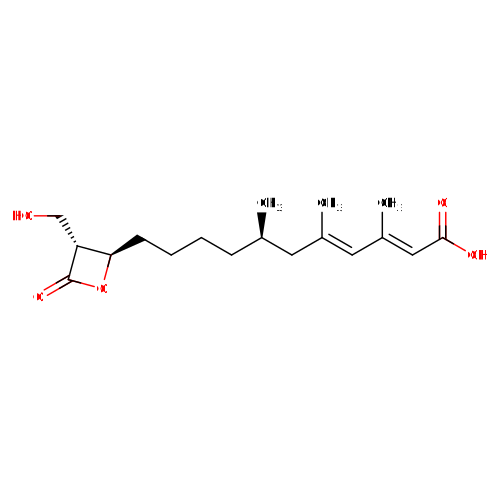
| Structure | C[C@H](CCCC[C@H]1OC(=O)[C@@H]1CO)C\C(C)=C\C(\C)=C\C(O)=O InChI=1S/C18H28O5/c1-12(8-13(2)9-14(3)10-17(20)21)6-4-5-7-16-15(11-19)18(22)23-16/h9-10,12,15-16,19H,4-8,11H2,1-3H3,(H,20,21)/b13-9+,14-10+/t12-,15-,16-/m1/s1 |
|---|
| Synonyms | | Value | Source |
|---|
| Antibiotic 1233a sodium | HMDB | | 11-(3-(Hydroxymethyl)-4-oxo-2-oxytanyl)-3,5,7-trimethyl-2,4-undecadienenoic acid | HMDB | | 3,5,7-Trimethyl-12-hydroxy-13-hydroxymethyl-2,4-tetradecadiendioic acid 12,14-lactone | HMDB | | Antibiotic 1233a | HMDB | | Antibiotic 1233a calcium | HMDB | | 11-(3'-(Hydroxymethyl)-4'-oxo-2'-oxetanyl)-3,5,7-trimethyl-2,4-undecadienoic acid | HMDB | | Antibiotic 1233a potassium | HMDB |
|
|---|
| Chemical Formula | C18H28O5 |
|---|
| Average Mass | 324.4170 Da |
|---|
| Monoisotopic Mass | 324.19367 Da |
|---|
| IUPAC Name | (2E,4E,7R)-11-[(2R,3R)-3-(hydroxymethyl)-4-oxooxetan-2-yl]-3,5,7-trimethylundeca-2,4-dienoic acid |
|---|
| Traditional Name | (2E,4E,7R)-11-[(2R,3R)-3-(hydroxymethyl)-4-oxooxetan-2-yl]-3,5,7-trimethylundeca-2,4-dienoic acid |
|---|
| CAS Registry Number | Not Available |
|---|
| SMILES | C[C@H](CCCC[C@H]1OC(=O)[C@@H]1CO)C\C(C)=C\C(\C)=C\C(O)=O |
|---|
| InChI Identifier | InChI=1S/C18H28O5/c1-12(8-13(2)9-14(3)10-17(20)21)6-4-5-7-16-15(11-19)18(22)23-16/h9-10,12,15-16,19H,4-8,11H2,1-3H3,(H,20,21)/b13-9+,14-10+/t12-,15-,16-/m1/s1 |
|---|
| InChI Key | ODCZJZWSXPVLAW-KXCGKLMDSA-N |
|---|
| Experimental Spectra |
|---|
|
| | Spectrum Type | Description | Depositor Email | Depositor Organization | Depositor | Deposition Date | View |
|---|
| 1D NMR | 1H NMR Spectrum (1D, 500 MHz, CD3OD, experimental) | [email protected] | University of São Paulo | Gabriela de Oliveira Almeida | 2025-07-30 | View Spectrum |
| | Predicted Spectra |
|---|
|
| | Spectrum Type | Description | Depositor ID | Depositor Organization | Depositor | Deposition Date | View |
|---|
| | Chemical Shift Submissions |
|---|
|
| Not Available | | Species |
|---|
| Species of Origin | | Species Name | Source | Reference |
|---|
| Fusarium falciforme | | |
|
|---|
| Chemical Taxonomy |
|---|
| Description | Belongs to the class of organic compounds known as long-chain fatty acids. These are fatty acids with an aliphatic tail that contains between 13 and 21 carbon atoms. |
|---|
| Kingdom | Organic compounds |
|---|
| Super Class | Lipids and lipid-like molecules |
|---|
| Class | Fatty Acyls |
|---|
| Sub Class | Fatty acids and conjugates |
|---|
| Direct Parent | Long-chain fatty acids |
|---|
| Alternative Parents | |
|---|
| Substituents | - Long-chain fatty acid
- Branched fatty acid
- Heterocyclic fatty acid
- Hydroxy fatty acid
- Methyl-branched fatty acid
- Dicarboxylic acid or derivatives
- Unsaturated fatty acid
- Beta_propiolactone
- Carboxylic acid ester
- Lactone
- Oxetane
- Organoheterocyclic compound
- Oxacycle
- Carboxylic acid
- Carboxylic acid derivative
- Hydrocarbon derivative
- Alcohol
- Carbonyl group
- Organic oxide
- Primary alcohol
- Organooxygen compound
- Organic oxygen compound
- Aliphatic heteromonocyclic compound
|
|---|
| Molecular Framework | Aliphatic heteromonocyclic compounds |
|---|
| External Descriptors | Not Available |
|---|
| Physical Properties |
|---|
| State | Not Available |
|---|
| Experimental Properties | | Property | Value | Reference |
|---|
| Melting Point | Not Available | Not Available | | Boiling Point | Not Available | Not Available | | Water Solubility | Not Available | Not Available | | LogP | Not Available | Not Available |
|
|---|
| Predicted Properties | |
|---|
| General References | - de Oliveira Almeida G, Mazucato VS, Tonani L, von Zeska Kress MR, Barbosa G, Krogh R, Andricopulo AD, Gomes Ferreira LL, Vieira PC: Exploring Bioactive Metabolites From Fusarium falciforme and Aspergillus terreus Isolated From Protease-Rich Fruits: Antifungal, Antitrypanosomal, and Enzymatic Inhibitory Activities. Chem Biodivers. 2025 Jul 20:e00673. doi: 10.1002/cbdv.202500673. [PubMed:40684465 ]
- Hirokawa M, Ozaki T, Tsukada K, Sugawara A, Morishita Y, Asai T: Ketosynthase Domain Catalyzes beta-Lactonization in the Biosynthesis of the HMG-CoA Synthase Inhibitor Hymeglusin. J Am Chem Soc. 2025 Jul 23;147(29):25136-25141. doi: 10.1021/jacs.5c07060. Epub 2025 Jul 10. [PubMed:40635350 ]
- Yi SA, Sun L, Rao Y, Ordureau A, Lewis JS, An H: Activity-based probes and chemical proteomics uncover the biological impact of targeting HMGCS1. bioRxiv [Preprint]. 2025 Jul 1:2025.05.21.655359. doi: 10.1101/2025.05.21.655359. [PubMed:40631324 ]
- Chemutai Sum W, Ebada SS, Wang H, Kellner H, Stadler M: Protoilludene and Alkenoic Acid Derivatives from the European Polypore Fomitiporia hartigii. ACS Omega. 2024 Jul 4;9(28):31006-31010. doi: 10.1021/acsomega.4c04287. eCollection 2024 Jul 16. [PubMed:39035915 ]
- Zhou C, Li J, Sun X, Zhao L, Zhan H, Liang H, Fang P, Zhang T, He Q, Du J, Zeng H: Targeting HMGCS1 restores chemotherapy sensitivity in acute myeloid leukemia. Blood Sci. 2024 Jul 10;6(3):e00192. doi: 10.1097/BS9.0000000000000192. eCollection 2024 Jul. [PubMed:38994525 ]
- DOI: 10.1002/cbdv.202500673
- PMID: 40684465
|
|---|