| Record Information |
|---|
| Version | 2.0 |
|---|
| Created at | 2025-07-16 23:01:58 UTC |
|---|
| Updated at | 2025-07-18 00:04:12 UTC |
|---|
| NP-MRD ID | NP0351322 |
|---|
| Natural Product DOI | https://doi.org/10.57994/4343 |
|---|
| Secondary Accession Numbers | None |
|---|
| Natural Product Identification |
|---|
| Common Name | D-Histidine |
|---|
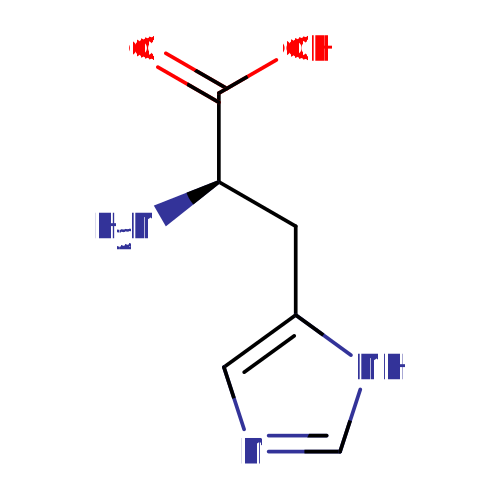
| Description | D-Histidine, also known as DHI, belongs to the class of organic compounds known as histidine and derivatives. Histidine and derivatives are compounds containing cysteine or a derivative thereof resulting from reaction of cysteine at the amino group or the carboxy group, or from the replacement of any hydrogen of glycine by a heteroatom. D-Histidine is a primary metabolite. Primary metabolites are metabolically or physiologically essential metabolites. They are directly involved in an organism’s growth, development or reproduction. D-Histidine was first documented in 2023 (PMID: 37992272). Based on a literature review a significant number of articles have been published on D-Histidine (PMID: 40549064) (PMID: 40195913) (PMID: 40126891) (PMID: 39918700) (PMID: 39832874) (PMID: 39728789). |
|---|
| Structure | InChI=1S/C6H9N3O2/c7-5(6(10)11)1-4-2-8-3-9-4/h2-3,5H,1,7H2,(H,8,9)(H,10,11)/t5-/m1/s1 |
|---|
| Synonyms | | Value | Source |
|---|
| (R)-alpha-Amino-1H-imidazole-4-propionic acid | ChEBI | | D-Histidin | ChEBI | | DHI | ChEBI | | (R)-a-Amino-1H-imidazole-4-propionate | Generator | | (R)-a-Amino-1H-imidazole-4-propionic acid | Generator | | (R)-alpha-Amino-1H-imidazole-4-propionate | Generator | | (R)-Α-amino-1H-imidazole-4-propionate | Generator | | (R)-Α-amino-1H-imidazole-4-propionic acid | Generator |
|
|---|
| Chemical Formula | C6H9N3O2 |
|---|
| Average Mass | 155.1570 Da |
|---|
| Monoisotopic Mass | 155.06948 Da |
|---|
| IUPAC Name | (2R)-2-amino-3-(1H-imidazol-5-yl)propanoic acid |
|---|
| Traditional Name | d-histidine |
|---|
| CAS Registry Number | Not Available |
|---|
| SMILES | N[C@H](CC1=CN=CN1)C(O)=O |
|---|
| InChI Identifier | InChI=1S/C6H9N3O2/c7-5(6(10)11)1-4-2-8-3-9-4/h2-3,5H,1,7H2,(H,8,9)(H,10,11)/t5-/m1/s1 |
|---|
| InChI Key | HNDVDQJCIGZPNO-RXMQYKEDSA-N |
|---|
| Experimental Spectra |
|---|
|
| | Spectrum Type | Description | Depositor Email | Depositor Organization | Depositor | Deposition Date | View |
|---|
| HMBC NMR | [1H, 13C] NMR Spectrum (2D, 600 MHz, C2D6OS, experimental) | Not Available | Sumner lab, University of Missouri | Ronald Myers | 2025-07-16 | View Spectrum | | HSQC NMR | [1H, 13C] NMR Spectrum (2D, 600 MHz, C2D6OS, experimental) | Not Available | Sumner lab, University of Missouri | Ronald Myers | 2025-07-16 | View Spectrum | | COSY NMR | [1H, 1H] NMR Spectrum (2D, 600 MHz, C2D6OS, experimental) | Not Available | Sumner lab, University of Missouri | Ronald Myers | 2025-07-16 | View Spectrum | | 1D NMR | 1H NMR Spectrum (1D, 600 MHz, C2D6OS, experimental) | Not Available | Sumner lab, University of Missouri | Ronald Myers | 2025-07-16 | View Spectrum | | 1D NMR | 1H NMR Spectrum (1D, 600.0 MHz, C2D6OS, experimental) | Wishart Lab | Wishart Lab | David Wishart | 2021-06-20 | View Spectrum |
| | Predicted Spectra |
|---|
|
| | Spectrum Type | Description | Depositor ID | Depositor Organization | Depositor | Deposition Date | View |
|---|
| | Chemical Shift Submissions |
|---|
|
| | Spectrum Type | Description | Depositor Email | Depositor Organization | Depositor | Deposition Date | View |
|---|
| 1D NMR | 1H NMR Spectrum (1D, 600.0, C2D6OS, simulated) | [email protected] | Sumner lab, University of Missouri | Ronald Myers | 2025-07-16 | View Spectrum |
| | Species |
|---|
| Species of Origin | Not Available |
|---|
| Chemical Taxonomy |
|---|
| Description | Belongs to the class of organic compounds known as histidine and derivatives. Histidine and derivatives are compounds containing cysteine or a derivative thereof resulting from reaction of cysteine at the amino group or the carboxy group, or from the replacement of any hydrogen of glycine by a heteroatom. |
|---|
| Kingdom | Organic compounds |
|---|
| Super Class | Organic acids and derivatives |
|---|
| Class | Carboxylic acids and derivatives |
|---|
| Sub Class | Amino acids, peptides, and analogues |
|---|
| Direct Parent | Histidine and derivatives |
|---|
| Alternative Parents | |
|---|
| Substituents | - Histidine or derivatives
- Alpha-amino acid
- D-alpha-amino acid
- Imidazolyl carboxylic acid derivative
- Aralkylamine
- Azole
- Imidazole
- Heteroaromatic compound
- Amino acid
- Carboxylic acid
- Azacycle
- Organoheterocyclic compound
- Monocarboxylic acid or derivatives
- Organic nitrogen compound
- Organooxygen compound
- Organonitrogen compound
- Primary amine
- Primary aliphatic amine
- Hydrocarbon derivative
- Organic oxide
- Organopnictogen compound
- Carbonyl group
- Organic oxygen compound
- Amine
- Aromatic heteromonocyclic compound
|
|---|
| Molecular Framework | Aromatic heteromonocyclic compounds |
|---|
| External Descriptors | |
|---|
| Physical Properties |
|---|
| State | Not Available |
|---|
| Experimental Properties | | Property | Value | Reference |
|---|
| Melting Point | Not Available | Not Available | | Boiling Point | Not Available | Not Available | | Water Solubility | Not Available | Not Available | | LogP | Not Available | Not Available |
|
|---|
| Predicted Properties | |
|---|
| General References | - Nakanishi R, Fujihara A: D-Amino acid analysis in solution using the photochemical properties of protonated adenosine. Photochem Photobiol Sci. 2025 Jul;24(7):1153-1158. doi: 10.1007/s43630-025-00751-6. Epub 2025 Jun 23. [PubMed:40549064 ]
- Sarkar S, Mathath AV, Chakraborty D: Controlling the Morphology and Orientation of the Helical Self-Assembly of Pyrazine Derivatives by Tuning Hydration Shells. Chemphyschem. 2025 Jun 23;26(12):e202400951. doi: 10.1002/cphc.202400951. Epub 2025 May 7. [PubMed:40195913 ]
- Chen M, Gao L, Liu H, Yu J, Zhao F, Bai L, Chu H, Zhao M, Qin S: Separation of dithiothreitol and dithioerythritol by an open tubular capillary electrochromatographic column with an MOF modified by histidine as the stationary phase. Anal Methods. 2025 Apr 3;17(14):2887-2893. doi: 10.1039/d5ay00097a. [PubMed:40126891 ]
- Huang W, Chen X, Xu X, Pan S: Urinary metabolomics analysis of patients with renal tubular dysfunction after PCI surgery. Int Urol Nephrol. 2025 Jul;57(7):2237-2244. doi: 10.1007/s11255-025-04397-2. Epub 2025 Feb 7. [PubMed:39918700 ]
- Gao X, Bai R, Yang J, Luo S, Yuan H, Wang L, Fu Z: D-Histidine modulated chiral metal-organic frameworks for discriminating 3,4-Dihydroxyphenylalanine enantiomers based on a chemiluminescence quenching mode. Anal Chim Acta. 2025 Feb 15;1339:343606. doi: 10.1016/j.aca.2024.343606. Epub 2025 Jan 1. [PubMed:39832874 ]
- Bendejacq-Seychelles A, Martinez L, Correard A, Totozafy JC, Steinberg C, Pouvreau JB, Reibel C, Mouille G, Mondy S, Poulin L, Gibot-Leclerc S: Image Analysis and Untargeted Metabolomics Reveal Potential Phytotoxins from Fusarium venenatum Against Major Parasitic Weed Phelipanche ramosa (L.) Pomel. Toxins (Basel). 2024 Dec 10;16(12):531. doi: 10.3390/toxins16120531. [PubMed:39728789 ]
- Xu M, Vallieres C, Finnis C, Winzer K, Avery SV: Exploiting phenotypic heterogeneity to improve production of glutathione by yeast. Microb Cell Fact. 2024 Oct 7;23(1):267. doi: 10.1186/s12934-024-02536-5. [PubMed:39375675 ]
- Li T, Li H, Chen J, Yu Y, Chen S, Wang J, Qiu H: Histidine-modified pillar[5]arene-functionalized mesoporous silica materials for highly selective enantioseparation. J Chromatogr A. 2024 Jul 19;1727:465011. doi: 10.1016/j.chroma.2024.465011. Epub 2024 May 18. [PubMed:38776604 ]
- Sun Q, Bao B, Dong W, Lyu Y, Wang M, Xi Z, Han J, Guo R: Expression of chiral molecular and supramolecular structure on enantioselective catalytic activity. J Colloid Interface Sci. 2024 Sep;669:944-951. doi: 10.1016/j.jcis.2024.05.027. Epub 2024 May 9. [PubMed:38759593 ]
- Qin S, Meng F, Jin F, Xu X, Zhao M, Chu H, Gao L, Liu S: Dual-functional porphyrinic zirconium-based metal-organic framework for the fluorescent sensing of histidine enantiomers and Hg(2). Anal Methods. 2024 Apr 18;16(15):2386-2399. doi: 10.1039/d3ay02241b. [PubMed:38572640 ]
- Zhang H, Mi Z, Wang J, Zhang J: D-histidine combated biofilm formation and enhanced the effect of amikacin against Pseudomonas aeruginosa in vitro. Arch Microbiol. 2024 Mar 11;206(4):148. doi: 10.1007/s00203-024-03918-4. [PubMed:38462558 ]
- Beyranvand F, Khosravi A, Zabihi F, Nemati M, Gholami MF, Tavakol M, Beyranvand S, Satari S, Rabe JP, Salimi A, Cheng C, Adeli M: Synthesis of Chiral Triazine Frameworks for Enantiodiscrimination. ACS Appl Mater Interfaces. 2023 Dec 6;15(48):56213-56222. doi: 10.1021/acsami.3c16659. Epub 2023 Nov 22. [PubMed:37992272 ]
|
|---|