| Record Information |
|---|
| Version | 2.0 |
|---|
| Created at | 2024-09-11 23:05:41 UTC |
|---|
| Updated at | 2024-09-11 23:05:41 UTC |
|---|
| NP-MRD ID | NP0339694 |
|---|
| Secondary Accession Numbers | None |
|---|
| Natural Product Identification |
|---|
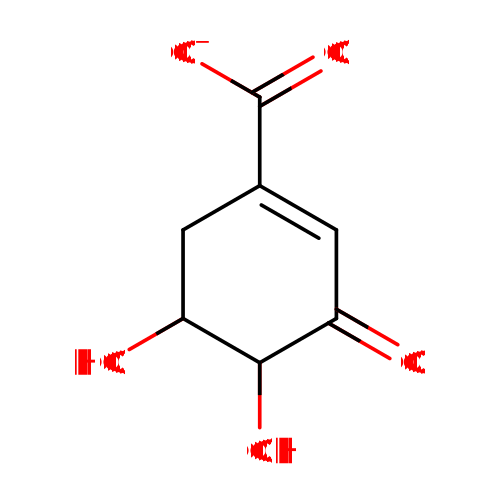
| Common Name | 3-dehydroshikimate |
|---|
| Description | 3-Dehydroshikimate belongs to the class of organic compounds known as cyclohexenones. Cyclohexenones are compounds containing a cylohexenone moiety, which is a six-membered aliphatic ring that carries a ketone and has one endocyclic double bond. 3-dehydroshikimate was first documented in 2024 (PMID: 39222859). Based on a literature review a small amount of articles have been published on 3-dehydroshikimate (PMID: 39153079) (PMID: 38809816) (PMID: 38780531) (PMID: 38521489). |
|---|
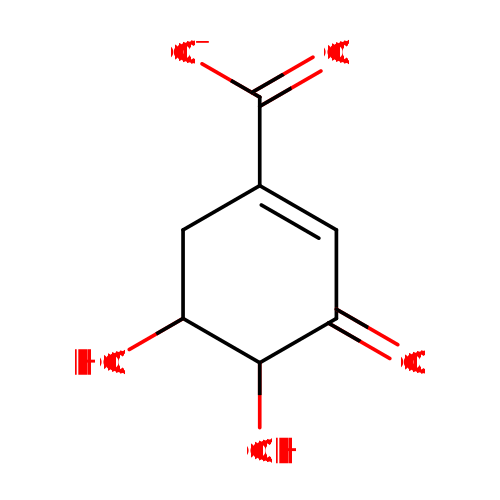
| Structure | OC1CC(=CC(=O)C1O)C([O-])=O InChI=1/C7H8O5/c8-4-1-3(7(11)12)2-5(9)6(4)10/h1,5-6,9-10H,2H2,(H,11,12)/p-1 |
|---|
| Synonyms | | Value | Source |
|---|
| 3-Dehydroshikimic acid | Generator |
|
|---|
| Chemical Formula | C7H7O5 |
|---|
| Average Mass | 171.1290 Da |
|---|
| Monoisotopic Mass | 171.02990 Da |
|---|
| IUPAC Name | 4,5-dihydroxy-3-oxocyclohex-1-ene-1-carboxylate |
|---|
| Traditional Name | 4,5-dihydroxy-3-oxocyclohex-1-ene-1-carboxylate |
|---|
| CAS Registry Number | Not Available |
|---|
| SMILES | OC1CC(=CC(=O)C1O)C([O-])=O |
|---|
| InChI Identifier | InChI=1/C7H8O5/c8-4-1-3(7(11)12)2-5(9)6(4)10/h1,5-6,9-10H,2H2,(H,11,12)/p-1 |
|---|
| InChI Key | SLWWJZMPHJJOPH-UHFFFAOYNA-M |
|---|
| Experimental Spectra |
|---|
|
| Not Available | | Predicted Spectra |
|---|
|
| Not Available | | Chemical Shift Submissions |
|---|
|
| Not Available | | Species |
|---|
| Species of Origin | Not Available |
|---|
| Chemical Taxonomy |
|---|
| Description | This compound belongs to the class of organic compounds known as cyclohexenones. These are compounds containing a cylohexenone moiety, which is a six-membered aliphatic ring that carries a ketone and has one endocyclic double bond. |
|---|
| Kingdom | Organic compounds |
|---|
| Super Class | Organic oxygen compounds |
|---|
| Class | Organooxygen compounds |
|---|
| Sub Class | Carbonyl compounds |
|---|
| Direct Parent | Cyclohexenones |
|---|
| Alternative Parents | |
|---|
| Substituents | - Cyclohexenone
- Secondary alcohol
- 1,2-diol
- Monocarboxylic acid or derivatives
- Carboxylic acid
- Carboxylic acid derivative
- Organic oxide
- Hydrocarbon derivative
- Alcohol
- Organic anion
- Aliphatic homomonocyclic compound
|
|---|
| Molecular Framework | Aliphatic homomonocyclic compounds |
|---|
| External Descriptors | |
|---|
| Physical Properties |
|---|
| State | Not Available |
|---|
| Experimental Properties | | Property | Value | Reference |
|---|
| Melting Point | Not Available | Not Available | | Boiling Point | Not Available | Not Available | | Water Solubility | Not Available | Not Available | | LogP | Not Available | Not Available |
|
|---|
| Predicted Properties | |
|---|
| External Links |
|---|
| HMDB ID | Not Available |
|---|
| DrugBank ID | Not Available |
|---|
| Phenol Explorer Compound ID | Not Available |
|---|
| FoodDB ID | Not Available |
|---|
| KNApSAcK ID | Not Available |
|---|
| Chemspider ID | Not Available |
|---|
| KEGG Compound ID | Not Available |
|---|
| BioCyc ID | Not Available |
|---|
| BiGG ID | Not Available |
|---|
| Wikipedia Link | 3-Dehydroshikimic acid |
|---|
| METLIN ID | Not Available |
|---|
| PubChem Compound | Not Available |
|---|
| PDB ID | Not Available |
|---|
| ChEBI ID | Not Available |
|---|
| Good Scents ID | Not Available |
|---|
| References |
|---|
| General References | - Liu D, Wang L, Ma L, Wang X, Li S, Zhou J: Metabolic network rewiring and temperature-dependent regulation for enhanced 3-dehydroshikimate production in Escherichia coli. Bioresour Technol. 2024 Nov;412:131403. doi: 10.1016/j.biortech.2024.131403. Epub 2024 Aug 31. [PubMed:39222859 ]
- Orn OE, Hagman A, Ismail M, Leiva Eriksson N, Hatti-Kaul R: Enhancing metabolic efficiency via novel constitutive promoters to produce protocatechuic acid in Escherichia coli. Appl Microbiol Biotechnol. 2024 Aug 17;108(1):442. doi: 10.1007/s00253-024-13256-6. [PubMed:39153079 ]
- Akyuz Turumtay E, Turumtay H, Tian Y, Lin CY, Chai YN, Louie KB, Chen Y, Lipzen A, Harwood T, Satish Kumar K, Bowen BP, Wang Q, Mansfield SD, Blow MJ, Petzold CJ, Northen TR, Mortimer JC, Scheller HV, Eudes A: Expression of dehydroshikimate dehydratase in poplar induces transcriptional and metabolic changes in the phenylpropanoid pathway. J Exp Bot. 2024 Aug 28;75(16):4960-4977. doi: 10.1093/jxb/erae251. [PubMed:38809816 ]
- Senanayake M, Lin CY, Mansfield SD, Eudes A, Davison BH, Pingali SV, O'Neill H: Ectopic Production of 3,4-Dihydroxybenzoate in Planta Affects Cellulose Structure and Organization. Biomacromolecules. 2024 Jun 10;25(6):3542-3553. doi: 10.1021/acs.biomac.4c00187. Epub 2024 May 23. [PubMed:38780531 ]
- Wu F, Wang S, Zhou D, Gao S, Song G, Liang Y, Wang Q: Metabolic engineering of Escherichia coli for high-level production of the biodegradable polyester monomer 2-pyrone-4,6-dicarboxylic acid. Metab Eng. 2024 May;83:52-60. doi: 10.1016/j.ymben.2024.03.003. Epub 2024 Mar 21. [PubMed:38521489 ]
|
|---|