| Record Information |
|---|
| Version | 2.0 |
|---|
| Created at | 2024-09-11 14:26:56 UTC |
|---|
| Updated at | 2024-09-11 14:26:56 UTC |
|---|
| NP-MRD ID | NP0338224 |
|---|
| Secondary Accession Numbers | None |
|---|
| Natural Product Identification |
|---|
| Common Name | Trehalulose |
|---|
| Description | Trehalulose belongs to the class of organic compounds known as o-glycosyl compounds. These are glycoside in which a sugar group is bonded through one carbon to another group via a O-glycosidic bond. Trehalulose was first documented in 2024 (PMID: 38890884). Based on a literature review a small amount of articles have been published on Trehalulose (PMID: 38688341) (PMID: 38260771) (PMID: 38124990) (PMID: 37862235). |
|---|
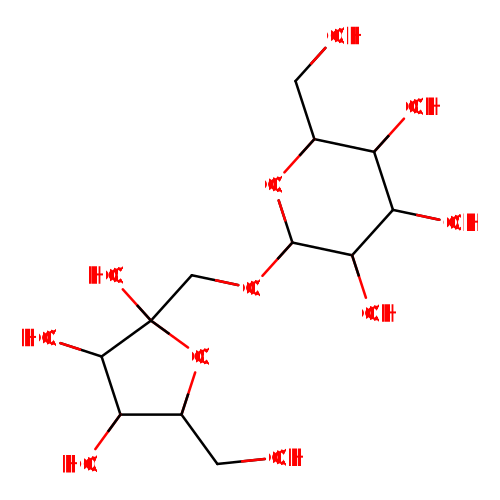
| Structure | OCC1OC(O)(COC2OC(CO)C(O)C(O)C2O)C(O)C1O InChI=1/C12H22O11/c13-1-4-6(15)8(17)9(18)11(22-4)21-3-12(20)10(19)7(16)5(2-14)23-12/h4-11,13-20H,1-3H2 |
|---|
| Synonyms | Not Available |
|---|
| Chemical Formula | C12H22O11 |
|---|
| Average Mass | 342.2970 Da |
|---|
| Monoisotopic Mass | 342.11621 Da |
|---|
| IUPAC Name | 2-(hydroxymethyl)-6-{[2,3,4-trihydroxy-5-(hydroxymethyl)oxolan-2-yl]methoxy}oxane-3,4,5-triol |
|---|
| Traditional Name | 2-(hydroxymethyl)-6-{[2,3,4-trihydroxy-5-(hydroxymethyl)oxolan-2-yl]methoxy}oxane-3,4,5-triol |
|---|
| CAS Registry Number | Not Available |
|---|
| SMILES | OCC1OC(O)(COC2OC(CO)C(O)C(O)C2O)C(O)C1O |
|---|
| InChI Identifier | InChI=1/C12H22O11/c13-1-4-6(15)8(17)9(18)11(22-4)21-3-12(20)10(19)7(16)5(2-14)23-12/h4-11,13-20H,1-3H2 |
|---|
| InChI Key | NMXLJRHBJVMYPD-UHFFFAOYNA-N |
|---|
| Experimental Spectra |
|---|
|
| Not Available | | Predicted Spectra |
|---|
|
| Not Available | | Chemical Shift Submissions |
|---|
|
| Not Available | | Species |
|---|
| Species of Origin | Not Available |
|---|
| Chemical Taxonomy |
|---|
| Description | This compound belongs to the class of organic compounds known as o-glycosyl compounds. These are glycoside in which a sugar group is bonded through one carbon to another group via a O-glycosidic bond. |
|---|
| Kingdom | Organic compounds |
|---|
| Super Class | Organic oxygen compounds |
|---|
| Class | Organooxygen compounds |
|---|
| Sub Class | Carbohydrates and carbohydrate conjugates |
|---|
| Direct Parent | O-glycosyl compounds |
|---|
| Alternative Parents | |
|---|
| Substituents | - O-glycosyl compound
- Disaccharide
- C-glycosyl compound
- Oxane
- Tetrahydrofuran
- Secondary alcohol
- Hemiacetal
- Oxacycle
- Organoheterocyclic compound
- Polyol
- Acetal
- Hydrocarbon derivative
- Primary alcohol
- Alcohol
- Aliphatic heteromonocyclic compound
|
|---|
| Molecular Framework | Aliphatic heteromonocyclic compounds |
|---|
| External Descriptors | Not Available |
|---|
| Physical Properties |
|---|
| State | Not Available |
|---|
| Experimental Properties | | Property | Value | Reference |
|---|
| Melting Point | Not Available | Not Available | | Boiling Point | Not Available | Not Available | | Water Solubility | Not Available | Not Available | | LogP | Not Available | Not Available |
|
|---|
| Predicted Properties | |
|---|
| General References | - Mello Dos Santos M, Khan N, Lim LY, Locher C: Antioxidant Activity, Physicochemical and Sensory Properties of Stingless Bee Honey from Australia. Foods. 2024 May 25;13(11):1657. doi: 10.3390/foods13111657. [PubMed:38890884 ]
- Lee CY, So YS, Lim MC, Jeong S, Yoo SH, Park CS, Jung JH, Seo DH: Characterization of a unique pH-dependent amylosucrase from Deinococcus cellulosilyticus. Int J Biol Macromol. 2024 Jun;269(Pt 2):131834. doi: 10.1016/j.ijbiomac.2024.131834. Epub 2024 Apr 29. [PubMed:38688341 ]
- Turck D, Bohn T, Castenmiller J, De Henauw S, Hirsch-Ernst KI, Maciuk A, Mangelsdorf I, McArdle HJ, Naska A, Pentieva K, Siani A, Thies F, Tsabouri S, Vinceti M, Aguilera-Gomez M, Cubadda F, Frenzel T, Heinonen M, Marchelli R, Neuhauser-Berthold M, Poulsen M, Prieto Maradona M, Schlatter JR, Siskos A, van Loveren H, Ferreira da Costa L, Albert O, Knutsen HK: Safety of isomaltulose syrup (dried) as a novel food pursuant to Regulation (EU) 2015/2283. EFSA J. 2024 Jan 22;22(1):e8491. doi: 10.2903/j.efsa.2024.8491. eCollection 2024 Jan. [PubMed:38260771 ]
- Rosli MA, Mohd Nasir NA, Mustafa MZ, Othman MA, Zakaria Z, Halim AS: Effectiveness of stingless bee (Kelulut) honey versus conventional gel dressing in diabetic wound bed preparation: A randomized controlled trial. J Taibah Univ Med Sci. 2023 Nov 24;19(1):209-219. doi: 10.1016/j.jtumed.2023.11.003. eCollection 2024 Feb. [PubMed:38124990 ]
- Ramlan NAFM, Mohamad Azman E, Muhammad K, Jusoh AZ, Johari NA, Yusof YA, Zawawi N: Physicochemical homogeneity of stingless bee honey (Heterotrigona itama) produced in the west coast, east coast and inland area of Peninsular Malaysia. J Sci Food Agric. 2024 Feb;104(3):1756-1767. doi: 10.1002/jsfa.13067. Epub 2023 Nov 15. [PubMed:37862235 ]
|
|---|