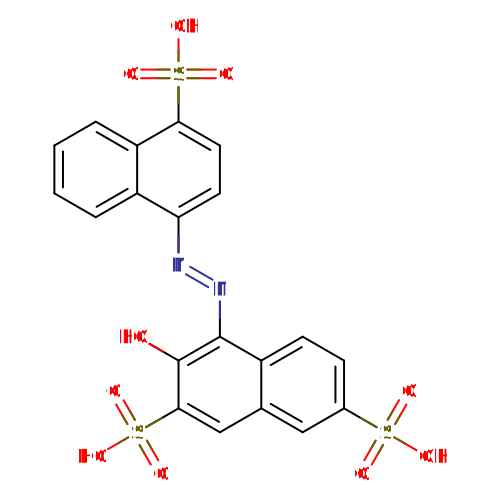
| Record Information |
|---|
| Version | 2.0 |
|---|
| Created at | 2024-09-11 13:46:43 UTC |
|---|
| Updated at | 2024-09-11 13:46:44 UTC |
|---|
| NP-MRD ID | NP0338087 |
|---|
| Secondary Accession Numbers | None |
|---|
| Natural Product Identification |
|---|
| Common Name | Amaranth |
|---|
| Description | Amaranth, also known as bordeaux S or c.I. 16185, Belongs to the class of organic compounds known as 1,1'-azonaphthalenes. These are organonitrogen aromatic compounds that contain a central azo group, where each nitrogen atom is conjugated to the 1-position of a naphthalene ring system. Naphthalene is a compound made up of two fused benzene rings. Cooked amaranth leaves are a good source of vitamin A, vitamin C, and folate; they are also a complementing source of other vitamins such as thiamine, niacin, and riboflavin, plus some dietary minerals including calcium, iron, potassium, zinc, copper, and manganese. Its seeds are a good source of protein. Amaranth may be a promising source of protein to those who are gluten sensitive, because unlike the protein found in grains such as wheat and rye, its protein does not contain gluten. Amaranth is an extremely weak basic (essentially neutral) compound (based on its pKa). Several species are raised for amaranth "grain" in Asia and the Americas. Approximately 60 species are recognized, with inflorescences and foliage ranging from purple and red to green or gold. It is used in food colouring, banned by FDA for use in food, drugs and cosmetics. Catkin-like cymes of densely packed flowers are borne in summer or autumn. Common grains such as wheat and corn are comparatively rich in amino acids that amaranth lacks; thus, amaranth and other grains can complement each other. |
|---|
| Structure | OC1=C(\N=N\C2=CC=C(C3=CC=CC=C23)S(O)(=O)=O)C2=CC=C(C=C2C=C1S(O)(=O)=O)S(O)(=O)=O InChI=1S/C20H14N2O10S3/c23-20-18(35(30,31)32)10-11-9-12(33(24,25)26)5-6-13(11)19(20)22-21-16-7-8-17(34(27,28)29)15-4-2-1-3-14(15)16/h1-10,23H,(H,24,25,26)(H,27,28,29)(H,30,31,32)/b22-21+ |
|---|
| Synonyms | | Value | Source |
|---|
| 3-Hydroxy-4-[(4-sulfO-1-naphthalenyl)azo]-2,7-naphthalenedisulfonic acid, 9ci | HMDB | | Amaranth R | HMDB | | Amaranth S | HMDB | | Bordeaux S | HMDB | | C.I. 16185 | HMDB | | C.I. acid red 27, 8ci | HMDB | | C.I. FOOD red 9 | HMDB | | e123 | HMDB | | FD And C red no. 2 | HMDB | | 3-Hydroxy-4-[(e)-2-(4-sulfonaphthalen-1-yl)diazen-1-yl]naphthalene-2,7-disulfonate | Generator | | 3-Hydroxy-4-[(e)-2-(4-sulphonaphthalen-1-yl)diazen-1-yl]naphthalene-2,7-disulphonate | Generator | | 3-Hydroxy-4-[(e)-2-(4-sulphonaphthalen-1-yl)diazen-1-yl]naphthalene-2,7-disulphonic acid | Generator |
|
|---|
| Chemical Formula | C20H14N2O10S3 |
|---|
| Average Mass | 538.5280 Da |
|---|
| Monoisotopic Mass | 537.98106 Da |
|---|
| IUPAC Name | 3-hydroxy-4-[(E)-2-(4-sulfonaphthalen-1-yl)diazen-1-yl]naphthalene-2,7-disulfonic acid |
|---|
| Traditional Name | 3-hydroxy-4-[(E)-2-(4-sulfonaphthalen-1-yl)diazen-1-yl]naphthalene-2,7-disulfonic acid |
|---|
| CAS Registry Number | Not Available |
|---|
| SMILES | OC1=C(\N=N\C2=CC=C(C3=CC=CC=C23)S(O)(=O)=O)C2=CC=C(C=C2C=C1S(O)(=O)=O)S(O)(=O)=O |
|---|
| InChI Identifier | InChI=1S/C20H14N2O10S3/c23-20-18(35(30,31)32)10-11-9-12(33(24,25)26)5-6-13(11)19(20)22-21-16-7-8-17(34(27,28)29)15-4-2-1-3-14(15)16/h1-10,23H,(H,24,25,26)(H,27,28,29)(H,30,31,32)/b22-21+ |
|---|
| InChI Key | IRPXADUBAQAOKL-QURGRASLSA-N |
|---|
| Experimental Spectra |
|---|
|
| Not Available | | Predicted Spectra |
|---|
|
| Not Available | | Chemical Shift Submissions |
|---|
|
| Not Available | | Species |
|---|
| Species of Origin | Not Available |
|---|
| Chemical Taxonomy |
|---|
| Description | Belongs to the class of organic compounds known as 1,1'-azonaphthalenes. These are organonitrogen aromatic compounds that contain a central azo group, where each nitrogen atom is conjugated to the 1-position of a naphthalene ring system. Naphthalene is a compound made up of two fused benzene rings. |
|---|
| Kingdom | Organic compounds |
|---|
| Super Class | Benzenoids |
|---|
| Class | Naphthalenes |
|---|
| Sub Class | 1,1'-azonaphthalenes |
|---|
| Direct Parent | 1,1'-azonaphthalenes |
|---|
| Alternative Parents | |
|---|
| Substituents | - 1,1'-azonaphthalene
- 2-naphthalene sulfonate
- 1-naphthalene sulfonate
- Naphthalene sulfonic acid or derivatives
- 2-naphthalene sulfonic acid or derivatives
- 1-naphthalene sulfonic acid or derivatives
- Naphthalene sulfonate
- 2-naphthol
- Arylsulfonic acid or derivatives
- 1-sulfo,2-unsubstituted aromatic compound
- Organic sulfonic acid or derivatives
- Organosulfonic acid or derivatives
- Organosulfonic acid
- Sulfonyl
- Azo compound
- Organic 1,3-dipolar compound
- Propargyl-type 1,3-dipolar organic compound
- Hydrocarbon derivative
- Organic oxide
- Organosulfur compound
- Organooxygen compound
- Organonitrogen compound
- Organopnictogen compound
- Organic oxygen compound
- Organic nitrogen compound
- Aromatic homopolycyclic compound
|
|---|
| Molecular Framework | Aromatic homopolycyclic compounds |
|---|
| External Descriptors | Not Available |
|---|
| Physical Properties |
|---|
| State | Not Available |
|---|
| Experimental Properties | | Property | Value | Reference |
|---|
| Melting Point | Not Available | Not Available | | Boiling Point | Not Available | Not Available | | Water Solubility | Not Available | Not Available | | LogP | Not Available | Not Available |
|
|---|
| Predicted Properties | |
|---|