| Record Information |
|---|
| Version | 2.0 |
|---|
| Created at | 2024-09-11 12:43:29 UTC |
|---|
| Updated at | 2024-09-11 12:43:29 UTC |
|---|
| NP-MRD ID | NP0337848 |
|---|
| Secondary Accession Numbers | None |
|---|
| Natural Product Identification |
|---|
| Common Name | Phlorisovalerophenone |
|---|
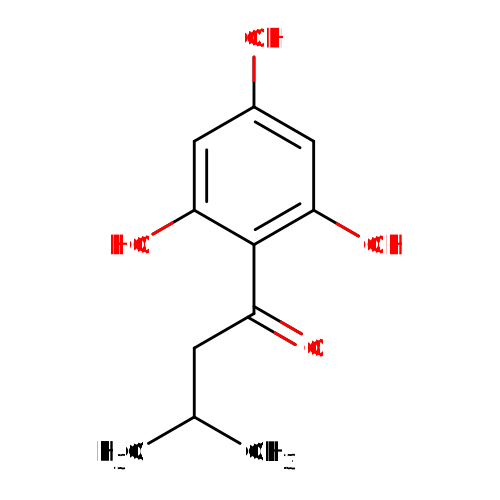
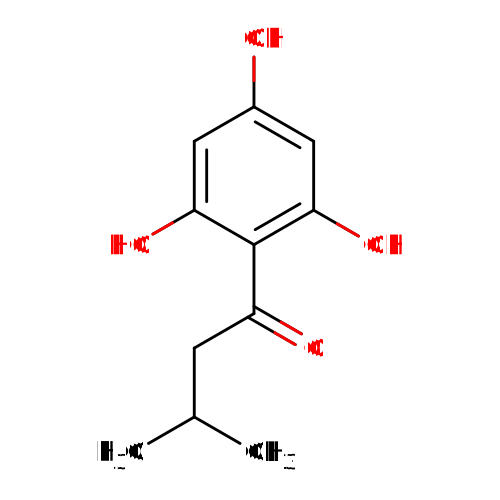
| Description | 3-Methyl-1-(2,4,6-trihydroxyphenyl)-1-butanone, also known as phlorisovalerophenone or 2',4',6'-trihydroxy-3-methylbutyrophenone, 8CI, belongs to the class of organic compounds known as alkyl-phenylketones. These are aromatic compounds containing a ketone substituted by one alkyl group, and a phenyl group. 3-Methyl-1-(2,4,6-trihydroxyphenyl)-1-butanone is an extremely weak basic (essentially neutral) compound (based on its pKa). Outside of the human body, 3-Methyl-1-(2,4,6-trihydroxyphenyl)-1-butanone has been detected, but not quantified in, several different foods, such as star fruits, black huckleberries, arctic blackberries, cornmints, and chicory roots. This could make 3-methyl-1-(2,4,6-trihydroxyphenyl)-1-butanone a potential biomarker for the consumption of these foods. |
|---|
| Structure | CC(C)CC(=O)C1=C(O)C=C(O)C=C1O InChI=1S/C11H14O4/c1-6(2)3-8(13)11-9(14)4-7(12)5-10(11)15/h4-6,12,14-15H,3H2,1-2H3 |
|---|
| Synonyms | | Value | Source |
|---|
| Phlorisovalerophenone | ChEBI | | 3-Methyl-1-(2,4,6-trihydroxyphenyl)butan-1-one | Kegg | | 2',4',6'-Trihydroxy-3-methylbutyrophenone, 8ci | HMDB | | 2,4,6-Trihydroxyisovalerophenone | HMDB |
|
|---|
| Chemical Formula | C11H14O4 |
|---|
| Average Mass | 210.2265 Da |
|---|
| Monoisotopic Mass | 210.08921 Da |
|---|
| IUPAC Name | 3-methyl-1-(2,4,6-trihydroxyphenyl)butan-1-one |
|---|
| Traditional Name | 3-methyl-1-(2,4,6-trihydroxyphenyl)butan-1-one |
|---|
| CAS Registry Number | Not Available |
|---|
| SMILES | CC(C)CC(=O)C1=C(O)C=C(O)C=C1O |
|---|
| InChI Identifier | InChI=1S/C11H14O4/c1-6(2)3-8(13)11-9(14)4-7(12)5-10(11)15/h4-6,12,14-15H,3H2,1-2H3 |
|---|
| InChI Key | VSDWHZGJGWMIRN-UHFFFAOYSA-N |
|---|
| Experimental Spectra |
|---|
|
| Not Available | | Predicted Spectra |
|---|
|
| Not Available | | Chemical Shift Submissions |
|---|
|
| Not Available | | Species |
|---|
| Species of Origin | Not Available |
|---|
| Chemical Taxonomy |
|---|
| Description | Belongs to the class of organic compounds known as alkyl-phenylketones. These are aromatic compounds containing a ketone substituted by one alkyl group, and a phenyl group. |
|---|
| Kingdom | Organic compounds |
|---|
| Super Class | Organic oxygen compounds |
|---|
| Class | Organooxygen compounds |
|---|
| Sub Class | Carbonyl compounds |
|---|
| Direct Parent | Alkyl-phenylketones |
|---|
| Alternative Parents | |
|---|
| Substituents | - Alkyl-phenylketone
- Acylphloroglucinol derivative
- Butyrophenone
- Benzenetriol
- Phloroglucinol derivative
- Aryl alkyl ketone
- Benzoyl
- 1-hydroxy-4-unsubstituted benzenoid
- 1-hydroxy-2-unsubstituted benzenoid
- Phenol
- Monocyclic benzene moiety
- Benzenoid
- Vinylogous acid
- Polyol
- Hydrocarbon derivative
- Organic oxide
- Aromatic homomonocyclic compound
|
|---|
| Molecular Framework | Aromatic homomonocyclic compounds |
|---|
| External Descriptors | |
|---|
| Physical Properties |
|---|
| State | Not Available |
|---|
| Experimental Properties | | Property | Value | Reference |
|---|
| Melting Point | Not Available | Not Available | | Boiling Point | Not Available | Not Available | | Water Solubility | Not Available | Not Available | | LogP | Not Available | Not Available |
|
|---|
| Predicted Properties | |
|---|