Np mrd loader

Record Information
Version2.0
Created at2024-09-11 12:18:12 UTC
Updated at2024-09-11 12:18:12 UTC
NP-MRD IDNP0337759
Secondary Accession NumbersNone
Natural Product Identification
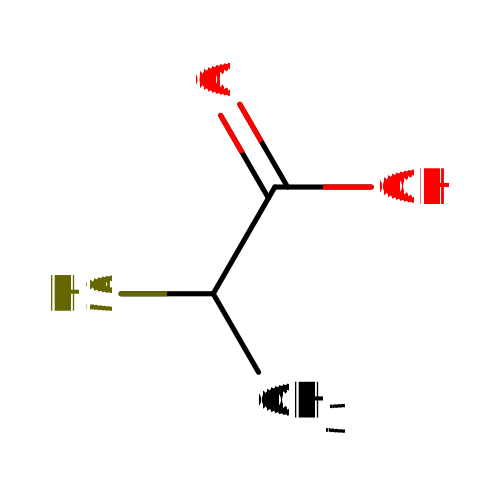
Common Name2-Mercaptopropanoic acid
Description2-Mercaptopropanoic acid belongs to the class of organic compounds known as alpha-mercaptocarboxylic acids. These are carboxylic acids that bear a thiol group at the C-2 position. Alpha-mercaptocarboxylic acids have the general formula RC(S)C(=O)O, where R = H, organyl group. 2-Mercaptopropanoic acid was first documented in 2009 (PMID: 19197128). Based on a literature review a small amount of articles have been published on 2-Mercaptopropanoic acid (PMID: 30960505) (PMID: 33418761) (PMID: 22941067) (PMID: 20383934).
Structure
Thumb
Synonyms
ValueSource
2-MercaptopropanoateGenerator
Chemical FormulaC3H6O2S
Average Mass106.1400 Da
Monoisotopic Mass106.00885 Da
IUPAC Name2-sulfanylpropanoic acid
Traditional Namethiolactic acid
CAS Registry NumberNot Available
SMILES
CC(S)C(O)=O
InChI Identifier
InChI=1/C3H6O2S/c1-2(6)3(4)5/h2,6H,1H3,(H,4,5)
InChI KeyPMNLUUOXGOOLSP-UHFFFAOYNA-N
Experimental Spectra
Not Available
Predicted Spectra
Not Available
Chemical Shift Submissions
Not Available
Species
Species of OriginNot Available
Chemical Taxonomy
DescriptionThis compound belongs to the class of organic compounds known as alpha-mercaptocarboxylic acids. These are carboxylic acids that bear a thiol group at the C-2 position. Alpha-mercaptocarboxylic acids have the general formula RC(S)C(=O)O, where R = H, organyl group.
KingdomOrganic compounds
Super ClassOrganic acids and derivatives
ClassCarboxylic acids and derivatives
Sub ClassCarboxylic acids
Direct Parentalpha-Mercaptocarboxylic acids
Alternative Parents
Substituents
  • 2-mercaptocarboxylic acid
  • Monocarboxylic acid or derivatives
  • Alkylthiol
  • Organic oxygen compound
  • Organic oxide
  • Hydrocarbon derivative
  • Organosulfur compound
  • Organooxygen compound
  • Carbonyl group
  • Aliphatic acyclic compound
Molecular FrameworkAliphatic acyclic compounds
External Descriptors
Physical Properties
StateNot Available
Experimental Properties
PropertyValueReference
Melting PointNot AvailableNot Available
Boiling PointNot AvailableNot Available
Water SolubilityNot AvailableNot Available
LogPNot AvailableNot Available
Predicted Properties
PropertyValueSource
logP0.57ChemAxon
pKa (Strongest Acidic)4.35ChemAxon
Physiological Charge-1ChemAxon
Hydrogen Acceptor Count2ChemAxon
Hydrogen Donor Count2ChemAxon
Polar Surface Area37.3 ŲChemAxon
Rotatable Bond Count1ChemAxon
Refractivity24.97 m³·mol⁻¹ChemAxon
Polarizability10.04 ųChemAxon
Number of Rings0ChemAxon
BioavailabilityYesChemAxon
Rule of FiveYesChemAxon
Ghose FilterNoChemAxon
Veber's RuleYesChemAxon
MDDR-like RuleNoChemAxon
HMDB IDNot Available
DrugBank IDNot Available
Phenol Explorer Compound IDNot Available
FoodDB IDNot Available
KNApSAcK IDNot Available
Chemspider IDNot Available
KEGG Compound IDNot Available
BioCyc IDNot Available
BiGG IDNot Available
Wikipedia LinkThiolactic acid
METLIN IDNot Available
PubChem CompoundNot Available
PDB IDNot Available
ChEBI IDNot Available
Good Scents IDNot Available
References
General References
  1. Song Z, Jia Q, Shi M, Feng T, Song S: Studies on the Origin of Carbons in Aroma Compounds from [(13)C(6)]Glucose -Cysteine-(E)-2-Nonenal Model Reaction Systems. Polymers (Basel). 2019 Mar 19;11(3):521. doi: 10.3390/polym11030521. [PubMed:30960505 ]
  2. Bajaj M, Pandey SK, Wangoo N, Sharma RK: Peptide Functionalized Metallic Nanoconstructs: Synthesis, Structural Characterization, and Antimicrobial Evaluation. ACS Biomater Sci Eng. 2018 Feb 12;4(2):739-747. doi: 10.1021/acsbiomaterials.7b00729. Epub 2018 Jan 24. [PubMed:33418761 ]
  3. Falcone G, Foti C, Gianguzza A, Giuffre O, Napoli A, Pettignano A, Piazzese D: Sequestering ability of some chelating agents towards methylmercury(II). Anal Bioanal Chem. 2013 Jan;405(2-3):881-93. doi: 10.1007/s00216-012-6336-5. Epub 2012 Sep 1. [PubMed:22941067 ]
  4. Ramulu K, Kumar TT, Krishna SR, Vasudev R, Kaviraj M, Rao BM, Rao NS: Identification, isolation and characterization of potential degradation products in pioglitazone hydrochloride drug substance. Pharmazie. 2010 Mar;65(3):162-8. [PubMed:20383934 ]
  5. Cao W, Yao D, Zheng R: [Resistance by hypermutable Pseudomonas aeruginosa and beta-lactamases production]. Zhong Nan Da Xue Xue Bao Yi Xue Ban. 2009 Jan;34(1):54-8. [PubMed:19197128 ]