| Record Information |
|---|
| Version | 2.0 |
|---|
| Created at | 2024-09-11 11:12:20 UTC |
|---|
| Updated at | 2024-09-11 11:12:20 UTC |
|---|
| NP-MRD ID | NP0337517 |
|---|
| Secondary Accession Numbers | None |
|---|
| Natural Product Identification |
|---|
| Common Name | Lithol Rubine |
|---|
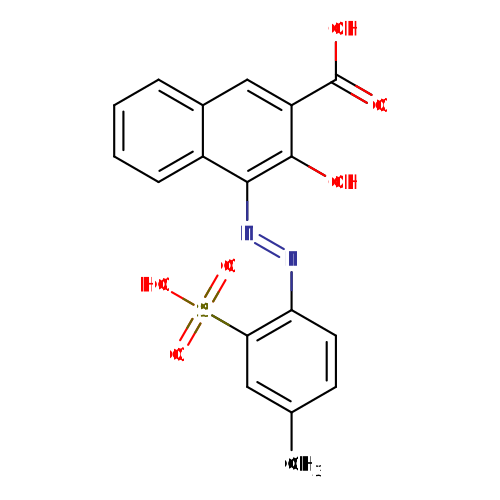
| Description | Lithol Rubine, also known as c.I. 15850 Or E180, belongs to the class of organic compounds known as naphthalenecarboxylic acids. Naphthalenecarboxylic acids are compounds containing a naphthalene moiety, which bears a carboxylic acid group one or more positions. Naphthalene is a bicyclic compound that is made up of two fused benzene ring. Lithol Rubine is an extremely weak basic (essentially neutral) compound (based on its pKa). |
|---|
| Structure | CC1=CC(=C(C=C1)\N=N\C1=C(O)C(=CC2=CC=CC=C12)C(O)=O)S(O)(=O)=O InChI=1S/C18H14N2O6S/c1-10-6-7-14(15(8-10)27(24,25)26)19-20-16-12-5-3-2-4-11(12)9-13(17(16)21)18(22)23/h2-9,21H,1H3,(H,22,23)(H,24,25,26)/b20-19+ |
|---|
| Synonyms | | Value | Source |
|---|
| 3-Hydroxy-4-((4-methyl-2-sulphophenyl)azo)-2-naphthoic acid | HMDB | | 3-Hydroxy-4-[(4-methyl-2-sulfophenyl)azo]-2-naphthalenecarboxylic acid, 9ci | HMDB | | C.I. 15850 | HMDB | | C.I. pigment red 57 | HMDB | | e180 | HMDB | | Litholrubine BK | HMDB |
|
|---|
| Chemical Formula | C18H14N2O6S |
|---|
| Average Mass | 386.3800 Da |
|---|
| Monoisotopic Mass | 386.05726 Da |
|---|
| IUPAC Name | 3-hydroxy-4-[(E)-2-(4-methyl-2-sulfophenyl)diazen-1-yl]naphthalene-2-carboxylic acid |
|---|
| Traditional Name | 3-hydroxy-4-[(E)-2-(4-methyl-2-sulfophenyl)diazen-1-yl]naphthalene-2-carboxylic acid |
|---|
| CAS Registry Number | Not Available |
|---|
| SMILES | CC1=CC(=C(C=C1)\N=N\C1=C(O)C(=CC2=CC=CC=C12)C(O)=O)S(O)(=O)=O |
|---|
| InChI Identifier | InChI=1S/C18H14N2O6S/c1-10-6-7-14(15(8-10)27(24,25)26)19-20-16-12-5-3-2-4-11(12)9-13(17(16)21)18(22)23/h2-9,21H,1H3,(H,22,23)(H,24,25,26)/b20-19+ |
|---|
| InChI Key | JYNBEDVXQNFTOX-FMQUCBEESA-N |
|---|
| Experimental Spectra |
|---|
|
| Not Available | | Predicted Spectra |
|---|
|
| Not Available | | Chemical Shift Submissions |
|---|
|
| Not Available | | Species |
|---|
| Species of Origin | Not Available |
|---|
| Chemical Taxonomy |
|---|
| Description | Belongs to the class of organic compounds known as naphthalenecarboxylic acids. Naphthalenecarboxylic acids are compounds containing a naphthalene moiety, which bears a carboxylic acid group one or more positions. Naphthalene is a bicyclic compound that is made up of two fused benzene ring. |
|---|
| Kingdom | Organic compounds |
|---|
| Super Class | Benzenoids |
|---|
| Class | Naphthalenes |
|---|
| Sub Class | Naphthalenecarboxylic acids and derivatives |
|---|
| Direct Parent | Naphthalenecarboxylic acids |
|---|
| Alternative Parents | |
|---|
| Substituents | - 2-naphthalenecarboxylic acid
- 2-naphthol
- Hydroxybenzoic acid
- Salicylic acid or derivatives
- Benzenesulfonate
- Arylsulfonic acid or derivatives
- Benzenesulfonyl group
- 1-sulfo,2-unsubstituted aromatic compound
- Toluene
- Monocyclic benzene moiety
- Vinylogous acid
- Sulfonyl
- Organosulfonic acid
- Organosulfonic acid or derivatives
- Organic sulfonic acid or derivatives
- Azo compound
- Carboxylic acid derivative
- Carboxylic acid
- Monocarboxylic acid or derivatives
- Organic 1,3-dipolar compound
- Propargyl-type 1,3-dipolar organic compound
- Hydrocarbon derivative
- Organic oxygen compound
- Organic oxide
- Organic nitrogen compound
- Organopnictogen compound
- Organonitrogen compound
- Organooxygen compound
- Organosulfur compound
- Aromatic homopolycyclic compound
|
|---|
| Molecular Framework | Aromatic homopolycyclic compounds |
|---|
| External Descriptors | Not Available |
|---|
| Physical Properties |
|---|
| State | Not Available |
|---|
| Experimental Properties | | Property | Value | Reference |
|---|
| Melting Point | Not Available | Not Available | | Boiling Point | Not Available | Not Available | | Water Solubility | Not Available | Not Available | | LogP | Not Available | Not Available |
|
|---|
| Predicted Properties | |
|---|