| Record Information |
|---|
| Version | 2.0 |
|---|
| Created at | 2024-09-11 09:11:05 UTC |
|---|
| Updated at | 2024-09-11 09:11:05 UTC |
|---|
| NP-MRD ID | NP0337079 |
|---|
| Secondary Accession Numbers | None |
|---|
| Natural Product Identification |
|---|
| Common Name | Alitame |
|---|
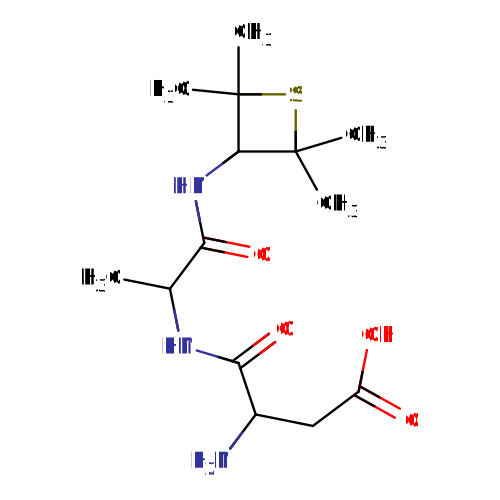
| Description | Alitame belongs to the class of organic compounds known as dipeptides. These are organic compounds containing a sequence of exactly two alpha-amino acids joined by a peptide bond. Alitame was first documented in 2013 (PMID: 23863365). Based on a literature review a significant number of articles have been published on Alitame (PMID: 38340820) (PMID: 38041977) (PMID: 36461268) (PMID: 34207293) (PMID: 34048820) (PMID: 31861939). |
|---|
| Structure | CC(NC(=O)C(N)CC(O)=O)C(=O)NC1C(C)(C)SC1(C)C InChI=1/C14H25N3O4S/c1-7(16-11(21)8(15)6-9(18)19)10(20)17-12-13(2,3)22-14(12,4)5/h7-8,12H,6,15H2,1-5H3,(H,16,21)(H,17,20)(H,18,19) |
|---|
| Synonyms | Not Available |
|---|
| Chemical Formula | C14H25N3O4S |
|---|
| Average Mass | 331.4300 Da |
|---|
| Monoisotopic Mass | 331.15658 Da |
|---|
| IUPAC Name | 3-amino-3-({1-[(2,2,4,4-tetramethylthietan-3-yl)carbamoyl]ethyl}carbamoyl)propanoic acid |
|---|
| Traditional Name | alitame |
|---|
| CAS Registry Number | Not Available |
|---|
| SMILES | CC(NC(=O)C(N)CC(O)=O)C(=O)NC1C(C)(C)SC1(C)C |
|---|
| InChI Identifier | InChI=1/C14H25N3O4S/c1-7(16-11(21)8(15)6-9(18)19)10(20)17-12-13(2,3)22-14(12,4)5/h7-8,12H,6,15H2,1-5H3,(H,16,21)(H,17,20)(H,18,19) |
|---|
| InChI Key | IVBOUFAWPCPFTQ-UHFFFAOYNA-N |
|---|
| Experimental Spectra |
|---|
|
| Not Available | | Predicted Spectra |
|---|
|
| Not Available | | Chemical Shift Submissions |
|---|
|
| Not Available | | Species |
|---|
| Species of Origin | Not Available |
|---|
| Chemical Taxonomy |
|---|
| Description | This compound belongs to the class of organic compounds known as dipeptides. These are organic compounds containing a sequence of exactly two alpha-amino acids joined by a peptide bond. |
|---|
| Kingdom | Organic compounds |
|---|
| Super Class | Organic acids and derivatives |
|---|
| Class | Carboxylic acids and derivatives |
|---|
| Sub Class | Amino acids, peptides, and analogues |
|---|
| Direct Parent | Dipeptides |
|---|
| Alternative Parents | |
|---|
| Substituents | - Alpha-dipeptide
- Aspartic acid or derivatives
- N-acyl-alpha amino acid or derivatives
- Alpha-amino acid amide
- Alanine or derivatives
- N-substituted-alpha-amino acid
- Alpha-amino acid or derivatives
- Heterocyclic fatty acid
- N-acyl-amine
- Fatty amide
- Fatty acid
- Fatty acyl
- Thietane
- Secondary carboxylic acid amide
- Amino acid or derivatives
- Amino acid
- Carboxamide group
- Dialkylthioether
- Thioether
- Carboxylic acid
- Monocarboxylic acid or derivatives
- Organoheterocyclic compound
- Organic nitrogen compound
- Primary aliphatic amine
- Organonitrogen compound
- Organooxygen compound
- Primary amine
- Hydrocarbon derivative
- Carbonyl group
- Organic oxide
- Amine
- Organopnictogen compound
- Organic oxygen compound
- Aliphatic heteromonocyclic compound
|
|---|
| Molecular Framework | Aliphatic heteromonocyclic compounds |
|---|
| External Descriptors | Not Available |
|---|
| Physical Properties |
|---|
| State | Not Available |
|---|
| Experimental Properties | | Property | Value | Reference |
|---|
| Melting Point | Not Available | Not Available | | Boiling Point | Not Available | Not Available | | Water Solubility | Not Available | Not Available | | LogP | Not Available | Not Available |
|
|---|
| Predicted Properties | |
|---|
| General References | - Jiang L, Yu Z, Zhao Y, Yin D: Obesogenic potentials of environmental artificial sweeteners with disturbances on both lipid metabolism and neural responses. Sci Total Environ. 2024 Apr 1;919:170755. doi: 10.1016/j.scitotenv.2024.170755. Epub 2024 Feb 9. [PubMed:38340820 ]
- Cheng S, Wang S, Zheng M, Jin Y, Li J, Zhang M, Li XL, Min JZ: Simultaneous analysis of natural and artificial sweeteners in sugar-free drinks and urine samples by column-switching UHPLC-charged aerosol detection method. J Chromatogr A. 2024 Jan 4;1713:464533. doi: 10.1016/j.chroma.2023.464533. Epub 2023 Nov 28. [PubMed:38041977 ]
- Farag MA, Rezk MM, Hamdi Elashal M, El-Araby M, Khalifa SAM, El-Seedi HR: An updated multifaceted overview of sweet proteins and dipeptides as sugar substitutes; the chemistry, health benefits, gut interactions, and safety. Food Res Int. 2022 Dec;162(Pt A):111853. doi: 10.1016/j.foodres.2022.111853. Epub 2022 Aug 24. [PubMed:36461268 ]
- Saputra F, Lai YH, Fernandez RAT, Macabeo APG, Lai HT, Huang JC, Hsiao CD: Acute and Sub-Chronic Exposure to Artificial Sweeteners at the Highest Environmentally Relevant Concentration Induce Less Cardiovascular Physiology Alterations in Zebrafish Larvae. Biology (Basel). 2021 Jun 18;10(6):548. doi: 10.3390/biology10060548. [PubMed:34207293 ]
- Pereira S, Henderson D, Hjelm M, Hard T, Hernandez Salazar LT, Laska M: Taste responsiveness of chimpanzees (Pan troglodytes) and black-handed spider monkeys (Ateles geoffroyi) to eight substances tasting sweet to humans. Physiol Behav. 2021 Sep 1;238:113470. doi: 10.1016/j.physbeh.2021.113470. Epub 2021 May 26. [PubMed:34048820 ]
- Ma K, Li X, Zhang Y, Liu F: Determining High-Intensity Sweeteners in White Spirits Using an Ultrahigh Performance Liquid Chromatograph with a Photo-Diode Array Detector and Charged Aerosol Detector. Molecules. 2019 Dec 20;25(1):40. doi: 10.3390/molecules25010040. [PubMed:31861939 ]
- Tang J, Yuan L, Xiao Y, Wang X, Wang S: [Simultaneous determination of nine artificial sweeteners in food by solid-phase extraction coupled with high performance liquid chromatography-tandem mass spectrometry]. Se Pu. 2019 Jun 8;37(6):619-625. doi: 10.3724/SP.J.1123.2019.01012. [PubMed:31152512 ]
- Tsuruda S, Sakamoto T, Akaki K: [Simultaneous determination of twelve sweeteners and nine preservatives in foods by solid-phase extraction and LC-MS/MS]. Shokuhin Eiseigaku Zasshi. 2013;54(3):204-12. doi: 10.3358/shokueishi.54.204. [PubMed:23863365 ]
- Mora MR, Dando R: The sensory properties and metabolic impact of natural and synthetic sweeteners. Compr Rev Food Sci Food Saf. 2021 Mar;20(2):1554-1583. doi: 10.1111/1541-4337.12703. Epub 2021 Feb 13. [PubMed:33580569 ]
- Li X, Li S, Li H, Wang J, Luo Q, Yin X: Quantification of artificial sweeteners in alcoholic drinks using direct analysis in real-time QTRAP mass spectrometry. Food Chem. 2021 Apr 16;342:128331. doi: 10.1016/j.foodchem.2020.128331. Epub 2020 Oct 8. [PubMed:33097326 ]
- Gatidou G, Vazaiou N, Thomaidis NS, Stasinakis AS: Biodegradability assessment of food additives using OECD 301F respirometric test. Chemosphere. 2020 Feb;241:125071. doi: 10.1016/j.chemosphere.2019.125071. Epub 2019 Oct 11. [PubMed:31683420 ]
- Lakade SS, Zhou Q, Li A, Borrull F, Fontanals N, Marce RM: Hypercrosslinked particles for the extraction of sweeteners using dispersive solid-phase extraction from environmental samples. J Sep Sci. 2018 Apr;41(7):1618-1624. doi: 10.1002/jssc.201701113. Epub 2018 Jan 25. [PubMed:29280297 ]
- Mooradian AD, Smith M, Tokuda M: The role of artificial and natural sweeteners in reducing the consumption of table sugar: A narrative review. Clin Nutr ESPEN. 2017 Apr;18:1-8. doi: 10.1016/j.clnesp.2017.01.004. Epub 2017 Feb 4. [PubMed:29132732 ]
- Kubica P, Namiesnik J, Wasik A: Determination of eight artificial sweeteners and common Stevia rebaudiana glycosides in non-alcoholic and alcoholic beverages by reversed-phase liquid chromatography coupled with tandem mass spectrometry. Anal Bioanal Chem. 2015 Feb;407(5):1505-12. doi: 10.1007/s00216-014-8355-x. Epub 2014 Dec 4. [PubMed:25471292 ]
- Chattopadhyay S, Raychaudhuri U, Chakraborty R: Artificial sweeteners - a review. J Food Sci Technol. 2014 Apr;51(4):611-21. doi: 10.1007/s13197-011-0571-1. Epub 2011 Oct 21. [PubMed:24741154 ]
|
|---|