| Record Information |
|---|
| Version | 2.0 |
|---|
| Created at | 2024-09-11 08:25:16 UTC |
|---|
| Updated at | 2024-09-11 08:25:16 UTC |
|---|
| NP-MRD ID | NP0336917 |
|---|
| Secondary Accession Numbers | None |
|---|
| Natural Product Identification |
|---|
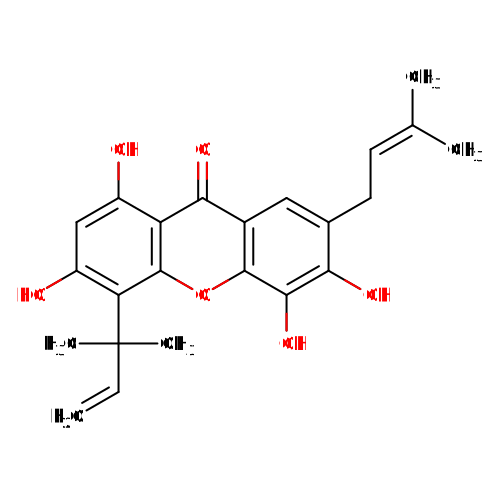
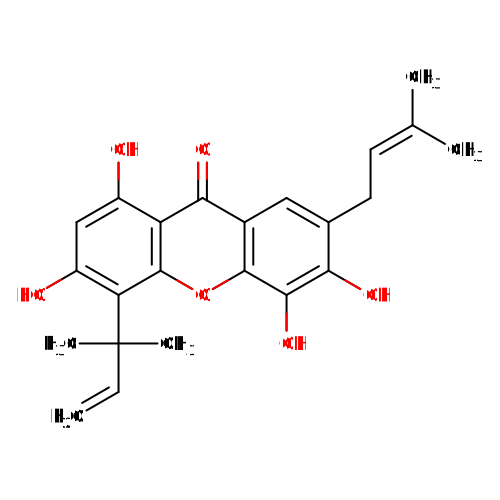
| Common Name | 4-(1,1-Dimethyl-2-propenyl)-1,3,5,6-tetrahydroxy-7-prenylxanthone |
|---|
| Description | 4-(1,1-Dimethyl-2-propenyl)-1,3,5,6-tetrahydroxy-7-prenylxanthone belongs to the class of organic compounds known as 2-prenylated xanthones. These are organic compounds containing a C5-isoprenoid group linked to a xanthone moiety at the 2-position. Xanthone is a tricyclic compound made up of two benzene rings linearly fused to each other through a pyran ring that carries a ketone group. 4-(1,1-Dimethyl-2-propenyl)-1,3,5,6-tetrahydroxy-7-prenylxanthone is an extremely weak basic (essentially neutral) compound (based on its pKa). Outside of the human body, 4-(1,1-Dimethyl-2-propenyl)-1,3,5,6-tetrahydroxy-7-prenylxanthone has been detected, but not quantified in, fruits and herbs and spices. This could make 4-(1,1-dimethyl-2-propenyl)-1,3,5,6-tetrahydroxy-7-prenylxanthone a potential biomarker for the consumption of these foods. |
|---|
| Structure | CC(C)=CCC1=CC2=C(OC3=C(C(O)=CC(O)=C3C(C)(C)C=C)C2=O)C(O)=C1O InChI=1S/C23H24O6/c1-6-23(4,5)17-15(25)10-14(24)16-19(27)13-9-12(8-7-11(2)3)18(26)20(28)21(13)29-22(16)17/h6-7,9-10,24-26,28H,1,8H2,2-5H3 |
|---|
| Synonyms | | Value | Source |
|---|
| 4-(1,1-Dimethyl-2-propenyl)-1,3,5,6-tetrahydroxy-7-(3-methyl-2-butenyl)-9H-xanthen-9-one, 9ci | HMDB |
|
|---|
| Chemical Formula | C23H24O6 |
|---|
| Average Mass | 396.4331 Da |
|---|
| Monoisotopic Mass | 396.15729 Da |
|---|
| IUPAC Name | 1,3,5,6-tetrahydroxy-7-(3-methylbut-2-en-1-yl)-4-(2-methylbut-3-en-2-yl)-9H-xanthen-9-one |
|---|
| Traditional Name | 1,3,5,6-tetrahydroxy-7-(3-methylbut-2-en-1-yl)-4-(2-methylbut-3-en-2-yl)xanthen-9-one |
|---|
| CAS Registry Number | Not Available |
|---|
| SMILES | CC(C)=CCC1=CC2=C(OC3=C(C(O)=CC(O)=C3C(C)(C)C=C)C2=O)C(O)=C1O |
|---|
| InChI Identifier | InChI=1S/C23H24O6/c1-6-23(4,5)17-15(25)10-14(24)16-19(27)13-9-12(8-7-11(2)3)18(26)20(28)21(13)29-22(16)17/h6-7,9-10,24-26,28H,1,8H2,2-5H3 |
|---|
| InChI Key | BPIPRLPHPUGIIF-UHFFFAOYSA-N |
|---|
| Experimental Spectra |
|---|
|
| Not Available | | Predicted Spectra |
|---|
|
| Not Available | | Chemical Shift Submissions |
|---|
|
| Not Available | | Species |
|---|
| Species of Origin | Not Available |
|---|
| Chemical Taxonomy |
|---|
| Description | Belongs to the class of organic compounds known as 2-prenylated xanthones. These are organic compounds containing a C5-isoprenoid group linked to a xanthone moiety at the 2-position. Xanthone is a tricyclic compound made up of two benzene rings linearly fused to each other through a pyran ring that carries a ketone group. |
|---|
| Kingdom | Organic compounds |
|---|
| Super Class | Organoheterocyclic compounds |
|---|
| Class | Benzopyrans |
|---|
| Sub Class | 1-benzopyrans |
|---|
| Direct Parent | 2-prenylated xanthones |
|---|
| Alternative Parents | |
|---|
| Substituents | - 2-prenylated xanthone
- Chromone
- 1-hydroxy-4-unsubstituted benzenoid
- 1-hydroxy-2-unsubstituted benzenoid
- Pyranone
- Pyran
- Benzenoid
- Heteroaromatic compound
- Vinylogous acid
- Polyol
- Oxacycle
- Hydrocarbon derivative
- Organic oxide
- Organooxygen compound
- Organic oxygen compound
- Aromatic heteropolycyclic compound
|
|---|
| Molecular Framework | Aromatic heteropolycyclic compounds |
|---|
| External Descriptors | Not Available |
|---|
| Physical Properties |
|---|
| State | Not Available |
|---|
| Experimental Properties | | Property | Value | Reference |
|---|
| Melting Point | Not Available | Not Available | | Boiling Point | Not Available | Not Available | | Water Solubility | Not Available | Not Available | | LogP | Not Available | Not Available |
|
|---|
| Predicted Properties | |
|---|