| Record Information |
|---|
| Version | 2.0 |
|---|
| Created at | 2024-09-11 08:24:31 UTC |
|---|
| Updated at | 2024-09-11 08:24:32 UTC |
|---|
| NP-MRD ID | NP0336914 |
|---|
| Secondary Accession Numbers | None |
|---|
| Natural Product Identification |
|---|
| Common Name | Benzenethiol |
|---|
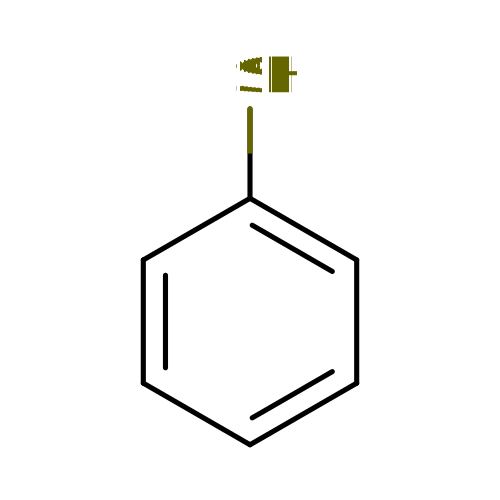
| Description | Benzenethiol, also known as mercaptobenzene or phenyl mercaptan, belongs to the class of organic compounds known as thiophenols. Thiophenols are compounds containing a thiophenol ring, which a phenol derivative obtained by replacing the oxygen atom from the hydroxyl group (attached to the benzene) by a sulfur atom. Benzenethiol is a very weakly acidic compound (based on its pKa). Benzenethiol is a garlic, penetrating, and repulsive tasting compound. Outside of the human body,. Benzenethiol is a flavouring agent Benzenethiol is a chemical compound with the formula C6H5SH, and sometimes abbreviated as PhSH. The prefix thio- implies a sulfur-containing compound and when used before a root word name for a compound which would normally contain an oxygen atom, thio- commonly means that the oxygen atom is replaced by a sulfur atom. Benzenethiol was first documented in 2008 (PMID: 18266323). The organosulfur ligand in medicine merthiolate is a thiophenol (PMID: 23902004) (PMID: 23961762) (PMID: 18321603) (PMID: 22121689). |
|---|
| Structure | InChI=1S/C6H6S/c7-6-4-2-1-3-5-6/h1-5,7H |
|---|
| Synonyms | | Value | Source |
|---|
| Mercaptobenzene | ChEBI | | Phenyl mercaptan | ChEBI | | Phenylthiol | ChEBI | | FEMA 3616 | HMDB | | Mercapto-benzene | HMDB | | Phenylmercaptan | HMDB | | Sodium benzenethiolate | HMDB | | Thio-phenol | HMDB | | Thiofenol | HMDB | | Thiophenate | HMDB | | Thiophenol | HMDB | | Thiophenol, potassium salt | HMDB | | Thiophenol, sodium salt | HMDB | | Thiophenol, copper (+1) salt | HMDB | | Benzenethiol | MeSH |
|
|---|
| Chemical Formula | C6H6S |
|---|
| Average Mass | 110.1770 Da |
|---|
| Monoisotopic Mass | 110.01902 Da |
|---|
| IUPAC Name | benzenethiol |
|---|
| Traditional Name | thiophenol |
|---|
| CAS Registry Number | Not Available |
|---|
| SMILES | SC1=CC=CC=C1 |
|---|
| InChI Identifier | InChI=1S/C6H6S/c7-6-4-2-1-3-5-6/h1-5,7H |
|---|
| InChI Key | RMVRSNDYEFQCLF-UHFFFAOYSA-N |
|---|
| Experimental Spectra |
|---|
|
| Not Available | | Predicted Spectra |
|---|
|
| Not Available | | Chemical Shift Submissions |
|---|
|
| Not Available | | Species |
|---|
| Species of Origin | Not Available |
|---|
| Chemical Taxonomy |
|---|
| Description | Belongs to the class of organic compounds known as thiophenols. Thiophenols are compounds containing a thiophenol ring, which a phenol derivative obtained by replacing the oxygen atom from the hydroxyl group (attached to the benzene) by a sulfur atom. |
|---|
| Kingdom | Organic compounds |
|---|
| Super Class | Benzenoids |
|---|
| Class | Thiophenols |
|---|
| Sub Class | Not Available |
|---|
| Direct Parent | Thiophenols |
|---|
| Alternative Parents | |
|---|
| Substituents | - Thiophenol
- Monocyclic benzene moiety
- Arylthiol
- Hydrocarbon derivative
- Organosulfur compound
- Aromatic homomonocyclic compound
|
|---|
| Molecular Framework | Aromatic homomonocyclic compounds |
|---|
| External Descriptors | |
|---|
| Physical Properties |
|---|
| State | Not Available |
|---|
| Experimental Properties | | Property | Value | Reference |
|---|
| Melting Point | Not Available | Not Available | | Boiling Point | Not Available | Not Available | | Water Solubility | Not Available | Not Available | | LogP | Not Available | Not Available |
|
|---|
| Predicted Properties | |
|---|
| External Links |
|---|
| HMDB ID | HMDB0033746 |
|---|
| DrugBank ID | Not Available |
|---|
| Phenol Explorer Compound ID | Not Available |
|---|
| FoodDB ID | FDB011878 |
|---|
| KNApSAcK ID | Not Available |
|---|
| Chemspider ID | 7681 |
|---|
| KEGG Compound ID | Not Available |
|---|
| BioCyc ID | CPD-8132 |
|---|
| BiGG ID | Not Available |
|---|
| Wikipedia Link | Thiophenol |
|---|
| METLIN ID | Not Available |
|---|
| PubChem Compound | 7969 |
|---|
| PDB ID | BT6 |
|---|
| ChEBI ID | 48498 |
|---|
| Good Scents ID | Not Available |
|---|
| References |
|---|
| General References | - Kitaguchi Y, Habuka S, Mitsui T, Okuyama H, Hatta S, Aruga T: Comparative study of phenol and thiophenol adsorption on Cu(110). J Chem Phys. 2013 Jul 28;139(4):044708. doi: 10.1063/1.4815968. [PubMed:23902004 ]
- Cabalo J, Guicheteau JA, Christesen S: Toward understanding the influence of intermolecular interactions and molecular orientation on the chemical enhancement of SERS. J Phys Chem A. 2013 Sep 19;117(37):9028-38. doi: 10.1021/jp403458k. Epub 2013 Sep 5. [PubMed:23961762 ]
- Barrese AA 3rd, Genis C, Fisher SZ, Orwenyo JN, Kumara MT, Dutta SK, Phillips E, Kiddle JJ, Tu C, Silverman DN, Govindasamy L, Agbandje-McKenna M, McKenna R, Tripp BC: Inhibition of carbonic anhydrase II by thioxolone: a mechanistic and structural study. Biochemistry. 2008 Mar 11;47(10):3174-84. doi: 10.1021/bi702385k. Epub 2008 Feb 12. [PubMed:18266323 ]
- Patil G, Rudolph R, Lange C: In vitro-refolding of a single-chain Fv fragment in the presence of heteroaromatic thiols. J Biotechnol. 2008 Apr 30;134(3-4):218-21. doi: 10.1016/j.jbiotec.2008.01.009. Epub 2008 Jan 18. [PubMed:18321603 ]
- Park G, Lee KG, Lee SJ, Park TJ, Wi R, Wang KW, Kim DH: Ultrasound-aided formation of gold nanoparticles on multi-walled carbon nanotubes functionalized with mercaptobenzene moieties. J Nanosci Nanotechnol. 2011 Jul;11(7):6222-6. doi: 10.1166/jnn.2011.4445. [PubMed:22121689 ]
|
|---|