Np mrd loader

Record Information
Version2.0
Created at2024-09-11 08:09:33 UTC
Updated at2024-09-11 08:09:33 UTC
NP-MRD IDNP0336857
Secondary Accession NumbersNone
Natural Product Identification
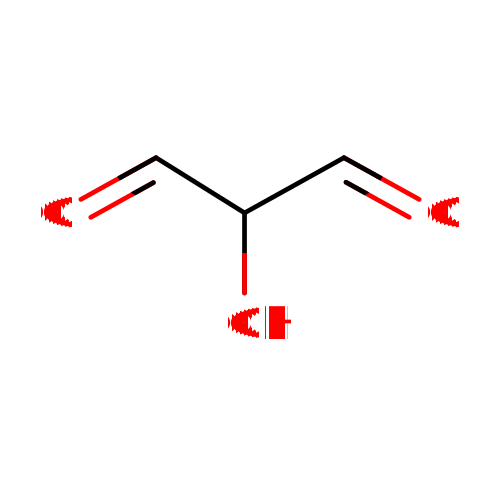
Common NameGlucosereductone
DescriptionGlucosereductone, also known as tartronal or glucic acid, belongs to the class of organic compounds known as 1,3-dicarbonyl compounds. These are carbonyl compounds with the generic formula O=C(R)C(H)C(R')=O, where R and R' can be any group. Glucosereductone is an extremely weak basic (essentially neutral) compound (based on its pKa). Outside of the human body, Glucosereductone has been detected, but not quantified in, alcoholic beverages. This could make glucosereductone a potential biomarker for the consumption of these foods.
Structure
Thumb
Synonyms
ValueSource
Glucic acidHMDB
Glucose-reductoneHMDB
Hydroxy-propanedialHMDB
Propanedial, hydroxy- (9ci)HMDB
ReductoneHMDB
TartronalHMDB
TartronaldehydeHMDB
Tartronic aldehydeHMDB
Triose reductoneHMDB
2-HydroxymalonaldehydeHMDB
2-Hydroxy-1,3-propanedialHMDB
Chemical FormulaC3H4O3
Average Mass88.0621 Da
Monoisotopic Mass88.01604 Da
IUPAC Name2-hydroxypropanedial
Traditional Nameglucic acid
CAS Registry NumberNot Available
SMILES
OC(C=O)C=O
InChI Identifier
InChI=1S/C3H4O3/c4-1-3(6)2-5/h1-3,6H
InChI KeyNVXLIZQNSVLKPO-UHFFFAOYSA-N
Experimental Spectra
Not Available
Predicted Spectra
Not Available
Chemical Shift Submissions
Not Available
Species
Species of OriginNot Available
Chemical Taxonomy
Description Belongs to the class of organic compounds known as 1,3-dicarbonyl compounds. These are carbonyl compounds with the generic formula O=C(R)C(H)C(R')=O, where R and R' can be any group.
KingdomOrganic compounds
Super ClassOrganic oxygen compounds
ClassOrganooxygen compounds
Sub ClassCarbonyl compounds
Direct Parent1,3-dicarbonyl compounds
Alternative Parents
Substituents
  • 1,3-dicarbonyl compound
  • Alpha-hydroxyaldehyde
  • Secondary alcohol
  • Organic oxide
  • Hydrocarbon derivative
  • Short-chain aldehyde
  • Aldehyde
  • Alcohol
  • Aliphatic acyclic compound
Molecular FrameworkAliphatic acyclic compounds
External DescriptorsNot Available
Physical Properties
StateNot Available
Experimental Properties
PropertyValueReference
Melting PointNot AvailableNot Available
Boiling PointNot AvailableNot Available
Water SolubilityNot AvailableNot Available
LogPNot AvailableNot Available
Predicted Properties
PropertyValueSource
logP-0.8ALOGPS
logP-1.4ChemAxon
logS0.71ALOGPS
pKa (Strongest Acidic)7.53ChemAxon
pKa (Strongest Basic)-4.1ChemAxon
Physiological Charge0ChemAxon
Hydrogen Acceptor Count3ChemAxon
Hydrogen Donor Count1ChemAxon
Polar Surface Area54.37 ŲChemAxon
Rotatable Bond Count2ChemAxon
Refractivity18.48 m³·mol⁻¹ChemAxon
Polarizability7.23 ųChemAxon
Number of Rings0ChemAxon
BioavailabilityYesChemAxon
Rule of FiveYesChemAxon
Ghose FilterNoChemAxon
Veber's RuleNoChemAxon
MDDR-like RuleNoChemAxon
HMDB IDHMDB0040261
DrugBank IDNot Available
Phenol Explorer Compound IDNot Available
FoodDB IDFDB019978
KNApSAcK IDNot Available
Chemspider ID3650542
KEGG Compound IDNot Available
BioCyc IDNot Available
BiGG IDNot Available
Wikipedia LinkNot Available
METLIN IDNot Available
PubChem Compound4451502
PDB IDNot Available
ChEBI IDNot Available
Good Scents IDNot Available
References
General References