Np mrd loader

Record Information
Version2.0
Created at2024-09-11 07:46:46 UTC
Updated at2024-09-11 07:46:46 UTC
NP-MRD IDNP0336776
Secondary Accession NumbersNone
Natural Product Identification
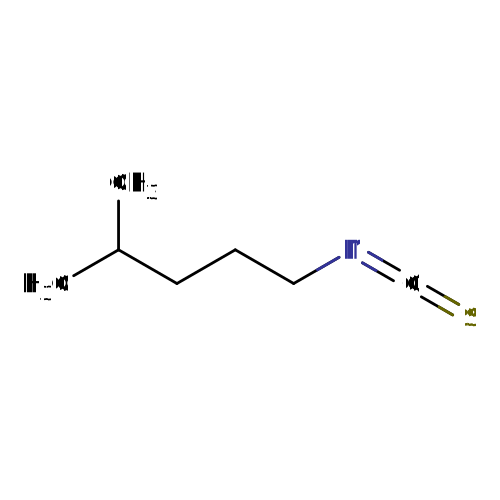
Common Name1-Isothiocyanato-4-methylpentane
Description1-Isothiocyanato-4-methylpentane, also known as 2-benzylidenemalononitrile or (phenylmethylene)-propanedinitrile, belongs to the class of organic compounds known as isothiocyanates. These are organic compounds containing the isothiocyanate group, an isocyanate analogue with the general formula RN=C=S. 1-Isothiocyanato-4-methylpentane is an extremely weak basic (essentially neutral) compound (based on its pKa). Outside of the human body, 1-Isothiocyanato-4-methylpentane has been detected, but not quantified in, root vegetables. 1-Isothiocyanato-4-methylpentane was first documented in 1983 (PMID: 6223814). This could make 1-isothiocyanato-4-methylpentane a potential biomarker for the consumption of these foods (PMID: 16526804) (PMID: 7916898) (PMID: 2897291) (PMID: 12353995).
Structure
Thumb
Synonyms
ValueSource
(Phenylmethylene)-propanedinitrileHMDB
2,2-Dicyano-1-phenylethyleneHMDB
2-BenzylidenemalononitrileHMDB
2-Phenyl-1,1-dicyanoethyleneHMDB
4-Methylpentyl isothiocyanateHMDB
alpha-CyanocinnamonitrileHMDB
Benzal-malonitrilHMDB
BenzalmalononitrileHMDB
Benzylidene malononitrileHMDB
Benzylidene-malononitrileHMDB
BenzylidenemalonodinitrileHMDB
BenzylidenemalononitrileHMDB
beta,beta-DicyanostyreneHMDB
beta,beta-StyrenedicarbonitrileHMDB
BMNHMDB
Isohexyl isothiocyanateHMDB
Propanedinitrile, (phenylmethylene)- (9ci)HMDB
Chemical FormulaC7H13NS
Average Mass143.2500 Da
Monoisotopic Mass143.07687 Da
IUPAC Name1-isothiocyanato-4-methylpentane
Traditional Name1-isothiocyanato-4-methylpentane
CAS Registry NumberNot Available
SMILES
CC(C)CCCN=C=S
InChI Identifier
InChI=1S/C7H13NS/c1-7(2)4-3-5-8-6-9/h7H,3-5H2,1-2H3
InChI KeyCZWUENKYXFGDIG-UHFFFAOYSA-N
Experimental Spectra
Not Available
Predicted Spectra
Not Available
Chemical Shift Submissions
Not Available
Species
Species of OriginNot Available
Chemical Taxonomy
Description Belongs to the class of organic compounds known as isothiocyanates. These are organic compounds containing the isothiocyanate group, an isocyanate analogue with the general formula RN=C=S.
KingdomOrganic compounds
Super ClassOrganosulfur compounds
ClassIsothiocyanates
Sub ClassNot Available
Direct ParentIsothiocyanates
Alternative Parents
Substituents
  • Isothiocyanate
  • Organic 1,3-dipolar compound
  • Propargyl-type 1,3-dipolar organic compound
  • Organic nitrogen compound
  • Organopnictogen compound
  • Hydrocarbon derivative
  • Organonitrogen compound
  • Aliphatic acyclic compound
Molecular FrameworkAliphatic acyclic compounds
External DescriptorsNot Available
Physical Properties
StateNot Available
Experimental Properties
PropertyValueReference
Melting PointNot AvailableNot Available
Boiling PointNot AvailableNot Available
Water SolubilityNot AvailableNot Available
LogPNot AvailableNot Available
Predicted Properties
PropertyValueSource
logP3.86ALOGPS
logP3.13ChemAxon
logS-3.4ALOGPS
pKa (Strongest Basic)-2.7ChemAxon
Physiological Charge0ChemAxon
Hydrogen Acceptor Count1ChemAxon
Hydrogen Donor Count0ChemAxon
Polar Surface Area12.36 ŲChemAxon
Rotatable Bond Count4ChemAxon
Refractivity44.35 m³·mol⁻¹ChemAxon
Polarizability17.31 ųChemAxon
Number of Rings0ChemAxon
BioavailabilityYesChemAxon
Rule of FiveYesChemAxon
Ghose FilterNoChemAxon
Veber's RuleYesChemAxon
MDDR-like RuleNoChemAxon
HMDB IDHMDB0038435
DrugBank IDNot Available
Phenol Explorer Compound IDNot Available
FoodDB IDFDB017793
KNApSAcK IDNot Available
Chemspider ID453098
KEGG Compound IDNot Available
BioCyc IDNot Available
BiGG IDNot Available
Wikipedia LinkNot Available
METLIN IDNot Available
PubChem Compound519452
PDB IDNot Available
ChEBI IDNot Available
Good Scents IDNot Available
References
General References
  1. Patil NT, Huo Z, Yamamoto Y: Beta-alkyl-alpha-allylation of Michael acceptors through the palladium-catalyzed three-component coupling between allylic substrates, trialkylboranes, and activated olefins. J Org Chem. 2006 Mar 17;71(6):2503-6. doi: 10.1021/jo0524876. [PubMed:16526804 ]
  2. Freeman KB, Yatscoff RW, Mason JR, Patel HV, Buckle M: Characterization of a Chinese hamster ovary cell line resistant to uncouplers. Eur J Biochem. 1983 Aug 1;134(2):215-22. doi: 10.1111/j.1432-1033.1983.tb07553.x. [PubMed:6223814 ]
  3. Brunton VG, Lear MJ, Robins DJ, Williamson S, Workman P: Synthesis and antiproliferative activity of tyrphostins containing heteroaromatic moieties. Anticancer Drug Des. 1994 Aug;9(4):291-309. [PubMed:7916898 ]
  4. Kaesler B, Schonheit P: Methanogenesis and ATP synthesis in methanogenic bacteria at low electrochemical proton potentials. An explanation for the apparent uncoupler insensitivity of ATP synthesis. Eur J Biochem. 1988 May 16;174(1):189-97. doi: 10.1111/j.1432-1033.1988.tb14081.x. [PubMed:2897291 ]
  5. Liu Y, Shen B, Kotora M, Nakajima K, Takahashi T: Direct addition of Zr-C bonds of alkylzirconocenes to activated alkenes. J Org Chem. 2002 Oct 4;67(20):7019-28. doi: 10.1021/jo0260701. [PubMed:12353995 ]