| Record Information |
|---|
| Version | 2.0 |
|---|
| Created at | 2024-09-11 07:23:07 UTC |
|---|
| Updated at | 2024-09-11 07:23:07 UTC |
|---|
| NP-MRD ID | NP0336680 |
|---|
| Secondary Accession Numbers | None |
|---|
| Natural Product Identification |
|---|
| Common Name | Sulfurous acid |
|---|
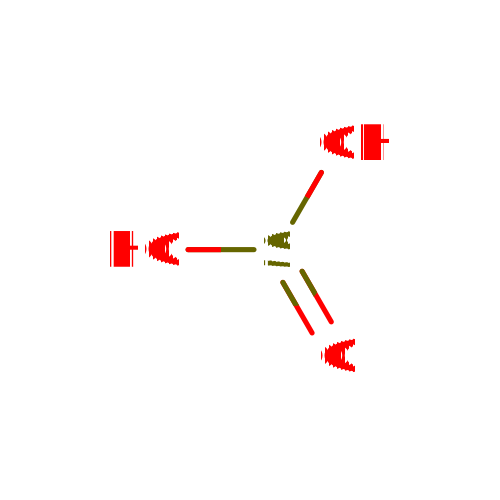
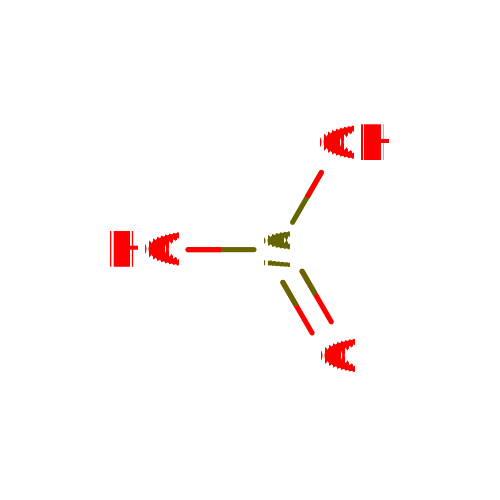
| Description | Sulfite, also known as sulphurous acid or [so(OH)2], belongs to the class of inorganic compounds known as non-metal sulfites. These are inorganic non-metallic compounds containing a sulfite as its largest oxoanion. Sulfite is a moderately acidic compound (based on its pKa). Sulfite exists in all living species, ranging from bacteria to humans. In humans, sulfite is involved in cystinosis, ocular nonnephropathic. Sulfite is a potentially toxic compound. The structure of the sulfite anion can be described with three equivalent resonance structures. Sulfur dioxide (SO2) protects wine from not only oxidation, but also from bacteria. In 1986, the U.S. Sulfurous acid was first documented in 1979 (PMID: 425377). Food and Drug Administration banned the use of sulfites as preservatives on foods intended to be eaten fresh (such as salad ingredients) (PMID: 9748040) (PMID: 7662518) (PMID: 9823763) (PMID: 6826700) (PMID: 6486442) (PMID: 15827731). |
|---|
| Structure | InChI=1S/H2O3S/c1-4(2)3/h(H2,1,2,3) |
|---|
| Synonyms | | Value | Source |
|---|
| [SO(OH)2] | ChEBI | | Acide sulfureux | ChEBI | | Acido sulfuroso | ChEBI | | H2SO3 | ChEBI | | S(O)(OH)2 | ChEBI | | Schweflige saeure | ChEBI | | Sulphurous acid | ChEBI | | Sulfurous acid | Kegg | | Acide sulphureux | Generator | | Acido sulphuroso | Generator | | Sulphite | Generator | | Sulfur dioxide solution | HMDB | | Sulfuric(IV) acid (H2SO3) | HMDB | | Hydrogen sulfite | HMDB | | Sulfite | ChEBI |
|
|---|
| Chemical Formula | H2O3S |
|---|
| Average Mass | 82.0790 Da |
|---|
| Monoisotopic Mass | 81.97246 Da |
|---|
| IUPAC Name | sulfurous acid |
|---|
| Traditional Name | sulfurous acid |
|---|
| CAS Registry Number | Not Available |
|---|
| SMILES | OS(O)=O |
|---|
| InChI Identifier | InChI=1S/H2O3S/c1-4(2)3/h(H2,1,2,3) |
|---|
| InChI Key | LSNNMFCWUKXFEE-UHFFFAOYSA-N |
|---|
| Experimental Spectra |
|---|
|
| Not Available | | Predicted Spectra |
|---|
|
| Not Available | | Chemical Shift Submissions |
|---|
|
| Not Available | | Species |
|---|
| Species of Origin | Not Available |
|---|
| Chemical Taxonomy |
|---|
| Description | Belongs to the class of inorganic compounds known as non-metal sulfites. These are inorganic non-metallic compounds containing a sulfite as its largest oxoanion. |
|---|
| Kingdom | Inorganic compounds |
|---|
| Super Class | Homogeneous non-metal compounds |
|---|
| Class | Non-metal oxoanionic compounds |
|---|
| Sub Class | Non-metal sulfites |
|---|
| Direct Parent | Non-metal sulfites |
|---|
| Alternative Parents | |
|---|
| Substituents | - Non-metal sulfite
- Inorganic oxide
|
|---|
| Molecular Framework | Not Available |
|---|
| External Descriptors | |
|---|
| Physical Properties |
|---|
| State | Not Available |
|---|
| Experimental Properties | | Property | Value | Reference |
|---|
| Melting Point | Not Available | Not Available | | Boiling Point | Not Available | Not Available | | Water Solubility | Not Available | Not Available | | LogP | Not Available | Not Available |
|
|---|
| Predicted Properties | |
|---|
| External Links |
|---|
| HMDB ID | HMDB0000240 |
|---|
| DrugBank ID | Not Available |
|---|
| Phenol Explorer Compound ID | Not Available |
|---|
| FoodDB ID | FDB013391 |
|---|
| KNApSAcK ID | C00019662 |
|---|
| Chemspider ID | 1069 |
|---|
| KEGG Compound ID | C00094 |
|---|
| BioCyc ID | Not Available |
|---|
| BiGG ID | Not Available |
|---|
| Wikipedia Link | Sulfite |
|---|
| METLIN ID | Not Available |
|---|
| PubChem Compound | 1100 |
|---|
| PDB ID | Not Available |
|---|
| ChEBI ID | 48854 |
|---|
| Good Scents ID | Not Available |
|---|
| References |
|---|
| General References | - Graf WD, Oleinik OE, Jack RM, Weiss AH, Johnson JL: Ahomocysteinemia in molybdenum cofactor deficiency. Neurology. 1998 Sep;51(3):860-2. [PubMed:9748040 ]
- Jeppesen C: Media for Aeromonas spp., Plesiomonas shigelloides and Pseudomonas spp. from food and environment. Int J Food Microbiol. 1995 Jun;26(1):25-41. doi: 10.1016/0168-1605(93)e0029-q. [PubMed:7662518 ]
- Mitsuhashi H, Nojima Y, Tanaka T, Ueki K, Maezawa A, Yano S, Naruse T: Sulfite is released by human neutrophils in response to stimulation with lipopolysaccharide. J Leukoc Biol. 1998 Nov;64(5):595-9. doi: 10.1002/jlb.64.5.595. [PubMed:9823763 ]
- von Graevenitz A, Bucher C: Evaluation of differential and selective media for isolation of Aeromonas and Plesiomonas spp. from human feces. J Clin Microbiol. 1983 Jan;17(1):16-21. doi: 10.1128/jcm.17.1.16-21.1983. [PubMed:6826700 ]
- Tsariuk LA, Rybachuk VN, Shevchenko LI, Tolstykh VM: [Determination of fibrinogen concentration in blood plasma by the sulfite precipitation method]. Vopr Med Khim. 1979 Jan-Feb;25(1):97-101. [PubMed:425377 ]
- Shea M, Howell S: High-performance liquid chromatographic measurement of exogenous thiosulfate in urine and plasma. Anal Biochem. 1984 Aug 1;140(2):589-94. doi: 10.1016/0003-2697(84)90211-2. [PubMed:6486442 ]
- Bor-Kucukatay M, Kucukatay V, Agar A, Baskurt OK: Effect of sulfite on red blood cell deformability ex vivo and in normal and sulfite oxidase-deficient rats in vivo. Arch Toxicol. 2005 Sep;79(9):542-6. doi: 10.1007/s00204-005-0657-5. Epub 2005 Apr 13. [PubMed:15827731 ]
- Gubash SM, Ingham L: Comparison of a new, bismuth-iron-sulfite-cycloserine agar for isolation of Clostridium perfringens with the tryptose-sulfite-cycloserine and blood agars. Zentralbl Bakteriol. 1997 Feb;285(3):397-402. doi: 10.1016/s0934-8840(97)80006-0. [PubMed:9084113 ]
- Kim E, Driscoll CF, Minah GE: The effect of a denture adhesive on the colonization of Candida species in vivo. J Prosthodont. 2003 Sep;12(3):187-91. doi: 10.1016/S1059-941X(03)00050-0. [PubMed:14508740 ]
- Willis CL, Cummings JH, Neale G, Gibson GR: Nutritional aspects of dissimilatory sulfate reduction in the human large intestine. Curr Microbiol. 1997 Nov;35(5):294-8. doi: 10.1007/s002849900257. [PubMed:9462959 ]
- Sardesai VM: Molybdenum: an essential trace element. Nutr Clin Pract. 1993 Dec;8(6):277-81. doi: 10.1177/0115426593008006277. [PubMed:8302261 ]
- Togawa T, Ogawa M, Nawata M, Ogasawara Y, Kawanabe K, Tanabe S: High performance liquid chromatographic determination of bound sulfide and sulfite and thiosulfate at their low levels in human serum by pre-column fluorescence derivatization with monobromobimane. Chem Pharm Bull (Tokyo). 1992 Nov;40(11):3000-4. doi: 10.1248/cpb.40.3000. [PubMed:1477915 ]
- Pearson SJ, Czudek C, Mercer K, Reynolds GP: Electrochemical detection of human brain transmitter amino acids by high-performance liquid chromatography of stable o-phthalaldehyde-sulphite derivatives. J Neural Transm Gen Sect. 1991;86(2):151-7. doi: 10.1007/BF01250576. [PubMed:1683240 ]
- Mishra A, Dayal N, Beck-Speier I: Effect of sulphite on the oxidative metabolism of human neutrophils: studies with lucigenin- and luminol-dependent chemiluminescence. J Biolumin Chemilumin. 1995 Jan-Feb;10(1):9-19. doi: 10.1002/bio.1170100103. [PubMed:7762419 ]
- Beck-Speier I, Lenz AG, Godleski JJ: Responses of human neutrophils to sulfite. J Toxicol Environ Health. 1994 Mar;41(3):285-97. doi: 10.1080/15287399409531844. [PubMed:8126751 ]
|
|---|