| Record Information |
|---|
| Version | 2.0 |
|---|
| Created at | 2024-09-11 07:11:27 UTC |
|---|
| Updated at | 2024-09-11 07:11:27 UTC |
|---|
| NP-MRD ID | NP0336637 |
|---|
| Secondary Accession Numbers | None |
|---|
| Natural Product Identification |
|---|
| Common Name | Sorbitan laurate |
|---|
| Description | Sorbitan laurate belongs to the class of organic compounds known as fatty acid esters. These are carboxylic ester derivatives of a fatty acid. Sorbitan laurate was first documented in 2005 (PMID: 15941350). Based on a literature review a significant number of articles have been published on Sorbitan laurate (PMID: 32344768) (PMID: 32126278) (PMID: 32065162) (PMID: 30251861) (PMID: 25187996) (PMID: 24441110). |
|---|
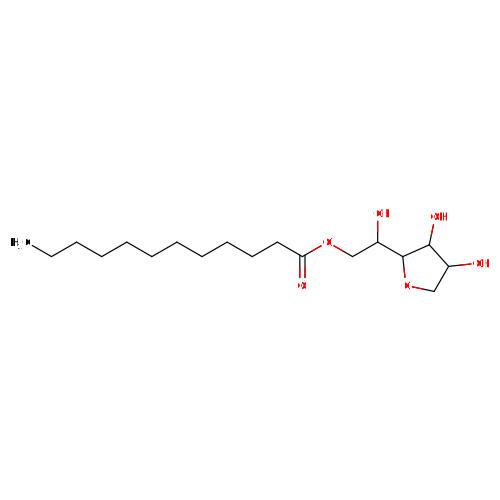
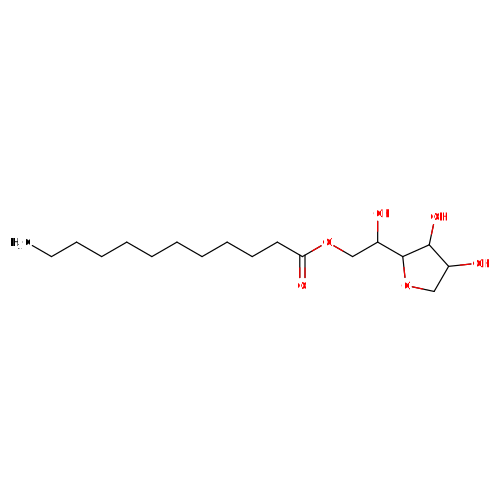
| Structure | CCCCCCCCCCCC(=O)OCC(O)C1OCC(O)C1O InChI=1/C18H34O6/c1-2-3-4-5-6-7-8-9-10-11-16(21)23-13-15(20)18-17(22)14(19)12-24-18/h14-15,17-20,22H,2-13H2,1H3 |
|---|
| Synonyms | | Value | Source |
|---|
| Sorbitan lauric acid | Generator |
|
|---|
| Chemical Formula | C18H34O6 |
|---|
| Average Mass | 346.4640 Da |
|---|
| Monoisotopic Mass | 346.23554 Da |
|---|
| IUPAC Name | 2-(3,4-dihydroxyoxolan-2-yl)-2-hydroxyethyl dodecanoate |
|---|
| Traditional Name | sorbitan monolaurate |
|---|
| CAS Registry Number | Not Available |
|---|
| SMILES | CCCCCCCCCCCC(=O)OCC(O)C1OCC(O)C1O |
|---|
| InChI Identifier | InChI=1/C18H34O6/c1-2-3-4-5-6-7-8-9-10-11-16(21)23-13-15(20)18-17(22)14(19)12-24-18/h14-15,17-20,22H,2-13H2,1H3 |
|---|
| InChI Key | LWZFANDGMFTDAV-UHFFFAOYNA-N |
|---|
| Experimental Spectra |
|---|
|
| Not Available | | Predicted Spectra |
|---|
|
| Not Available | | Chemical Shift Submissions |
|---|
|
| Not Available | | Species |
|---|
| Species of Origin | Not Available |
|---|
| Chemical Taxonomy |
|---|
| Description | This compound belongs to the class of organic compounds known as fatty acid esters. These are carboxylic ester derivatives of a fatty acid. |
|---|
| Kingdom | Organic compounds |
|---|
| Super Class | Lipids and lipid-like molecules |
|---|
| Class | Fatty Acyls |
|---|
| Sub Class | Fatty acid esters |
|---|
| Direct Parent | Fatty acid esters |
|---|
| Alternative Parents | |
|---|
| Substituents | - Fatty acid ester
- Tetrahydrofuran
- Carboxylic acid ester
- Secondary alcohol
- Carboxylic acid derivative
- Dialkyl ether
- Ether
- Monocarboxylic acid or derivatives
- Oxacycle
- Organoheterocyclic compound
- Carbonyl group
- Organic oxide
- Alcohol
- Organooxygen compound
- Hydrocarbon derivative
- Organic oxygen compound
- Aliphatic heteromonocyclic compound
|
|---|
| Molecular Framework | Aliphatic heteromonocyclic compounds |
|---|
| External Descriptors | Not Available |
|---|
| Physical Properties |
|---|
| State | Not Available |
|---|
| Experimental Properties | | Property | Value | Reference |
|---|
| Melting Point | Not Available | Not Available | | Boiling Point | Not Available | Not Available | | Water Solubility | Not Available | Not Available | | LogP | Not Available | Not Available |
|
|---|
| Predicted Properties | |
|---|
| External Links |
|---|
| HMDB ID | Not Available |
|---|
| DrugBank ID | Not Available |
|---|
| Phenol Explorer Compound ID | Not Available |
|---|
| FoodDB ID | Not Available |
|---|
| KNApSAcK ID | Not Available |
|---|
| Chemspider ID | Not Available |
|---|
| KEGG Compound ID | Not Available |
|---|
| BioCyc ID | Not Available |
|---|
| BiGG ID | Not Available |
|---|
| Wikipedia Link | Sorbitan monolaurate |
|---|
| METLIN ID | Not Available |
|---|
| PubChem Compound | Not Available |
|---|
| PDB ID | Not Available |
|---|
| ChEBI ID | Not Available |
|---|
| Good Scents ID | Not Available |
|---|
| References |
|---|
| General References | - Islam MR, Chowdhury MR, Wakabayashi R, Kamiya N, Moniruzzaman M, Goto M: Ionic Liquid-In-Oil Microemulsions Prepared with Biocompatible Choline Carboxylic Acids for Improving the Transdermal Delivery of a Sparingly Soluble Drug. Pharmaceutics. 2020 Apr 24;12(4):392. doi: 10.3390/pharmaceutics12040392. [PubMed:32344768 ]
- Kass LG, Rullan PP, Brody HJ: Clinical preliminary evaluation of PEG-80 sorbitan laurate (Novisol) versus sodium C14-16 olefin sulfonate & triclosan (Septisol) in deep-peeling Hetter formulas. J Am Acad Dermatol. 2020 Jun;82(6):e255-e256. doi: 10.1016/j.jaad.2020.02.062. Epub 2020 Feb 29. [PubMed:32126278 ]
- Zhang YR, Qiao HL, Ren LL, Wang R, Lu PF: Sample Preparation Method of Scanning and Transmission Electron Microscope for the Appendages of Woodboring Beetle. J Vis Exp. 2020 Feb 3;(156). doi: 10.3791/59251. [PubMed:32065162 ]
- Sakuragi M, Tsutsumi S, Kusakabe K: Deep Eutectic Solvent-Induced Structural Transition of Microemulsions Explored with Small-Angle X-ray Scattering. Langmuir. 2018 Oct 23;34(42):12635-12641. doi: 10.1021/acs.langmuir.8b02565. Epub 2018 Oct 10. [PubMed:30251861 ]
- Giannousi K, Sarafidis G, Mourdikoudis S, Pantazaki A, Dendrinou-Samara C: Selective synthesis of Cu(2)O and Cu/Cu(2)O NPs: antifungal activity to yeast Saccharomyces cerevisiae and DNA interaction. Inorg Chem. 2014 Sep 15;53(18):9657-66. doi: 10.1021/ic501143z. Epub 2014 Sep 4. [PubMed:25187996 ]
- Giannousi K, Lafazanis K, Arvanitidis J, Pantazaki A, Dendrinou-Samara C: Hydrothermal synthesis of copper based nanoparticles: antimicrobial screening and interaction with DNA. J Inorg Biochem. 2014 Apr;133:24-32. doi: 10.1016/j.jinorgbio.2013.12.009. Epub 2014 Jan 3. [PubMed:24441110 ]
- Mandal S, Ghosh S, Banerjee C, Kuchlyan J, Banik D, Sarkar N: A novel ionic liquid-in-oil microemulsion composed of biologically acceptable components: an excitation wavelength dependent fluorescence resonance energy transfer study. J Phys Chem B. 2013 Mar 21;117(11):3221-31. doi: 10.1021/jp4009515. Epub 2013 Mar 13. [PubMed:23445434 ]
- Moniruzzaman M, Kamiya N, Goto M: Ionic liquid based microemulsion with pharmaceutically accepted components: Formulation and potential applications. J Colloid Interface Sci. 2010 Dec 1;352(1):136-42. doi: 10.1016/j.jcis.2010.08.035. Epub 2010 Aug 13. [PubMed:20825949 ]
- Moniruzzaman M, Tamura M, Tahara Y, Kamiya N, Goto M: Ionic liquid-in-oil microemulsion as a potential carrier of sparingly soluble drug: characterization and cytotoxicity evaluation. Int J Pharm. 2010 Nov 15;400(1-2):243-50. doi: 10.1016/j.ijpharm.2010.08.034. Epub 2010 Sep 9. [PubMed:20813174 ]
- Moniruzzaman M, Tahara Y, Tamura M, Kamiya N, Goto M: Ionic liquid-assisted transdermal delivery of sparingly soluble drugs. Chem Commun (Camb). 2010 Mar 7;46(9):1452-4. doi: 10.1039/b907462g. Epub 2010 Jan 14. [PubMed:20162145 ]
- Lin SY, Krochta JM: Whey protein coating efficiency on surfactant-modified hydrophobic surfaces. J Agric Food Chem. 2005 Jun 15;53(12):5018-23. doi: 10.1021/jf0481305. [PubMed:15941350 ]
|
|---|