| Record Information |
|---|
| Version | 2.0 |
|---|
| Created at | 2024-09-11 04:26:06 UTC |
|---|
| Updated at | 2024-09-11 04:26:06 UTC |
|---|
| NP-MRD ID | NP0336034 |
|---|
| Secondary Accession Numbers | None |
|---|
| Natural Product Identification |
|---|
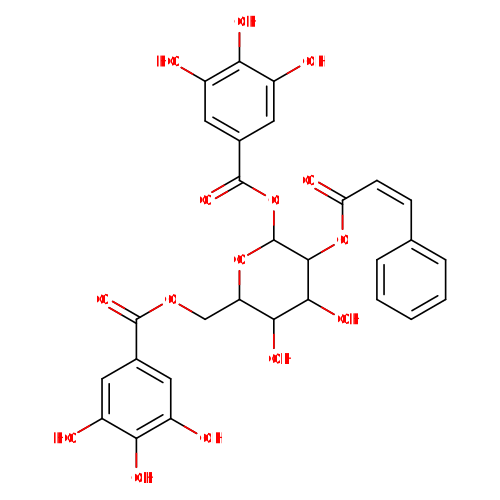
| Common Name | 2-Cinnamoyl-1,6-digalloyl-beta-D-glucopyranose |
|---|
| Description | 2-Cinnamoyl-1,6-digalloyl-beta-D-glucopyranose belongs to the class of organic compounds known as tannins. These are naturally occurring polyphenols which be categorized into four main classes: Hydrolyzable tannin (based on ellagic acid or gallic acid), condensed tannins (made of oligomeric or polymeric proanthocyanidins), complex tannins (made of a catechin bound to a gallotannin or elagitannin), and phlorotannins (oligomers of phloroglucinol). Based on a literature review very few articles have been published on 2-Cinnamoyl-1,6-digalloyl-beta-D-glucopyranose. |
|---|
| Structure | OC1C(COC(=O)C2=CC(O)=C(O)C(O)=C2)OC(OC(=O)C2=CC(O)=C(O)C(O)=C2)C(OC(=O)\C=C/C2=CC=CC=C2)C1O InChI=1/C29H26O15/c30-16-8-14(9-17(31)22(16)35)27(39)41-12-20-24(37)25(38)26(43-21(34)7-6-13-4-2-1-3-5-13)29(42-20)44-28(40)15-10-18(32)23(36)19(33)11-15/h1-11,20,24-26,29-33,35-38H,12H2/b7-6- |
|---|
| Synonyms | | Value | Source |
|---|
| 2-Cinnamoyl-1,6-digalloyl-b-D-glucopyranose | Generator | | 2-Cinnamoyl-1,6-digalloyl-β-D-glucopyranose | Generator |
|
|---|
| Chemical Formula | C29H26O15 |
|---|
| Average Mass | 614.5120 Da |
|---|
| Monoisotopic Mass | 614.12717 Da |
|---|
| IUPAC Name | (3,4-dihydroxy-5-{[(2Z)-3-phenylprop-2-enoyl]oxy}-6-(3,4,5-trihydroxybenzoyloxy)oxan-2-yl)methyl 3,4,5-trihydroxybenzoate |
|---|
| Traditional Name | (3,4-dihydroxy-5-{[(2Z)-3-phenylprop-2-enoyl]oxy}-6-(3,4,5-trihydroxybenzoyloxy)oxan-2-yl)methyl 3,4,5-trihydroxybenzoate |
|---|
| CAS Registry Number | Not Available |
|---|
| SMILES | OC1C(COC(=O)C2=CC(O)=C(O)C(O)=C2)OC(OC(=O)C2=CC(O)=C(O)C(O)=C2)C(OC(=O)\C=C/C2=CC=CC=C2)C1O |
|---|
| InChI Identifier | InChI=1/C29H26O15/c30-16-8-14(9-17(31)22(16)35)27(39)41-12-20-24(37)25(38)26(43-21(34)7-6-13-4-2-1-3-5-13)29(42-20)44-28(40)15-10-18(32)23(36)19(33)11-15/h1-11,20,24-26,29-33,35-38H,12H2/b7-6- |
|---|
| InChI Key | AKNNKSLRUQXXCZ-SREVYHEPNA-N |
|---|
| Experimental Spectra |
|---|
|
| Not Available | | Predicted Spectra |
|---|
|
| Not Available | | Chemical Shift Submissions |
|---|
|
| Not Available | | Species |
|---|
| Species of Origin | Not Available |
|---|
| Chemical Taxonomy |
|---|
| Description | This compound belongs to the class of organic compounds known as tannins. These are naturally occurring polyphenols which be categorized into four main classes: Hydrolyzable tannin (based on ellagic acid or gallic acid), condensed tannins (made of oligomeric or polymeric proanthocyanidins), complex tannins (made of a catechin bound to a gallotannin or elagitannin), and phlorotannins (oligomers of phloroglucinol). |
|---|
| Kingdom | Organic compounds |
|---|
| Super Class | Phenylpropanoids and polyketides |
|---|
| Class | Tannins |
|---|
| Sub Class | Not Available |
|---|
| Direct Parent | Tannins |
|---|
| Alternative Parents | |
|---|
| Substituents | - Tannin
- Galloyl ester
- Cinnamic acid or derivatives
- Gallic acid or derivatives
- Cinnamic acid ester
- P-hydroxybenzoic acid alkyl ester
- M-hydroxybenzoic acid ester
- P-hydroxybenzoic acid ester
- Benzoate ester
- Pyrogallol derivative
- Tricarboxylic acid or derivatives
- Benzenetriol
- Benzoic acid or derivatives
- Styrene
- Benzoyl
- 1-hydroxy-2-unsubstituted benzenoid
- Fatty acid ester
- 1-hydroxy-4-unsubstituted benzenoid
- Phenol
- Monocyclic benzene moiety
- Oxane
- Benzenoid
- Monosaccharide
- Fatty acyl
- Enoate ester
- Alpha,beta-unsaturated carboxylic ester
- 1,2-diol
- Secondary alcohol
- Carboxylic acid ester
- Acetal
- Oxacycle
- Organoheterocyclic compound
- Polyol
- Carboxylic acid derivative
- Organic oxygen compound
- Hydrocarbon derivative
- Alcohol
- Carbonyl group
- Organic oxide
- Organooxygen compound
- Aromatic heteromonocyclic compound
|
|---|
| Molecular Framework | Aromatic heteromonocyclic compounds |
|---|
| External Descriptors | Not Available |
|---|
| Physical Properties |
|---|
| State | Not Available |
|---|
| Experimental Properties | | Property | Value | Reference |
|---|
| Melting Point | Not Available | Not Available | | Boiling Point | Not Available | Not Available | | Water Solubility | Not Available | Not Available | | LogP | Not Available | Not Available |
|
|---|
| Predicted Properties | |
|---|