| Record Information |
|---|
| Version | 2.0 |
|---|
| Created at | 2024-09-11 04:13:21 UTC |
|---|
| Updated at | 2024-09-11 04:13:21 UTC |
|---|
| NP-MRD ID | NP0335993 |
|---|
| Secondary Accession Numbers | None |
|---|
| Natural Product Identification |
|---|
| Common Name | Bn-NCC-1 |
|---|
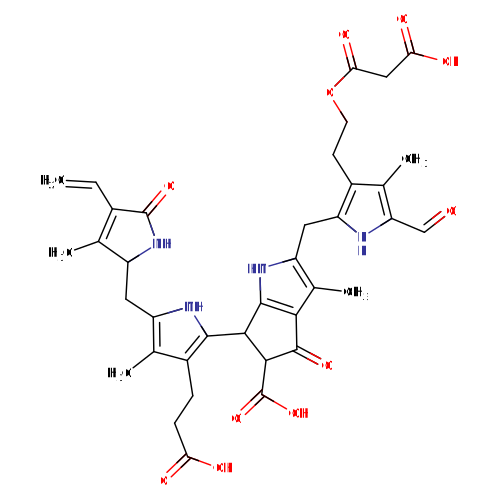
| Description | Bn-NCC-1 belongs to the class of organic compounds known as tetrapyrroles and derivatives. These are polycyclic aromatic compounds containing four pyrrole rings joined by one-carbon units linking position 2 of one pyrrole ring to position 5 of the next. Bn-NCC-1 was first documented in 1996 (PMID: 8910294). Based on a literature review a small amount of articles have been published on Bn-NCC-1 (PMID: 9788143) (PMID: 9681016) (PMID: 9490749). |
|---|
| Structure | CC1=C(C=C)C(=O)NC1CC1=C(C)C(CCC(O)=O)=C(N1)C1C(C(O)=O)C(=O)C2=C1NC(CC1=C(CCOC(=O)CC(O)=O)C(C)=C(N1)C=O)=C2C InChI=1/C37H40N4O11/c1-6-19-15(2)23(41-36(19)49)11-22-17(4)21(7-8-27(43)44)33(39-22)31-32(37(50)51)35(48)30-18(5)24(40-34(30)31)12-25-20(16(3)26(14-42)38-25)9-10-52-29(47)13-28(45)46/h6,14,23,31-32,38-40H,1,7-13H2,2-5H3,(H,41,49)(H,43,44)(H,45,46)(H,50,51) |
|---|
| Synonyms | Not Available |
|---|
| Chemical Formula | C37H40N4O11 |
|---|
| Average Mass | 716.7440 Da |
|---|
| Monoisotopic Mass | 716.26936 Da |
|---|
| IUPAC Name | 2-[(3-{2-[(2-carboxyacetyl)oxy]ethyl}-5-formyl-4-methyl-1H-pyrrol-2-yl)methyl]-6-[3-(2-carboxyethyl)-5-[(4-ethenyl-3-methyl-5-oxo-2,5-dihydro-1H-pyrrol-2-yl)methyl]-4-methyl-1H-pyrrol-2-yl]-3-methyl-4-oxo-1H,4H,5H,6H-cyclopenta[b]pyrrole-5-carboxylic acid |
|---|
| Traditional Name | 2-[(3-{2-[(2-carboxyacetyl)oxy]ethyl}-5-formyl-4-methyl-1H-pyrrol-2-yl)methyl]-6-[3-(2-carboxyethyl)-5-[(4-ethenyl-3-methyl-5-oxo-1,2-dihydropyrrol-2-yl)methyl]-4-methyl-1H-pyrrol-2-yl]-3-methyl-4-oxo-1H,5H,6H-cyclopenta[b]pyrrole-5-carboxylic acid |
|---|
| CAS Registry Number | Not Available |
|---|
| SMILES | CC1=C(C=C)C(=O)NC1CC1=C(C)C(CCC(O)=O)=C(N1)C1C(C(O)=O)C(=O)C2=C1NC(CC1=C(CCOC(=O)CC(O)=O)C(C)=C(N1)C=O)=C2C |
|---|
| InChI Identifier | InChI=1/C37H40N4O11/c1-6-19-15(2)23(41-36(19)49)11-22-17(4)21(7-8-27(43)44)33(39-22)31-32(37(50)51)35(48)30-18(5)24(40-34(30)31)12-25-20(16(3)26(14-42)38-25)9-10-52-29(47)13-28(45)46/h6,14,23,31-32,38-40H,1,7-13H2,2-5H3,(H,41,49)(H,43,44)(H,45,46)(H,50,51) |
|---|
| InChI Key | GVQYIMKPSDOTAH-UHFFFAOYNA-N |
|---|
| Experimental Spectra |
|---|
|
| Not Available | | Predicted Spectra |
|---|
|
| Not Available | | Chemical Shift Submissions |
|---|
|
| Not Available | | Species |
|---|
| Species of Origin | Not Available |
|---|
| Chemical Taxonomy |
|---|
| Description | This compound belongs to the class of organic compounds known as tetrapyrroles and derivatives. These are polycyclic aromatic compounds containing four pyrrole rings joined by one-carbon units linking position 2 of one pyrrole ring to position 5 of the next. |
|---|
| Kingdom | Organic compounds |
|---|
| Super Class | Organoheterocyclic compounds |
|---|
| Class | Tetrapyrroles and derivatives |
|---|
| Sub Class | Not Available |
|---|
| Direct Parent | Tetrapyrroles and derivatives |
|---|
| Alternative Parents | |
|---|
| Substituents | - Tetrapyrrole skeleton
- Tetracarboxylic acid or derivatives
- Aryl ketone
- Aryl alkyl ketone
- Aryl-aldehyde
- Substituted pyrrole
- 1,3-dicarbonyl compound
- Pyrrole
- Pyrroline
- Heteroaromatic compound
- Vinylogous amide
- Carboxamide group
- Carboxylic acid ester
- Ketone
- Lactam
- Secondary carboxylic acid amide
- Azacycle
- Carboxylic acid derivative
- Carboxylic acid
- Organonitrogen compound
- Organic nitrogen compound
- Organic oxygen compound
- Carbonyl group
- Organopnictogen compound
- Organic oxide
- Hydrocarbon derivative
- Organooxygen compound
- Aldehyde
- Aromatic heteropolycyclic compound
|
|---|
| Molecular Framework | Aromatic heteropolycyclic compounds |
|---|
| External Descriptors | Not Available |
|---|
| Physical Properties |
|---|
| State | Not Available |
|---|
| Experimental Properties | | Property | Value | Reference |
|---|
| Melting Point | Not Available | Not Available | | Boiling Point | Not Available | Not Available | | Water Solubility | Not Available | Not Available | | LogP | Not Available | Not Available |
|
|---|
| Predicted Properties | |
|---|
| General References | - Hortensteiner S: NCC malonyltransferase catalyses the final step of chlorophyll breakdown in rape (Brassica napus). Phytochemistry. 1998 Oct;49(4):953-6. doi: 10.1016/s0031-9422(98)00001-6. [PubMed:9788143 ]
- Tommasini R, Vogt E, Fromenteau M, Hortensteiner S, Matile P, Amrhein N, Martinoia E: An ABC-transporter of Arabidopsis thaliana has both glutathione-conjugate and chlorophyll catabolite transport activity. Plant J. 1998 Mar;13(6):773-80. doi: 10.1046/j.1365-313x.1998.00076.x. [PubMed:9681016 ]
- Lu YP, Li ZS, Drozdowicz YM, Hortensteiner S, Martinoia E, Rea PA: AtMRP2, an Arabidopsis ATP binding cassette transporter able to transport glutathione S-conjugates and chlorophyll catabolites: functional comparisons with Atmrp1. Plant Cell. 1998 Feb;10(2):267-82. doi: 10.1105/tpc.10.2.267. [PubMed:9490749 ]
- Hinder B, Schellenberg M, Rodoni S, Ginsburg S, Vogt E, Martinoia E, Matile P, Hortensteiner S: How plants dispose of chlorophyll catabolites. Directly energized uptake of tetrapyrrolic breakdown products into isolated vacuoles. J Biol Chem. 1996 Nov 1;271(44):27233-6. doi: 10.1074/jbc.271.44.27233. [PubMed:8910294 ]
|
|---|