| Record Information |
|---|
| Version | 2.0 |
|---|
| Created at | 2024-09-11 02:01:24 UTC |
|---|
| Updated at | 2024-09-11 02:01:25 UTC |
|---|
| NP-MRD ID | NP0335528 |
|---|
| Secondary Accession Numbers | None |
|---|
| Natural Product Identification |
|---|
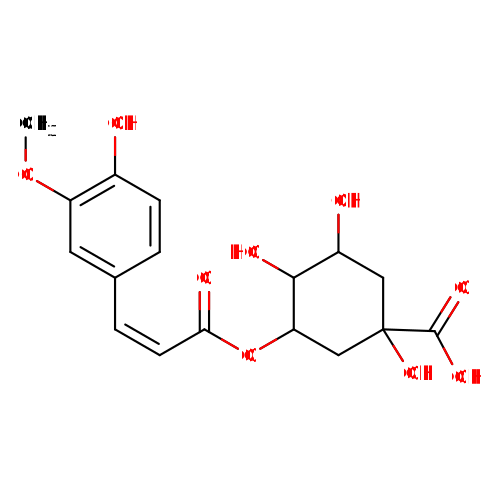
| Common Name | 3-O-Caffeoyl-4-O-methylquinic acid |
|---|
| Description | 3-O-Caffeoyl-4-O-methylquinic acid belongs to the class of organic compounds known as quinic acids and derivatives. Quinic acids and derivatives are compounds containing a quinic acid moiety (or a derivative thereof), which is a cyclitol made up of a cyclohexane ring that bears four hydroxyl groups at positions 1,3.4, And 5, as well as a carboxylic acid at position 1. 3-O-Caffeoyl-4-O-methylquinic acid was first documented in 2024 (PMID: 38774328). Based on a literature review very few articles have been published on 3-O-Caffeoyl-4-O-methylquinic acid. |
|---|
| Structure | COC1=C(O)C=CC(\C=C/C(=O)OC2CC(O)(CC(O)C2O)C(O)=O)=C1 InChI=1/C17H20O9/c1-25-12-6-9(2-4-10(12)18)3-5-14(20)26-13-8-17(24,16(22)23)7-11(19)15(13)21/h2-6,11,13,15,18-19,21,24H,7-8H2,1H3,(H,22,23)/b5-3- |
|---|
| Synonyms | | Value | Source |
|---|
| 3-O-Caffeoyl-4-O-methylquinate | Generator |
|
|---|
| Chemical Formula | C17H20O9 |
|---|
| Average Mass | 368.3380 Da |
|---|
| Monoisotopic Mass | 368.11073 Da |
|---|
| IUPAC Name | 1,3,4-trihydroxy-5-{[(2Z)-3-(4-hydroxy-3-methoxyphenyl)prop-2-enoyl]oxy}cyclohexane-1-carboxylic acid |
|---|
| Traditional Name | 1,3,4-trihydroxy-5-{[(2Z)-3-(4-hydroxy-3-methoxyphenyl)prop-2-enoyl]oxy}cyclohexane-1-carboxylic acid |
|---|
| CAS Registry Number | Not Available |
|---|
| SMILES | COC1=C(O)C=CC(\C=C/C(=O)OC2CC(O)(CC(O)C2O)C(O)=O)=C1 |
|---|
| InChI Identifier | InChI=1/C17H20O9/c1-25-12-6-9(2-4-10(12)18)3-5-14(20)26-13-8-17(24,16(22)23)7-11(19)15(13)21/h2-6,11,13,15,18-19,21,24H,7-8H2,1H3,(H,22,23)/b5-3- |
|---|
| InChI Key | RAGZUCNPTLULOL-HYXAFXHYNA-N |
|---|
| Experimental Spectra |
|---|
|
| Not Available | | Predicted Spectra |
|---|
|
| Not Available | | Chemical Shift Submissions |
|---|
|
| Not Available | | Species |
|---|
| Species of Origin | Not Available |
|---|
| Chemical Taxonomy |
|---|
| Description | This compound belongs to the class of organic compounds known as quinic acids and derivatives. These are compounds containing a quinic acid moiety (or a derivative thereof), which is a cyclitol made up of a cyclohexane ring that bears four hydroxyl groups at positions 1,3.4, And 5, as well as a carboxylic acid at position 1. |
|---|
| Kingdom | Organic compounds |
|---|
| Super Class | Organic oxygen compounds |
|---|
| Class | Organooxygen compounds |
|---|
| Sub Class | Alcohols and polyols |
|---|
| Direct Parent | Quinic acids and derivatives |
|---|
| Alternative Parents | |
|---|
| Substituents | - Quinic acid
- Cinnamic acid or derivatives
- Coumaric acid or derivatives
- Hydroxycinnamic acid or derivatives
- Cinnamic acid ester
- Methoxyphenol
- Phenoxy compound
- Phenol ether
- Anisole
- Methoxybenzene
- Styrene
- 1-hydroxy-2-unsubstituted benzenoid
- Cyclohexanol
- Fatty acid ester
- Alkyl aryl ether
- Phenol
- Benzenoid
- Monocyclic benzene moiety
- Hydroxy acid
- Dicarboxylic acid or derivatives
- Alpha-hydroxy acid
- Fatty acyl
- Alpha,beta-unsaturated carboxylic ester
- Enoate ester
- Tertiary alcohol
- Secondary alcohol
- Carboxylic acid ester
- Carboxylic acid derivative
- Polyol
- Carboxylic acid
- Ether
- Hydrocarbon derivative
- Carbonyl group
- Organic oxide
- Aromatic homomonocyclic compound
|
|---|
| Molecular Framework | Aromatic homomonocyclic compounds |
|---|
| External Descriptors | Not Available |
|---|
| Physical Properties |
|---|
| State | Not Available |
|---|
| Experimental Properties | | Property | Value | Reference |
|---|
| Melting Point | Not Available | Not Available | | Boiling Point | Not Available | Not Available | | Water Solubility | Not Available | Not Available | | LogP | Not Available | Not Available |
|
|---|
| Predicted Properties | |
|---|