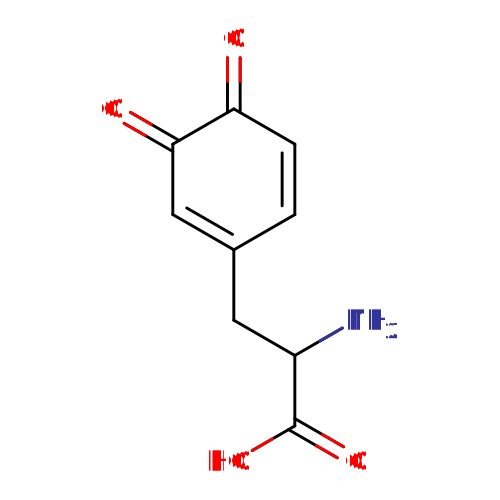
| Record Information |
|---|
| Version | 2.0 |
|---|
| Created at | 2024-09-11 00:48:19 UTC |
|---|
| Updated at | 2024-09-11 00:48:19 UTC |
|---|
| NP-MRD ID | NP0335263 |
|---|
| Secondary Accession Numbers | None |
|---|
| Natural Product Identification |
|---|
| Common Name | L-Dopaquinone |
|---|
| Description | L-Dopaquinone belongs to the class of organic compounds known as alpha amino acids. These are amino acids in which the amino group is attached to the carbon atom immediately adjacent to the carboxylate group (alpha carbon). L-Dopaquinone was first documented in 2006 (PMID: 16784814). Based on a literature review a significant number of articles have been published on L-Dopaquinone (PMID: 39304291) (PMID: 34662013) (PMID: 35964734) (PMID: 35850043) (PMID: 33542935) (PMID: 33211468). |
|---|
| Structure | NC(CC1=CC(=O)C(=O)C=C1)C(O)=O InChI=1/C9H9NO4/c10-6(9(13)14)3-5-1-2-7(11)8(12)4-5/h1-2,4,6H,3,10H2,(H,13,14) |
|---|
| Synonyms | Not Available |
|---|
| Chemical Formula | C9H9NO4 |
|---|
| Average Mass | 195.1740 Da |
|---|
| Monoisotopic Mass | 195.05316 Da |
|---|
| IUPAC Name | 2-amino-3-(3,4-dioxocyclohexa-1,5-dien-1-yl)propanoic acid |
|---|
| Traditional Name | 2-amino-3-(3,4-dioxocyclohexa-1,5-dien-1-yl)propanoic acid |
|---|
| CAS Registry Number | Not Available |
|---|
| SMILES | NC(CC1=CC(=O)C(=O)C=C1)C(O)=O |
|---|
| InChI Identifier | InChI=1/C9H9NO4/c10-6(9(13)14)3-5-1-2-7(11)8(12)4-5/h1-2,4,6H,3,10H2,(H,13,14) |
|---|
| InChI Key | AHMIDUVKSGCHAU-UHFFFAOYNA-N |
|---|
| Experimental Spectra |
|---|
|
| Not Available | | Predicted Spectra |
|---|
|
| Not Available | | Chemical Shift Submissions |
|---|
|
| Not Available | | Species |
|---|
| Species of Origin | Not Available |
|---|
| Chemical Taxonomy |
|---|
| Description | This compound belongs to the class of organic compounds known as alpha amino acids. These are amino acids in which the amino group is attached to the carbon atom immediately adjacent to the carboxylate group (alpha carbon). |
|---|
| Kingdom | Organic compounds |
|---|
| Super Class | Organic acids and derivatives |
|---|
| Class | Carboxylic acids and derivatives |
|---|
| Sub Class | Amino acids, peptides, and analogues |
|---|
| Direct Parent | Alpha amino acids |
|---|
| Alternative Parents | |
|---|
| Substituents | - Alpha-amino acid
- O-benzoquinone
- Quinone
- Ketone
- Cyclic ketone
- Amino acid
- Monocarboxylic acid or derivatives
- Carboxylic acid
- Organic nitrogen compound
- Organopnictogen compound
- Primary amine
- Organooxygen compound
- Organonitrogen compound
- Organic oxygen compound
- Primary aliphatic amine
- Carbonyl group
- Hydrocarbon derivative
- Amine
- Organic oxide
- Aliphatic homomonocyclic compound
|
|---|
| Molecular Framework | Aliphatic homomonocyclic compounds |
|---|
| External Descriptors | Not Available |
|---|
| Physical Properties |
|---|
| State | Not Available |
|---|
| Experimental Properties | | Property | Value | Reference |
|---|
| Melting Point | Not Available | Not Available | | Boiling Point | Not Available | Not Available | | Water Solubility | Not Available | Not Available | | LogP | Not Available | Not Available |
|
|---|
| Predicted Properties | |
|---|
| General References | - Di Costanzo LF: Structural characterization of tyrosinases and an update on human enzymes. Enzymes. 2024;56:55-83. doi: 10.1016/bs.enz.2024.06.004. Epub 2024 Aug 6. [PubMed:39304291 ]
- Lui F, Stokkermans TJ: Heterochromia.. 2024 Jan. [PubMed:34662013 ]
- Mine M, Mizuguchi H, Takayanagi T: Kinetic analyses of two-steps oxidation from l-tyrosine to l-dopaquinone with tyrosinase by capillary electrophoresis/dynamic frontal analysis. Anal Biochem. 2022 Oct 15;655:114856. doi: 10.1016/j.ab.2022.114856. Epub 2022 Aug 11. [PubMed:35964734 ]
- Cao S, Wang D, Cheng R, Shi W, Zhang Q, Zeng H, Chen J: Modulation of the lipophilicity and molecular size of thiosemicarbazone inhibitors to regulate tyrosinase activity. Spectrochim Acta A Mol Biomol Spectrosc. 2022 Nov 15;281:121590. doi: 10.1016/j.saa.2022.121590. Epub 2022 Jul 6. [PubMed:35850043 ]
- Shahrisa A, Nikkhah M, Shirzad H, Behzadi R, Sadeghizadeh M: Enhancing Catecholase Activity of a Recombinant Human Tyrosinase Through Multiple Strategies. Iran J Biotechnol. 2020 Apr 1;18(2):e2310. doi: 10.30498/IJB.2020.137293.2310. eCollection 2020 Apr. [PubMed:33542935 ]
- Yang SJ, Zou LY, Liu C, Zhong Q, Ma ZY, Yang J, Ji J, Muller-Buschbaum P, Xu ZK: Codeposition of Levodopa and Polyethyleneimine: Reaction Mechanism and Coating Construction. ACS Appl Mater Interfaces. 2020 Dec 2;12(48):54094-54103. doi: 10.1021/acsami.0c16142. Epub 2020 Nov 19. [PubMed:33211468 ]
- Wu YC, Wang IJ: Heat-shock-induced tyrosinase gene ablation with CRISPR in zebrafish. Mol Genet Genomics. 2020 Jul;295(4):911-922. doi: 10.1007/s00438-020-01681-x. Epub 2020 May 4. [PubMed:32367255 ]
- VanArsdale E, Hornstrom D, Sjoberg G, Jarbur I, Pitzer J, Payne GF, van Maris AJA, Bentley WE: A Coculture Based Tyrosine-Tyrosinase Electrochemical Gene Circuit for Connecting Cellular Communication with Electronic Networks. ACS Synth Biol. 2020 May 15;9(5):1117-1128. doi: 10.1021/acssynbio.9b00469. Epub 2020 Apr 2. [PubMed:32208720 ]
- Yu L, Chen L, Luo G, Liu L, Zhu W, Yan P, Zhang P, Zhang C, Wu W: Study on Synthesis and Biological Evaluation of 3-Aryl Substituted Xanthone Derivatives as Novel and Potent Tyrosinase Inhibitors. Chem Pharm Bull (Tokyo). 2019 Nov 1;67(11):1232-1241. doi: 10.1248/cpb.c19-00572. Epub 2019 Sep 6. [PubMed:31495804 ]
- Ochiai A, Tanaka S, Imai Y, Yoshida H, Kanaoka T, Tanaka T, Taniguchi M: New tyrosinase inhibitory decapeptide: Molecular insights into the role of tyrosine residues. J Biosci Bioeng. 2016 Jun;121(6):607-613. doi: 10.1016/j.jbiosc.2015.10.010. Epub 2015 Nov 14. [PubMed:26589783 ]
- Fogal S, Carotti M, Giaretta L, Lanciai F, Nogara L, Bubacco L, Bergantino E: Human tyrosinase produced in insect cells: a landmark for the screening of new drugs addressing its activity. Mol Biotechnol. 2015 Jan;57(1):45-57. doi: 10.1007/s12033-014-9800-y. [PubMed:25189462 ]
- Yi W, Dubois C, Yahiaoui S, Haudecoeur R, Belle C, Song H, Hardre R, Reglier M, Boumendjel A: Refinement of arylthiosemicarbazone pharmacophore in inhibition of mushroom tyrosinase. Eur J Med Chem. 2011 Sep;46(9):4330-5. doi: 10.1016/j.ejmech.2011.07.003. Epub 2011 Jul 8. [PubMed:21777998 ]
- Gasowska B, Frackowiak B, Wojtasek H: Indirect oxidation of amino acid phenylhydrazides by mushroom tyrosinase. Biochim Biophys Acta. 2006 Sep;1760(9):1373-9. doi: 10.1016/j.bbagen.2006.05.001. Epub 2006 May 16. [PubMed:16784814 ]
- Lavado A, Jeffery G, Tovar V, de la Villa P, Montoliu L: Ectopic expression of tyrosine hydroxylase in the pigmented epithelium rescues the retinal abnormalities and visual function common in albinos in the absence of melanin. J Neurochem. 2006 Feb;96(4):1201-11. doi: 10.1111/j.1471-4159.2006.03657.x. [PubMed:16445854 ]
|
|---|