| Record Information |
|---|
| Version | 2.0 |
|---|
| Created at | 2024-09-10 22:47:43 UTC |
|---|
| Updated at | 2024-09-10 22:47:43 UTC |
|---|
| NP-MRD ID | NP0334854 |
|---|
| Secondary Accession Numbers | None |
|---|
| Natural Product Identification |
|---|
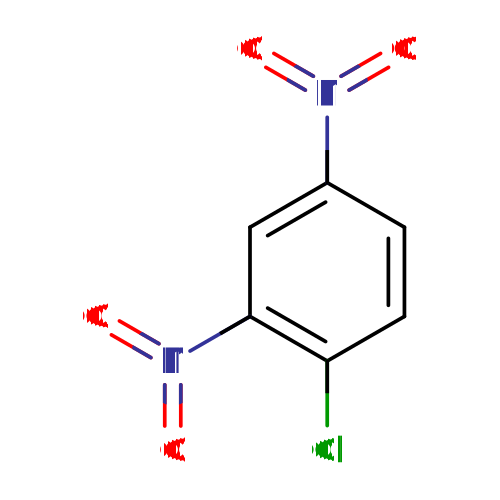
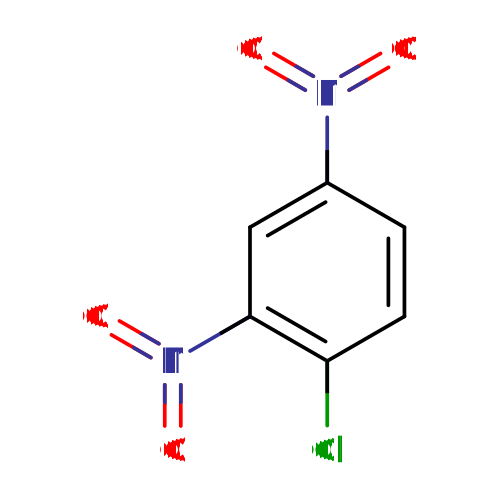
| Common Name | 1-chloro-2,4-dinitrobenzene |
|---|
| Description | 1-chloro-2,4-dinitrobenzene was first documented in 1975 (PMID: 1155304). |
|---|
| Structure | ClC1=C(C=C(C=C1)N(=O)=O)N(=O)=O InChI=1S/C6H3ClN2O4/c7-5-2-1-4(8(10)11)3-6(5)9(12)13/h1-3H |
|---|
| Synonyms | | Value | Source |
|---|
| 1,3-Dinitro-4-chlorobenzene | ChEBI | | 1-Chloro-2,4-dinitrobenzol | ChEBI | | 2,4-Dinitro-1-chlorobenzene | ChEBI | | 2,4-Dinitrochlorobenzene | ChEBI | | 2,4-Dinitrophenyl chloride | ChEBI | | 4-Chloro-1,3-dinitrobenzene | ChEBI | | 6-Chloro-1,3-dinitrobenzene | ChEBI | | CDNB | ChEBI | | Chlorodinitrobenzene | ChEBI | | CLDNB | ChEBI | | DNCB | ChEBI | | DNPCL | ChEBI | | 1-Chloro-2,4-dinitrobenzene | Kegg | | Dinitrochlorobenzene | ChEBI | | 1 chloro 2,4 Dinitrobenzene | MeSH |
|
|---|
| Chemical Formula | C6H3ClN2O4 |
|---|
| Average Mass | 202.5520 Da |
|---|
| Monoisotopic Mass | 201.97813 Da |
|---|
| IUPAC Name | 1-chloro-2,4-dinitrobenzene |
|---|
| Traditional Name | Cdnb |
|---|
| CAS Registry Number | Not Available |
|---|
| SMILES | ClC1=C(C=C(C=C1)N(=O)=O)N(=O)=O |
|---|
| InChI Identifier | InChI=1S/C6H3ClN2O4/c7-5-2-1-4(8(10)11)3-6(5)9(12)13/h1-3H |
|---|
| InChI Key | VYZAHLCBVHPDDF-UHFFFAOYSA-N |
|---|
| Experimental Spectra |
|---|
|
| | Spectrum Type | Description | Depositor Email | Depositor Organization | Depositor | Deposition Date | View |
|---|
| 1D NMR | 1H NMR Spectrum (1D, 300 MHz, N-methylacetamide, experimental) | Wishart Lab | Wishart Lab | David Wishart | 2021-06-20 | View Spectrum | | 1D NMR | 13C NMR Spectrum (1D, 25.16 MHz, CDCl3, experimental) | Wishart Lab | Wishart Lab | David Wishart | 2021-06-20 | View Spectrum |
| | Predicted Spectra |
|---|
|
| Not Available | | Chemical Shift Submissions |
|---|
|
| Not Available | | Species |
|---|
| Species of Origin | Not Available |
|---|
| Chemical Taxonomy |
|---|
| Description | Belongs to the class of organic compounds known as nitrobenzenes. Nitrobenzenes are compounds containing a nitrobenzene moiety, which consists of a benzene ring with a carbon bearing a nitro group. |
|---|
| Kingdom | Organic compounds |
|---|
| Super Class | Benzenoids |
|---|
| Class | Benzene and substituted derivatives |
|---|
| Sub Class | Nitrobenzenes |
|---|
| Direct Parent | Nitrobenzenes |
|---|
| Alternative Parents | |
|---|
| Substituents | - Nitrobenzene
- Nitroaromatic compound
- Chlorobenzene
- Halobenzene
- Aryl chloride
- Aryl halide
- C-nitro compound
- Organic nitro compound
- Organic 1,3-dipolar compound
- Propargyl-type 1,3-dipolar organic compound
- Allyl-type 1,3-dipolar organic compound
- Organic oxoazanium
- Organic nitrogen compound
- Organochloride
- Organohalogen compound
- Organonitrogen compound
- Hydrocarbon derivative
- Organic oxide
- Organopnictogen compound
- Organic oxygen compound
- Aromatic homomonocyclic compound
|
|---|
| Molecular Framework | Aromatic homomonocyclic compounds |
|---|
| External Descriptors | |
|---|
| Physical Properties |
|---|
| State | Not Available |
|---|
| Experimental Properties | | Property | Value | Reference |
|---|
| Melting Point | Not Available | Not Available | | Boiling Point | Not Available | Not Available | | Water Solubility | Not Available | Not Available | | LogP | Not Available | Not Available |
|
|---|
| Predicted Properties | |
|---|
| General References | - Dearman RJ, Basketter DA, Kimber I: Variable effects of chemical allergens on serum IgE concentration in mice. Preliminary evaluation of a novel approach to the identification of respiratory sensitizers. J Appl Toxicol. 1992 Oct;12(5):317-23. doi: 10.1002/jat.2550120505. [PubMed:1447476 ]
- Maurer T, Thomann P, Weirich EG, Hess R: The optimization test in the guinea-pig. A method for the predictive evaluation of the contact allergenicity of chemicals. Agents Actions. 1975 May;5(2):174-9. doi: 10.1007/BF02027360. [PubMed:1155304 ]
- Kato H, Hayashi M, Fukumori Y, Kaneko H: MHC restriction in contact hypersensitivity to dicyclohexylcarbodiimide. Food Chem Toxicol. 2002 Nov;40(11):1713-8. doi: 10.1016/s0278-6915(02)00132-1. [PubMed:12176098 ]
- Palmer RA, Friedmann PS: Ultraviolet radiation causes less immunosuppression in patients with polymorphic light eruption than in controls. J Invest Dermatol. 2004 Feb;122(2):291-4. doi: 10.1046/j.0022-202X.2004.22213.x. [PubMed:15009707 ]
- Hopkins JE, Naisbitt DJ, Humphreys N, Dearman RJ, Kimber I, Park BK: Exposure of mice to the nitroso metabolite of sulfamethoxazole stimulates interleukin 5 production by CD4+ T-cells. Toxicology. 2005 Jan 15;206(2):221-31. doi: 10.1016/j.tox.2004.08.010. [PubMed:15588915 ]
|
|---|