| Record Information |
|---|
| Version | 2.0 |
|---|
| Created at | 2024-09-10 20:03:11 UTC |
|---|
| Updated at | 2024-09-10 20:03:11 UTC |
|---|
| NP-MRD ID | NP0334808 |
|---|
| Secondary Accession Numbers | None |
|---|
| Natural Product Identification |
|---|
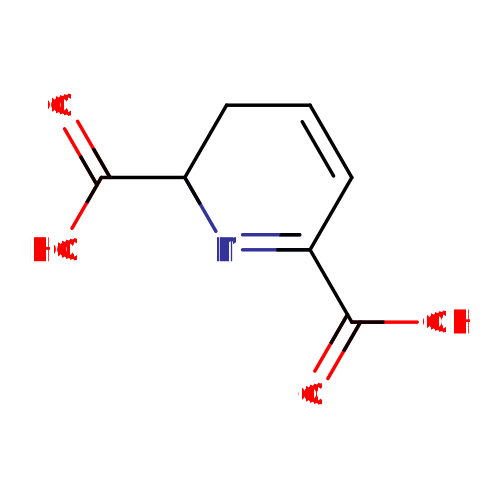
| Common Name | L-2,3-Dihydrodipicolinate |
|---|
| Description | L-2,3-Dihydrodipicolinate belongs to the class of organic compounds known as alpha amino acids and derivatives. These are amino acids in which the amino group is attached to the carbon atom immediately adjacent to the carboxylate group (alpha carbon), or a derivative thereof. L-2,3-Dihydrodipicolinate was first documented in 2016 (PMID: 26750477). Based on a literature review a small amount of articles have been published on L-2,3-Dihydrodipicolinate (PMID: 37875653). |
|---|
| Structure | InChI=1/C7H7NO4/c9-6(10)4-2-1-3-5(8-4)7(11)12/h1-2,5H,3H2,(H,9,10)(H,11,12) |
|---|
| Synonyms | | Value | Source |
|---|
| L-2,3-Dihydrodipicolinic acid | Generator |
|
|---|
| Chemical Formula | C7H7NO4 |
|---|
| Average Mass | 169.1360 Da |
|---|
| Monoisotopic Mass | 169.03751 Da |
|---|
| IUPAC Name | 2,3-dihydropyridine-2,6-dicarboxylic acid |
|---|
| Traditional Name | 2,3-dihydrodipicolinic acid |
|---|
| CAS Registry Number | Not Available |
|---|
| SMILES | OC(=O)C1CC=CC(=N1)C(O)=O |
|---|
| InChI Identifier | InChI=1/C7H7NO4/c9-6(10)4-2-1-3-5(8-4)7(11)12/h1-2,5H,3H2,(H,9,10)(H,11,12) |
|---|
| InChI Key | UWOCFOFVIBZJGH-UHFFFAOYNA-N |
|---|
| Experimental Spectra |
|---|
|
| Not Available | | Predicted Spectra |
|---|
|
| Not Available | | Chemical Shift Submissions |
|---|
|
| Not Available | | Species |
|---|
| Species of Origin | Not Available |
|---|
| Chemical Taxonomy |
|---|
| Description | This compound belongs to the class of organic compounds known as alpha amino acids and derivatives. These are amino acids in which the amino group is attached to the carbon atom immediately adjacent to the carboxylate group (alpha carbon), or a derivative thereof. |
|---|
| Kingdom | Organic compounds |
|---|
| Super Class | Organic acids and derivatives |
|---|
| Class | Carboxylic acids and derivatives |
|---|
| Sub Class | Amino acids, peptides, and analogues |
|---|
| Direct Parent | Alpha amino acids and derivatives |
|---|
| Alternative Parents | |
|---|
| Substituents | - Alpha-amino acid or derivatives
- Dihydropyridinecarboxylic acid derivative
- Dihydropyridine
- Dicarboxylic acid or derivatives
- Hydropyridine
- Ketimine
- Carboxylic acid
- Azacycle
- Propargyl-type 1,3-dipolar organic compound
- Organic 1,3-dipolar compound
- Organoheterocyclic compound
- Organic nitrogen compound
- Imine
- Hydrocarbon derivative
- Organic oxide
- Organopnictogen compound
- Organonitrogen compound
- Organooxygen compound
- Carbonyl group
- Organic oxygen compound
- Aliphatic heteromonocyclic compound
|
|---|
| Molecular Framework | Aliphatic heteromonocyclic compounds |
|---|
| External Descriptors | |
|---|
| Physical Properties |
|---|
| State | Not Available |
|---|
| Experimental Properties | | Property | Value | Reference |
|---|
| Melting Point | Not Available | Not Available | | Boiling Point | Not Available | Not Available | | Water Solubility | Not Available | Not Available | | LogP | Not Available | Not Available |
|
|---|
| Predicted Properties | |
|---|
| General References | - Chen Y, Chen S, Xu C, Yu L, Chu S, Bao J, Wang J, Wang J: Identification of Diagnostic Biomarkers for Compensatory Liver Cirrhosis Based on Gut Microbiota and Urine Metabolomics Analyses. Mol Biotechnol. 2023 Oct 24. doi: 10.1007/s12033-023-00922-9. [PubMed:37875653 ]
- Naqvi KF, Staker BL, Dobson RC, Serbzhinskiy D, Sankaran B, Myler PJ, Hudson AO: Cloning, expression, purification, crystallization and X-ray diffraction analysis of dihydrodipicolinate synthase from the human pathogenic bacterium Bartonella henselae strain Houston-1 at 2.1 A resolution. Acta Crystallogr F Struct Biol Commun. 2016 Jan;72(Pt 1):2-9. doi: 10.1107/S2053230X15023213. Epub 2016 Jan 1. [PubMed:26750477 ]
|
|---|