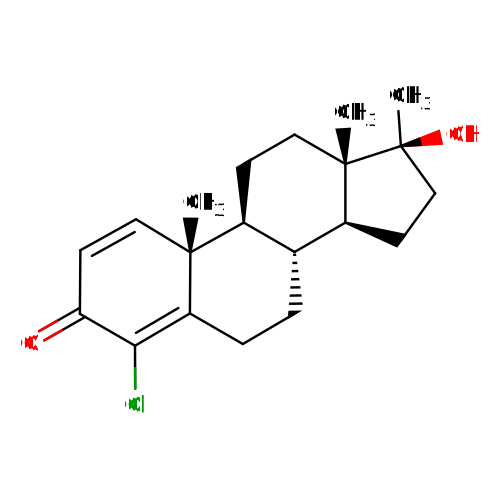
| Record Information |
|---|
| Version | 2.0 |
|---|
| Created at | 2024-09-10 19:43:23 UTC |
|---|
| Updated at | 2024-09-10 19:43:24 UTC |
|---|
| NP-MRD ID | NP0334732 |
|---|
| Secondary Accession Numbers | None |
|---|
| Natural Product Identification |
|---|
| Common Name | 4-Chloromethandienone |
|---|
| Description | 4-Chloromethandienone, also known as 4-chlorodianabol or CDMT, belongs to the class of organic compounds known as androgens and derivatives. These are 3-hydroxylated C19 steroid hormones. They are known to favor the development of masculine characteristics. They also show profound effects on scalp and body hair in humans. 4-Chloromethandienone is an extremely weak basic (essentially neutral) compound (based on its pKa). The doping was done in secret; it was only in the 1990s that Franke and Berendonk looked closely at the original archived information and discovered the true scope of just how well-planned and successful the doping regime had been (in terms of medal success and world record performances). Following allegations by the German documentary of widespread doping the IOC kicked off a reanalysis of Beijing 2008 and London 2012 samples for all sports. Weightlifters and sprinters in particular were found to have used CDMT. The idea of combining the structures of 4-chlorotestosterone (clostebol) and metandienone originated from the chemist Albert Stachowiak. It is the 4-chloro-substituted derivative of metandienone (dehydromethyltestosterone). The doping program was run by the East German Government from about 1968 until 1989 when the GDR collapsed. CDMT was the key steroid administered to approximately 10,000 athletes from East Germany (GDR) as secret official policy, often without their knowing the nature of the "vitamins" they were forced to take. Most of the doped athletes coming from Russia, Ukraine, and Belarus. The product had been introduced for clinical use from 1965 until 1994 when its production was discontinued. 4-Chloromethandienone was first documented in 1999 (PMID: 10526287). ChlorodehydromethyltestosteroneCDMT was the first original product of Jenapharm, an East German pharmaceutical company. |
|---|
| Structure | [H][C@@]12CC[C@](C)(O)[C@@]1(C)CC[C@@]1([H])[C@@]2([H])CCC2=C(Cl)C(=O)C=C[C@]12C InChI=1S/C20H27ClO2/c1-18-9-8-16(22)17(21)15(18)5-4-12-13(18)6-10-19(2)14(12)7-11-20(19,3)23/h8-9,12-14,23H,4-7,10-11H2,1-3H3/t12-,13+,14+,18-,19+,20+/m1/s1 |
|---|
| Synonyms | | Value | Source |
|---|
| (17b)-4-Chloro-17-hydroxy-17-methyl-androsta-1,4-dien-3-one | HMDB | | 1-Dehydro-4-chloro-17-methyltestosterone | HMDB | | 1-Dehydro-4-chloro-17a-methyltestosterone | HMDB | | 4-Chloro-1,2-dehydro-17a-methyltestosterone | HMDB | | 4-Chloro-1-dehydro-17-methyltestosterone | HMDB | | 4-Chloro-1-dehydromethyltestosterone | HMDB | | 4-Chloro-17a-methyl-17b-hydroxyandrosta-1,4-dien-3-one | HMDB | | 4-Chloro-17b-hydroxy-17-methyl-androsta-1,4-dien-3-one | HMDB | | 4-Chloro-17b-hydroxy-17a-methyl-5a-androsta-1,4-dien-3-one | HMDB | | 4-Chlorodehydromethyltestosterone | HMDB | | 4-Chlorodianabol | HMDB | | CDMT | HMDB | | Oral-turinabol | HMDB | | Turinabol-oral | HMDB | | Dehydrochlormethyltestosterone | HMDB | | D-4-Chloro-17 beta-hydroxy-3-oxo-17 alpha-methylandrosta-1,4-diene | HMDB | | 4-Chloro-methandienone | HMDB | | Oral turinabol | HMDB |
|
|---|
| Chemical Formula | C20H27ClO2 |
|---|
| Average Mass | 334.8800 Da |
|---|
| Monoisotopic Mass | 334.16996 Da |
|---|
| IUPAC Name | (1S,2R,10R,11S,14S,15S)-6-chloro-14-hydroxy-2,14,15-trimethyltetracyclo[8.7.0.0²,⁷.0¹¹,¹⁵]heptadeca-3,6-dien-5-one |
|---|
| Traditional Name | oral turinabol |
|---|
| CAS Registry Number | Not Available |
|---|
| SMILES | [H][C@@]12CC[C@](C)(O)[C@@]1(C)CC[C@@]1([H])[C@@]2([H])CCC2=C(Cl)C(=O)C=C[C@]12C |
|---|
| InChI Identifier | InChI=1S/C20H27ClO2/c1-18-9-8-16(22)17(21)15(18)5-4-12-13(18)6-10-19(2)14(12)7-11-20(19,3)23/h8-9,12-14,23H,4-7,10-11H2,1-3H3/t12-,13+,14+,18-,19+,20+/m1/s1 |
|---|
| InChI Key | AGUNEISBPXQOPA-XMUHMHRVSA-N |
|---|
| Experimental Spectra |
|---|
|
| Not Available | | Predicted Spectra |
|---|
|
| Not Available | | Chemical Shift Submissions |
|---|
|
| Not Available | | Species |
|---|
| Species of Origin | Not Available |
|---|
| Chemical Taxonomy |
|---|
| Description | Belongs to the class of organic compounds known as androgens and derivatives. These are 3-hydroxylated C19 steroid hormones. They are known to favor the development of masculine characteristics. They also show profound effects on scalp and body hair in humans. |
|---|
| Kingdom | Organic compounds |
|---|
| Super Class | Lipids and lipid-like molecules |
|---|
| Class | Steroids and steroid derivatives |
|---|
| Sub Class | Androstane steroids |
|---|
| Direct Parent | Androgens and derivatives |
|---|
| Alternative Parents | |
|---|
| Substituents | - Androgen-skeleton
- 3-oxo-delta-1,4-steroid
- 3-oxosteroid
- 17-hydroxysteroid
- 4-halo-steroid
- Halo-steroid
- Oxosteroid
- Hydroxysteroid
- Delta-1,4-steroid
- Alpha-haloketone
- Alpha-chloroketone
- Cyclic alcohol
- Tertiary alcohol
- Cyclic ketone
- Ketone
- Chloroalkene
- Haloalkene
- Vinyl halide
- Vinyl chloride
- Alcohol
- Organic oxide
- Organic oxygen compound
- Carbonyl group
- Hydrocarbon derivative
- Organooxygen compound
- Organochloride
- Organohalogen compound
- Aliphatic homopolycyclic compound
|
|---|
| Molecular Framework | Aliphatic homopolycyclic compounds |
|---|
| External Descriptors | Not Available |
|---|
| Physical Properties |
|---|
| State | Not Available |
|---|
| Experimental Properties | | Property | Value | Reference |
|---|
| Melting Point | Not Available | Not Available | | Boiling Point | Not Available | Not Available | | Water Solubility | Not Available | Not Available | | LogP | Not Available | Not Available |
|
|---|
| Predicted Properties | |
|---|