Np mrd loader

Record Information
Version2.0
Created at2024-09-10 19:38:50 UTC
Updated at2024-09-10 19:38:50 UTC
NP-MRD IDNP0334714
Secondary Accession NumbersNone
Natural Product Identification
Common NameIduronic acid
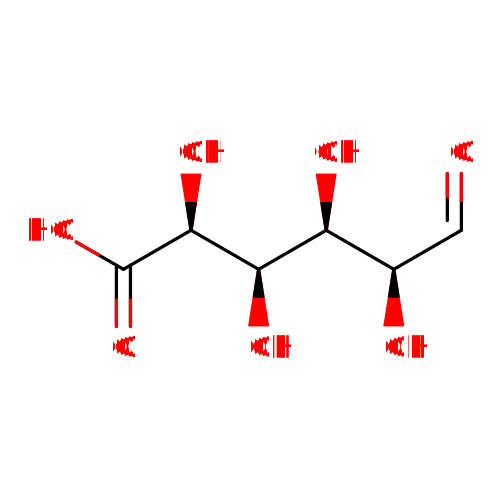
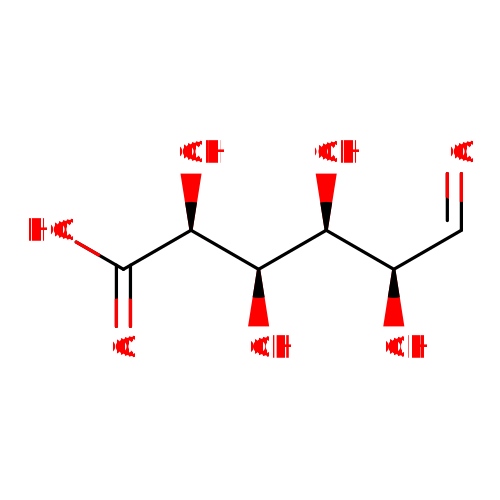
DescriptionIduronic acid, also known as iduronate or acid, iduronic, belongs to the class of organic compounds known as glucuronic acid derivatives. Glucuronic acid derivatives are compounds containing a glucuronic acid moiety (or a derivative), which consists of a glucose moiety with the C6 carbon oxidized to a carboxylic acid. Iduronic acid is an extremely weak basic (essentially neutral) compound (based on its pKa). IdoA is a hexapyranose sugar. L-Iduronic acid (IdoA) is the major uronic acid component of the glycosaminoglycans (GAGs) dermatan sulfate, and heparin. When internally positioned within an oligosaccharide, the 1C4 and 2S0 conformations (shown below for IdoA2S) predominate. IdoA may be modified by the addition of an O-sulfate group at carbon position 2 to form 2-O-sulfo-l-iduronic acid (IdoA2S). Dermatan sulfate and heparan sulfate were the only GAGs containing IdoA, and they were the only ones that inhibited RSV infection in cell culture. These are the 1C4 and 4C1 chair forms and an additional 2S0 skew-boat conformation. It is also present in heparan sulfate although here in a minor amount relative to its carbon-5 epimer glucuronic acid. Most hexapyranoses are stable in one of two chair conformations 1C4 or 4C1. Iduronic acid was first documented in 1978 (PMID: 98232). In 2000, LK Hallak described the importance of this sugar in respiratory syncytial virus (RSV) infection (PMID: 14718373) (PMID: 11746503) (PMID: 3082866) (PMID: 3076283) (PMID: 8466951) (PMID: 8542607).
Structure
Thumb
Synonyms
ValueSource
IduronateGenerator
L-IduronateHMDB
L-Iduronic acidHMDB
Acid, iduronicHMDB
(2S,3R,4R,5S)-2,3,4,5-Tetrahydroxy-6-oxohexanoateHMDB
Iduronic acidMeSH
Chemical FormulaC6H10O7
Average Mass194.1394 Da
Monoisotopic Mass194.04265 Da
IUPAC Name(2S,3R,4R,5S)-2,3,4,5-tetrahydroxy-6-oxohexanoic acid
Traditional Nameiduronic acid
CAS Registry NumberNot Available
SMILES
O[C@H](C=O)[C@H](O)[C@@H](O)[C@H](O)C(O)=O
InChI Identifier
InChI=1S/C6H10O7/c7-1-2(8)3(9)4(10)5(11)6(12)13/h1-5,8-11H,(H,12,13)/t2-,3+,4-,5+/m1/s1
InChI KeyIAJILQKETJEXLJ-LECHCGJUSA-N
Experimental Spectra
Not Available
Predicted Spectra
Not Available
Chemical Shift Submissions
Not Available
Species
Species of OriginNot Available
Chemical Taxonomy
Description Belongs to the class of organic compounds known as glucuronic acid derivatives. Glucuronic acid derivatives are compounds containing a glucuronic acid moiety (or a derivative), which consists of a glucose moiety with the C6 carbon oxidized to a carboxylic acid.
KingdomOrganic compounds
Super ClassOrganic oxygen compounds
ClassOrganooxygen compounds
Sub ClassCarbohydrates and carbohydrate conjugates
Direct ParentGlucuronic acid derivatives
Alternative Parents
Substituents
  • Glucuronic acid or derivatives
  • Hexose monosaccharide
  • Medium-chain hydroxy acid
  • Medium-chain fatty acid
  • Beta-hydroxy acid
  • Hydroxy fatty acid
  • Monosaccharide
  • Fatty acyl
  • Hydroxy acid
  • Fatty acid
  • Alpha-hydroxy acid
  • Beta-hydroxy aldehyde
  • Alpha-hydroxyaldehyde
  • Secondary alcohol
  • Polyol
  • Monocarboxylic acid or derivatives
  • Carboxylic acid
  • Carboxylic acid derivative
  • Aldehyde
  • Carbonyl group
  • Alcohol
  • Organic oxide
  • Hydrocarbon derivative
  • Aliphatic acyclic compound
Molecular FrameworkAliphatic acyclic compounds
External DescriptorsNot Available
Physical Properties
StateNot Available
Experimental Properties
PropertyValueReference
Melting PointNot AvailableNot Available
Boiling PointNot AvailableNot Available
Water SolubilityNot AvailableNot Available
LogPNot AvailableNot Available
Predicted Properties
PropertyValueSource
logP-2.3ALOGPS
logP-3.2ChemAxon
logS-0.29ALOGPS
pKa (Strongest Acidic)3.24ChemAxon
pKa (Strongest Basic)-3.7ChemAxon
Physiological Charge-1ChemAxon
Hydrogen Acceptor Count7ChemAxon
Hydrogen Donor Count5ChemAxon
Polar Surface Area135.29 ŲChemAxon
Rotatable Bond Count5ChemAxon
Refractivity37.21 m³·mol⁻¹ChemAxon
Polarizability16.1 ųChemAxon
Number of Rings0ChemAxon
BioavailabilityYesChemAxon
Rule of FiveYesChemAxon
Ghose FilterNoChemAxon
Veber's RuleNoChemAxon
MDDR-like RuleNoChemAxon
HMDB IDHMDB0002704
DrugBank IDNot Available
Phenol Explorer Compound IDNot Available
FoodDB IDFDB023047
KNApSAcK IDNot Available
Chemspider ID17794
KEGG Compound IDC06472
BioCyc IDNot Available
BiGG ID48353
Wikipedia LinkIduronic acid
METLIN ID3331
PubChem Compound18845
PDB IDNot Available
ChEBI ID24769
Good Scents IDNot Available
References
General References
  1. Fuller M, Meikle PJ, Hopwood JJ: Glycosaminoglycan degradation fragments in mucopolysaccharidosis I. Glycobiology. 2004 May;14(5):443-50. doi: 10.1093/glycob/cwh049. Epub 2004 Jan 12. [PubMed:14718373 ]
  2. Cheng F, Petersson P, Arroyo-Yanguas Y, Westergren-Thorsson G: Differences in the uptake and nuclear localization of anti-proliferative heparan sulfate between human lung fibroblasts and human lung carcinoma cells. J Cell Biochem. 2001;83(4):597-606. doi: 10.1002/jcb.1254. [PubMed:11746503 ]
  3. Inoue H, Otsu K, Suzuki S, Nakanishi Y: Difference between N-acetylgalactosamine 4-sulfate 6-O-sulfotransferases from human serum and squid cartilage in specificity toward the terminal and interior portion of chondroitin sulfate. J Biol Chem. 1986 Apr 5;261(10):4470-5. [PubMed:3082866 ]
  4. Ginsberg LC, Di Ferrante DT, Di Ferrante N: A substrate for direct measurement of L-iduronic acid 2-sulfate sulfatase. Carbohydr Res. 1978 Jul;64:225-35. doi: 10.1016/s0008-6215(00)83703-9. [PubMed:98232 ]
  5. Casu B, Petitou M, Provasoli M, Sinay P: Conformational flexibility: a new concept for explaining binding and biological properties of iduronic acid-containing glycosaminoglycans. Trends Biochem Sci. 1988 Jun;13(6):221-5. doi: 10.1016/0968-0004(88)90088-6. [PubMed:3076283 ]
  6. Gigli M, Ghiselli G, Torri G, Naggi A, Rizzo V: A comparative study of low-density lipoprotein interaction with glycosaminoglycans. Biochim Biophys Acta. 1993 Apr 7;1167(2):211-7. doi: 10.1016/0005-2760(93)90164-5. [PubMed:8466951 ]
  7. Bartolucci C, Cellai L, Iannelli MA, Lamba D, Liverani L, Mascellani G, Perola E: Inhibition of human leukocyte elastase by chemically and naturally oversulfated galactosaminoglycans. Carbohydr Res. 1995 Oct 23;276(2):401-8. doi: 10.1016/0008-6215(95)00179-w. [PubMed:8542607 ]
  8. Mulloy B, Forster MJ: Conformation and dynamics of heparin and heparan sulfate. Glycobiology. 2000 Nov;10(11):1147-56. doi: 10.1093/glycob/10.11.1147. [PubMed:11087707 ]