| Record Information |
|---|
| Version | 2.0 |
|---|
| Created at | 2024-09-10 19:32:57 UTC |
|---|
| Updated at | 2024-09-10 19:32:57 UTC |
|---|
| NP-MRD ID | NP0334692 |
|---|
| Secondary Accession Numbers | None |
|---|
| Natural Product Identification |
|---|
| Common Name | myristoyl-CoA |
|---|
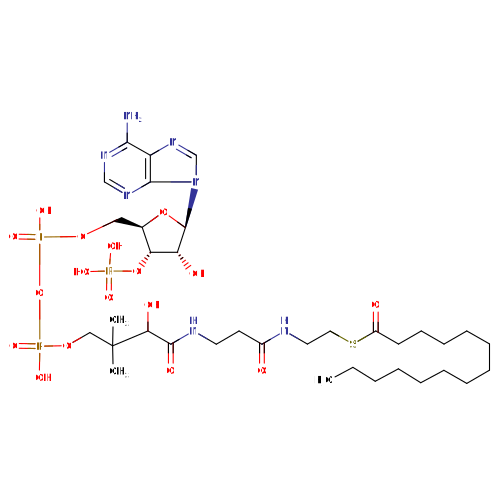
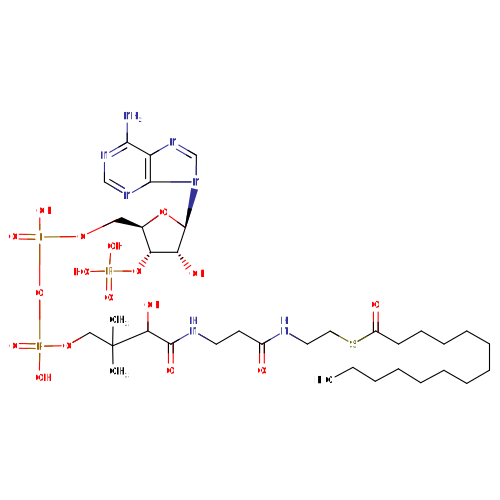
| Description | Tetradecanoyl-CoA, also known as myristoyl-CoA or N-C14:0CoA, belongs to the class of organic compounds known as long-chain fatty acyl coas. These are acyl CoAs where the group acylated to the coenzyme A moiety is a long aliphatic chain of 13 to 21 carbon atoms. The first pass through the beta-oxidation process starts with the saturated fatty acid palmitoyl-CoA and produces myristoyl-CoA. Tetradecanoyl-CoA is a strong basic compound (based on its pKa). Tetradecanoyl-CoA exists in all living species, ranging from bacteria to humans. In humans, tetradecanoyl-CoA is involved in the metabolic disorder called de novo triacylglycerol biosynthesis pathway. Tetradecanoyl-CoA (or myristoyl-CoA) is an intermediate in fatty acid biosynthesis, fatty acid elongation and the beta oxidation of fatty acids. Outside of the human body, Tetradecanoyl-CoA has been detected, but not quantified in, several different foods, such as jew's ears, hickory nuts, cucumbers, saffrons, and swiss chards. This could make tetradecanoyl-CoA a potential biomarker for the consumption of these foods. Myristoylation also occurs post-translationally, for example when previously internal glycine residues become exposed by caspase cleavage during apoptosis. It is also used in the myristoylation of proteins. Myristoylation is an irreversible, co-translational (during translation) protein modification found in animals, plants, fungi and viruses. It is more common on glycine residues but also occurs on other amino acids. In this protein modification a myristoyl group (derived from myristioyl CoA) is covalently attached via an amide bond to the alpha-amino group of an N-terminal amino acid of a nascent polypeptide. myristoyl-CoA was first documented in 2005 (PMID: 15638818). Compared to other species that possess a single functional myristoyl-CoA: Protein N-myristoyltransferase (NMT) gene copy, human, mouse and cow possess 2 NMT genes, and more than 2 protein isoforms. |
|---|
| Structure | CCCCCCCCCCCCCC(=O)SCCNC(=O)CCNC(=O)C(O)C(C)(C)COP(O)(=O)OP(O)(=O)OC[C@H]1O[C@H]([C@H](O)[C@@H]1OP(O)(O)=O)N1C=NC2=C1N=CN=C2N InChI=1S/C35H62N7O17P3S/c1-4-5-6-7-8-9-10-11-12-13-14-15-26(44)63-19-18-37-25(43)16-17-38-33(47)30(46)35(2,3)21-56-62(53,54)59-61(51,52)55-20-24-29(58-60(48,49)50)28(45)34(57-24)42-23-41-27-31(36)39-22-40-32(27)42/h22-24,28-30,34,45-46H,4-21H2,1-3H3,(H,37,43)(H,38,47)(H,51,52)(H,53,54)(H2,36,39,40)(H2,48,49,50)/t24-,28-,29-,30?,34-/m1/s1 |
|---|
| Synonyms | | Value | Source |
|---|
| Myristoyl-CoA | HMDB | | Myristoyl-coenzyme A | HMDB | | N-C14:0CoA | HMDB | | N-C14:0coenzyme A | HMDB | | S-Tetradecanoyl-coenzyme A | HMDB | | Tetradecanoyl CoA | HMDB | | Tetradecanoyl coenzyme A | HMDB | | Tetradecanoyl-coenzyme A | HMDB | | Tetradecanoyl-CoA | MeSH, HMDB |
|
|---|
| Chemical Formula | C35H62N7O17P3S |
|---|
| Average Mass | 977.8900 Da |
|---|
| Monoisotopic Mass | 977.31357 Da |
|---|
| IUPAC Name | {[(2R,3S,4R,5R)-5-(6-amino-9H-purin-9-yl)-4-hydroxy-2-({[hydroxy({[hydroxy({3-hydroxy-2,2-dimethyl-3-[(2-{[2-(tetradecanoylsulfanyl)ethyl]carbamoyl}ethyl)carbamoyl]propoxy})phosphoryl]oxy})phosphoryl]oxy}methyl)oxolan-3-yl]oxy}phosphonic acid |
|---|
| Traditional Name | [(2R,3S,4R,5R)-5-(6-aminopurin-9-yl)-4-hydroxy-2-[({hydroxy[hydroxy(3-hydroxy-2,2-dimethyl-3-[(2-{[2-(tetradecanoylsulfanyl)ethyl]carbamoyl}ethyl)carbamoyl]propoxy)phosphoryl]oxyphosphoryl}oxy)methyl]oxolan-3-yl]oxyphosphonic acid |
|---|
| CAS Registry Number | Not Available |
|---|
| SMILES | CCCCCCCCCCCCCC(=O)SCCNC(=O)CCNC(=O)C(O)C(C)(C)COP(O)(=O)OP(O)(=O)OC[C@H]1O[C@H]([C@H](O)[C@@H]1OP(O)(O)=O)N1C=NC2=C1N=CN=C2N |
|---|
| InChI Identifier | InChI=1S/C35H62N7O17P3S/c1-4-5-6-7-8-9-10-11-12-13-14-15-26(44)63-19-18-37-25(43)16-17-38-33(47)30(46)35(2,3)21-56-62(53,54)59-61(51,52)55-20-24-29(58-60(48,49)50)28(45)34(57-24)42-23-41-27-31(36)39-22-40-32(27)42/h22-24,28-30,34,45-46H,4-21H2,1-3H3,(H,37,43)(H,38,47)(H,51,52)(H,53,54)(H2,36,39,40)(H2,48,49,50)/t24-,28-,29-,30?,34-/m1/s1 |
|---|
| InChI Key | DUAFKXOFBZQTQE-XVDJLSDJSA-N |
|---|
| Experimental Spectra |
|---|
|
| Not Available | | Predicted Spectra |
|---|
|
| Not Available | | Chemical Shift Submissions |
|---|
|
| Not Available | | Species |
|---|
| Species of Origin | Not Available |
|---|
| Chemical Taxonomy |
|---|
| Description | Belongs to the class of organic compounds known as long-chain fatty acyl coas. These are acyl CoAs where the group acylated to the coenzyme A moiety is a long aliphatic chain of 13 to 21 carbon atoms. |
|---|
| Kingdom | Organic compounds |
|---|
| Super Class | Lipids and lipid-like molecules |
|---|
| Class | Fatty Acyls |
|---|
| Sub Class | Fatty acyl thioesters |
|---|
| Direct Parent | Long-chain fatty acyl CoAs |
|---|
| Alternative Parents | |
|---|
| Substituents | - Coenzyme a or derivatives
- Purine ribonucleoside 3',5'-bisphosphate
- Purine ribonucleoside bisphosphate
- Purine ribonucleoside diphosphate
- Ribonucleoside 3'-phosphate
- Pentose phosphate
- Pentose-5-phosphate
- Beta amino acid or derivatives
- Glycosyl compound
- N-glycosyl compound
- 6-aminopurine
- Monosaccharide phosphate
- Organic pyrophosphate
- Pentose monosaccharide
- Imidazopyrimidine
- Purine
- Monoalkyl phosphate
- Aminopyrimidine
- Imidolactam
- N-acyl-amine
- N-substituted imidazole
- Organic phosphoric acid derivative
- Monosaccharide
- Pyrimidine
- Alkyl phosphate
- Fatty amide
- Phosphoric acid ester
- Tetrahydrofuran
- Imidazole
- Azole
- Heteroaromatic compound
- Carbothioic s-ester
- Secondary alcohol
- Thiocarboxylic acid ester
- Carboxamide group
- Secondary carboxylic acid amide
- Amino acid or derivatives
- Sulfenyl compound
- Thiocarboxylic acid or derivatives
- Organoheterocyclic compound
- Azacycle
- Oxacycle
- Carboxylic acid derivative
- Organosulfur compound
- Organic oxygen compound
- Hydrocarbon derivative
- Carbonyl group
- Organic nitrogen compound
- Primary amine
- Organopnictogen compound
- Organic oxide
- Organooxygen compound
- Organonitrogen compound
- Alcohol
- Amine
- Aromatic heteropolycyclic compound
|
|---|
| Molecular Framework | Aromatic heteropolycyclic compounds |
|---|
| External Descriptors | |
|---|
| Physical Properties |
|---|
| State | Not Available |
|---|
| Experimental Properties | | Property | Value | Reference |
|---|
| Melting Point | Not Available | Not Available | | Boiling Point | Not Available | Not Available | | Water Solubility | Not Available | Not Available | | LogP | Not Available | Not Available |
|
|---|
| Predicted Properties | |
|---|