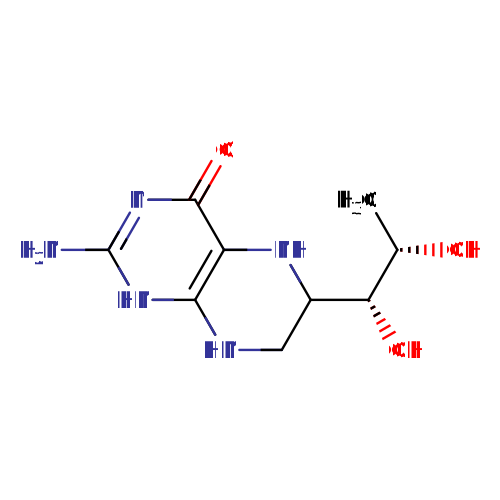
| Record Information |
|---|
| Version | 2.0 |
|---|
| Created at | 2024-09-10 19:21:48 UTC |
|---|
| Updated at | 2024-09-10 19:21:48 UTC |
|---|
| NP-MRD ID | NP0334661 |
|---|
| Secondary Accession Numbers | None |
|---|
| Natural Product Identification |
|---|
| Common Name | Sapropterin |
|---|
| Description | Sapropterin belongs to the class of organic compounds known as biopterins and derivatives. These are coenzymes containing a 2-amino-pteridine-4-one derivative. They are mainly synthesized in several parts of the body, including the pineal gland. Sapropterin was first documented in 2006 (PMID: 32401468). Based on a literature review a small amount of articles have been published on Sapropterin (PMID: 39275225) (PMID: 39237321) (PMID: 38999811) (PMID: 38801163). |
|---|
| Structure | C[C@H](O)[C@H](O)C1CNC2=C(N1)C(=O)N=C(N)N2 InChI=1/C9H15N5O3/c1-3(15)6(16)4-2-11-7-5(12-4)8(17)14-9(10)13-7/h3-4,6,12,15-16H,2H2,1H3,(H4,10,11,13,14,17)/t3-,4?,6-/s2 |
|---|
| Synonyms | Not Available |
|---|
| Chemical Formula | C9H15N5O3 |
|---|
| Average Mass | 241.2510 Da |
|---|
| Monoisotopic Mass | 241.11749 Da |
|---|
| IUPAC Name | 2-amino-6-[(1R,2S)-1,2-dihydroxypropyl]-1,4,5,6,7,8-hexahydropteridin-4-one |
|---|
| Traditional Name | 2-amino-6-[(1R,2S)-1,2-dihydroxypropyl]-5,6,7,8-tetrahydro-1H-pteridin-4-one |
|---|
| CAS Registry Number | Not Available |
|---|
| SMILES | C[C@H](O)[C@H](O)C1CNC2=C(N1)C(=O)N=C(N)N2 |
|---|
| InChI Identifier | InChI=1/C9H15N5O3/c1-3(15)6(16)4-2-11-7-5(12-4)8(17)14-9(10)13-7/h3-4,6,12,15-16H,2H2,1H3,(H4,10,11,13,14,17)/t3-,4?,6-/s2 |
|---|
| InChI Key | FNKQXYHWGSIFBK-CLGFIFAMNA-N |
|---|
| Experimental Spectra |
|---|
|
| Not Available | | Predicted Spectra |
|---|
|
| Not Available | | Chemical Shift Submissions |
|---|
|
| Not Available | | Species |
|---|
| Species of Origin | Not Available |
|---|
| Chemical Taxonomy |
|---|
| Description | This compound belongs to the class of organic compounds known as biopterins and derivatives. These are coenzymes containing a 2-amino-pteridine-4-one derivative. They are mainly synthesized in several parts of the body, including the pineal gland. |
|---|
| Kingdom | Organic compounds |
|---|
| Super Class | Organoheterocyclic compounds |
|---|
| Class | Pteridines and derivatives |
|---|
| Sub Class | Pterins and derivatives |
|---|
| Direct Parent | Biopterins and derivatives |
|---|
| Alternative Parents | |
|---|
| Substituents | - Biopterin
- Aminopyrimidine
- Pyrimidone
- Secondary aliphatic/aromatic amine
- Pyrimidine
- 1,3-aminoalcohol
- Vinylogous amide
- Heteroaromatic compound
- Secondary alcohol
- 1,2-diol
- 1,2-aminoalcohol
- Secondary amine
- Azacycle
- Hydrocarbon derivative
- Organic oxide
- Organopnictogen compound
- Primary amine
- Organooxygen compound
- Organonitrogen compound
- Organic oxygen compound
- Organic nitrogen compound
- Amine
- Alcohol
- Aromatic heteropolycyclic compound
|
|---|
| Molecular Framework | Aromatic heteropolycyclic compounds |
|---|
| External Descriptors | |
|---|
| Physical Properties |
|---|
| State | Not Available |
|---|
| Experimental Properties | | Property | Value | Reference |
|---|
| Melting Point | Not Available | Not Available | | Boiling Point | Not Available | Not Available | | Water Solubility | Not Available | Not Available | | LogP | Not Available | Not Available |
|
|---|
| Predicted Properties | |
|---|
| General References | - Pinto A, Ahring K, Almeida MF, Ashmore C, Belanger-Quintana A, Burlina A, Coskun T, Daly A, van Dam E, Dursun A, Evans S, Feillet F, Gizewska M, Gokmen-Ozel H, Hickson M, Hoekstra Y, Ilgaz F, Jackson R, Lesniak A, Loro C, Malicka K, Patalan M, Rocha JC, Sivri S, Rodenburg I, van Spronsen F, Straczek K, Tokatli A, MacDonald A: Longitudinal Dietary Intake Data in Patients with Phenylketonuria from Europe: The Impact of Age and Phenylketonuria Severity. Nutrients. 2024 Aug 31;16(17):2909. doi: 10.3390/nu16172909. [PubMed:39275225 ]
- Feillet F, Arnoux JB, Delgado MB, Burlina A, Chabrol B, Kucuksayrac E, Lagler FB, Muntau AC, Olsson D, Paci S, Rutsch F, van Spronsen FJ: Long-term safety of sapropterin in paediatric and adult individuals with phenylalanine hydroxylase deficiency: Final results of the Kuvan(R) Adult Maternal Paediatric European Registry multinational observational study. J Inherit Metab Dis. 2024 Sep 5. doi: 10.1002/jimd.12796. [PubMed:39237321 ]
- Pinto A, Ahring K, Almeida MF, Ashmore C, Belanger-Quintana A, Burlina A, Coskun T, Daly A, van Dam E, Dursun A, Evans S, Feillet F, Gizewska M, Gokmen-Ozel H, Hickson M, Hoekstra Y, Ilgaz F, Jackson R, Lesniak A, Loro C, Malicka K, Patalan M, Rocha JC, Sivri S, Rodenburg I, van Spronsen F, Straczek K, Tokatli A, MacDonald A: Blood Phenylalanine Levels in Patients with Phenylketonuria from Europe between 2012 and 2018: Is It a Changing Landscape? Nutrients. 2024 Jun 28;16(13):2064. doi: 10.3390/nu16132064. [PubMed:38999811 ]
- Delbreil P, Dhondt S, Kenaan El Rahbani RM, Banquy X, Mitchell JJ, Brambilla D: Current Advances and Material Innovations in the Search for Novel Treatments of Phenylketonuria. Adv Healthc Mater. 2024 May 27:e2401353. doi: 10.1002/adhm.202401353. [PubMed:38801163 ]
- Authors unspecified: Sapropterin.. 2006. [PubMed:32401468 ]
|
|---|