| Record Information |
|---|
| Version | 2.0 |
|---|
| Created at | 2024-09-10 19:06:22 UTC |
|---|
| Updated at | 2024-09-10 19:06:22 UTC |
|---|
| NP-MRD ID | NP0334603 |
|---|
| Secondary Accession Numbers | None |
|---|
| Natural Product Identification |
|---|
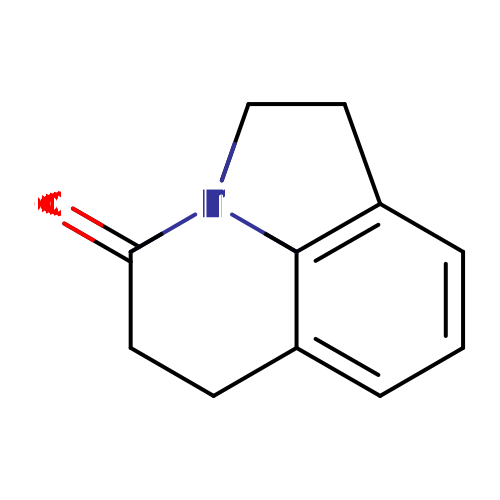
| Common Name | 1,2,5,6-Tetrahydro-4H-pyrrolo[3,2,1-ij]quinolin-4-one |
|---|
| Description | 1,2,5,6-Tetrahydro-4H-pyrrolo[3,2,1-ij]quinolin-4-one, also known as fongoren or pyroquilone, belongs to the class of organic compounds known as hydroquinolones. Hydroquinolones are compounds containing a hydrogenated quinoline bearing a ketone group. 1,2,5,6-Tetrahydro-4H-pyrrolo[3,2,1-ij]quinolin-4-one is an extremely weak basic (essentially neutral) compound (based on its pKa). 1,2,5,6-Tetrahydro-4H-pyrrolo[3,2,1-ij]quinolin-4-one was first documented in 2014 (PMID: 24646830). A pyrroloquinoline that is 1,2,5,6-tetrahydro-4H-pyrroloquinoline in which the hydrogens at position 4 are replaced by an oxo group. |
|---|
| Structure | InChI=1S/C11H11NO/c13-10-5-4-8-2-1-3-9-6-7-12(10)11(8)9/h1-3H,4-7H2 |
|---|
| Synonyms | | Value | Source |
|---|
| 1,2,5,6-Tetrahydropyrrolo[3,2,1-ij]quinolin-4-one | ChEBI | | Coratop | ChEBI | | Fongoren | ChEBI | | Fongorene | ChEBI | | Lilolidone | ChEBI | | Pyroquilone | ChEBI | | 1,2,5,6-Tetrahydro-4H-pyrrolo(3,2,1-ij)quinolin-4-one | HMDB | | 1,2,5,6-Tetrahydro-4H-pyrrolo(3,2,1-ij)quinolin-4-one (9ci) | HMDB | | 1,2,5,6-Tetrahydropyrrolo(3,2,1-ij)quinolin-4-one | HMDB | | 4-Oxolilidine | HMDB | | PYQ | HMDB | | Pyroquilon | HMDB | | Pyroquilon, bsi, iso | HMDB |
|
|---|
| Chemical Formula | C11H11NO |
|---|
| Average Mass | 173.2111 Da |
|---|
| Monoisotopic Mass | 173.08406 Da |
|---|
| IUPAC Name | 1-azatricyclo[6.3.1.0⁴,¹²]dodeca-4(12),5,7-trien-11-one |
|---|
| Traditional Name | pyroquilon |
|---|
| CAS Registry Number | Not Available |
|---|
| SMILES | O=C1CCC2=CC=CC3=C2N1CC3 |
|---|
| InChI Identifier | InChI=1S/C11H11NO/c13-10-5-4-8-2-1-3-9-6-7-12(10)11(8)9/h1-3H,4-7H2 |
|---|
| InChI Key | XRJLAOUDSILTFT-UHFFFAOYSA-N |
|---|
| Experimental Spectra |
|---|
|
| Not Available | | Predicted Spectra |
|---|
|
| Not Available | | Chemical Shift Submissions |
|---|
|
| Not Available | | Species |
|---|
| Species of Origin | Not Available |
|---|
| Chemical Taxonomy |
|---|
| Description | Belongs to the class of organic compounds known as hydroquinolones. Hydroquinolones are compounds containing a hydrogenated quinoline bearing a ketone group. |
|---|
| Kingdom | Organic compounds |
|---|
| Super Class | Organoheterocyclic compounds |
|---|
| Class | Quinolines and derivatives |
|---|
| Sub Class | Quinolones and derivatives |
|---|
| Direct Parent | Hydroquinolones |
|---|
| Alternative Parents | |
|---|
| Substituents | - Tetrahydroquinolone
- Tetrahydroquinoline
- Indole or derivatives
- Benzenoid
- Tertiary carboxylic acid amide
- Carboxamide group
- Lactam
- Carboxylic acid derivative
- Azacycle
- Carbonyl group
- Organonitrogen compound
- Organooxygen compound
- Hydrocarbon derivative
- Organic oxide
- Organopnictogen compound
- Organic oxygen compound
- Organic nitrogen compound
- Aromatic heteropolycyclic compound
|
|---|
| Molecular Framework | Aromatic heteropolycyclic compounds |
|---|
| External Descriptors | |
|---|
| Physical Properties |
|---|
| State | Not Available |
|---|
| Experimental Properties | | Property | Value | Reference |
|---|
| Melting Point | Not Available | Not Available | | Boiling Point | Not Available | Not Available | | Water Solubility | Not Available | Not Available | | LogP | Not Available | Not Available |
|
|---|
| Predicted Properties | |
|---|
| General References | - Beltran-Garcia MJ, Prado FM, Oliveira MS, Ortiz-Mendoza D, Scalfo AC, Pessoa A Jr, Medeiros MH, White JF, Di Mascio P: Singlet molecular oxygen generation by light-activated DHN-melanin of the fungal pathogen Mycosphaerella fijiensis in black Sigatoka disease of bananas. PLoS One. 2014 Mar 19;9(3):e91616. doi: 10.1371/journal.pone.0091616. eCollection 2014. [PubMed:24646830 ]
|
|---|