Np mrd loader

Record Information
Version2.0
Created at2024-09-10 18:58:30 UTC
Updated at2024-09-10 18:58:30 UTC
NP-MRD IDNP0334576
Secondary Accession NumbersNone
Natural Product Identification
Common NameSumatriptan
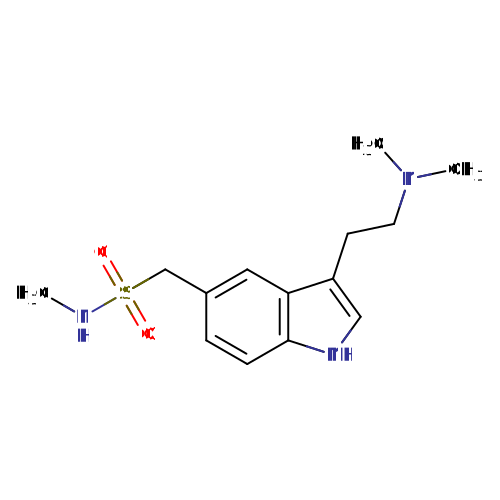
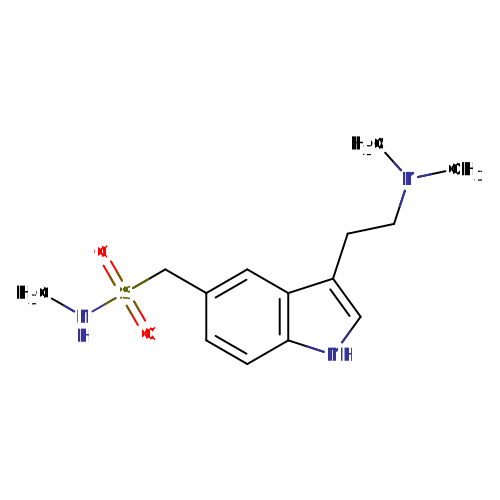
DescriptionSumatriptan, also known as imigran or imitrex, belongs to the class of organic compounds known as tryptamines and derivatives. Tryptamines and derivatives are compounds containing the tryptamine backbone, which is structurally characterized by an indole ring substituted at the 3-position by an ethanamine. A sulfonamide that consists of N,N-dimethyltryptamine bearing an additional (N-methylsulfamoyl)methyl substituent at position 5. Sumatriptan is a very strong basic compound (based on its pKa). Sumatriptan is a potentially toxic compound. Used (in the form of its succinate salt) for the acute treatment of migraine with or without aura in adults. Sumatriptan was first documented in 1996 (PMID: 8869766). Selective agonist for a vascular 5-HT1 receptor subtype (probably a member of the 5-HT1D family) (PMID: 9225278) (PMID: 11045888) (PMID: 11401410) (PMID: 12172708).
Structure
Thumb
Synonyms
ValueSource
(3-[2-(Dimethylamino)ethyl]-1H-indol-5-yl)-N-methylmethanesulfonamideChEBI
1-[3-(2-Dimethylaminoethyl)-1H-indol-5-yl]-N-methyl-methanesulfonamideChEBI
3-(2-(Dimethylamino)ethyl)-N-methyl-1H-indole-5-methanesulfonamideChEBI
3-[2-(Dimethylamino)ethyl]-N-methylindole-5-methanesulfonamideChEBI
ImigranChEBI
ImitrexChEBI
SumatranChEBI
SumatriptanumChEBI
SumaxChEBI
(3-[2-(Dimethylamino)ethyl]-1H-indol-5-yl)-N-methylmethanesulphonamideGenerator
1-[3-(2-Dimethylaminoethyl)-1H-indol-5-yl]-N-methyl-methanesulphonamideGenerator
3-(2-(Dimethylamino)ethyl)-N-methyl-1H-indole-5-methanesulphonamideGenerator
3-[2-(Dimethylamino)ethyl]-N-methylindole-5-methanesulphonamideGenerator
Imigran recoveryHMDB
Glaxo wellcome brand OF sumatriptanHMDB
Sumatriptan GSK brandHMDB
GSK Brand OF sumatriptanHMDB
Sumatriptan succinateHMDB
Succinate, sumatriptanHMDB
Chemical FormulaC14H21N3O2S
Average Mass295.4000 Da
Monoisotopic Mass295.13545 Da
IUPAC Name1-{3-[2-(dimethylamino)ethyl]-1H-indol-5-yl}-N-methylmethanesulfonamide
Traditional Namesumatriptan
CAS Registry NumberNot Available
SMILES
CNS(=O)(=O)CC1=CC2=C(NC=C2CCN(C)C)C=C1
InChI Identifier
InChI=1S/C14H21N3O2S/c1-15-20(18,19)10-11-4-5-14-13(8-11)12(9-16-14)6-7-17(2)3/h4-5,8-9,15-16H,6-7,10H2,1-3H3
InChI KeyKQKPFRSPSRPDEB-UHFFFAOYSA-N
Experimental Spectra
Not Available
Predicted Spectra
Not Available
Chemical Shift Submissions
Not Available
Species
Species of OriginNot Available
Chemical Taxonomy
Description Belongs to the class of organic compounds known as tryptamines and derivatives. Tryptamines and derivatives are compounds containing the tryptamine backbone, which is structurally characterized by an indole ring substituted at the 3-position by an ethanamine.
KingdomOrganic compounds
Super ClassOrganoheterocyclic compounds
ClassIndoles and derivatives
Sub ClassTryptamines and derivatives
Direct ParentTryptamines and derivatives
Alternative Parents
Substituents
  • Tryptamine
  • 3-alkylindole
  • Indole
  • Aralkylamine
  • Substituted pyrrole
  • Organic sulfonic acid amide
  • Benzenoid
  • Organosulfonic acid amide
  • Pyrrole
  • Organic sulfonic acid or derivatives
  • Heteroaromatic compound
  • Organosulfonic acid or derivatives
  • Aminosulfonyl compound
  • Sulfonyl
  • Tertiary aliphatic amine
  • Tertiary amine
  • Azacycle
  • Hydrocarbon derivative
  • Organic oxide
  • Organopnictogen compound
  • Organic oxygen compound
  • Organosulfur compound
  • Organonitrogen compound
  • Organic nitrogen compound
  • Amine
  • Aromatic heteropolycyclic compound
Molecular FrameworkAromatic heteropolycyclic compounds
External Descriptors
Physical Properties
StateNot Available
Experimental Properties
PropertyValueReference
Melting PointNot AvailableNot Available
Boiling PointNot AvailableNot Available
Water SolubilityNot AvailableNot Available
LogPNot AvailableNot Available
Predicted Properties
PropertyValueSource
logP1.17ALOGPS
logP0.74ChemAxon
logS-3.4ALOGPS
pKa (Strongest Acidic)11.24ChemAxon
pKa (Strongest Basic)9.54ChemAxon
Physiological Charge1ChemAxon
Hydrogen Acceptor Count3ChemAxon
Hydrogen Donor Count2ChemAxon
Polar Surface Area65.2 ŲChemAxon
Rotatable Bond Count5ChemAxon
Refractivity82.08 m³·mol⁻¹ChemAxon
Polarizability32.31 ųChemAxon
Number of Rings2ChemAxon
BioavailabilityYesChemAxon
Rule of FiveYesChemAxon
Ghose FilterYesChemAxon
Veber's RuleNoChemAxon
MDDR-like RuleNoChemAxon
HMDB IDHMDB0005037
DrugBank IDDB00669
Phenol Explorer Compound IDNot Available
FoodDB IDFDB023604
KNApSAcK IDNot Available
Chemspider ID5165
KEGG Compound IDC07319
BioCyc IDNot Available
BiGG IDNot Available
Wikipedia LinkSumatriptan
METLIN ID2612
PubChem Compound5358
PDB IDNot Available
ChEBI ID10650
Good Scents IDNot Available
References
General References
  1. Pascual J, del Arco C, Romon T, del Olmo E, Castro E, Pazos A: Autoradiographic distribution of [3H]sumatriptan-binding sites in post-mortem human brain. Cephalalgia. 1996 Aug;16(5):317-22. doi: 10.1046/j.1468-2982.1996.1605317.x. [PubMed:8869766 ]
  2. Castro ME, Pascual J, Romon T, del Arco C, del Olmo E, Pazos A: Differential distribution of [3H]sumatriptan binding sites (5-HT1B, 5-HT1D and 5-HT1F receptors) in human brain: focus on brainstem and spinal cord. Neuropharmacology. 1997 Apr-May;36(4-5):535-42. doi: 10.1016/s0028-3908(97)00061-0. [PubMed:9225278 ]
  3. Poondru S, Devaraj R, Boinpally RR, Yamasani MR: Chronopharmacokinetics of sumatriptan in healthy human subjects. J Pharm Pharmacol. 2000 Sep;52(9):1085-90. doi: 10.1211/0022357001775001. [PubMed:11045888 ]
  4. Cipolla G, Sacco S, Crema F, Moro E, De Ponti F, Frigo G: Gastric motor effects of triptans: open questions and future perspectives. Pharmacol Res. 2001 Mar;43(3):205-10. doi: 10.1006/phrs.2000.0766. [PubMed:11401410 ]
  5. Gul H, Yildiz O: Amplification of sumatriptan-induced contractions with phenylephrine, histamine and KCl in the isolated human mesenteric artery: in-vitro evidence for sumatriptan-induced mesenteric ischaemia. Naunyn Schmiedebergs Arch Pharmacol. 2002 Sep;366(3):254-61. doi: 10.1007/s00210-002-0587-1. Epub 2002 Jun 22. [PubMed:12172708 ]