| Record Information |
|---|
| Version | 2.0 |
|---|
| Created at | 2024-09-10 18:53:15 UTC |
|---|
| Updated at | 2024-09-10 18:53:15 UTC |
|---|
| NP-MRD ID | NP0334556 |
|---|
| Secondary Accession Numbers | None |
|---|
| Natural Product Identification |
|---|
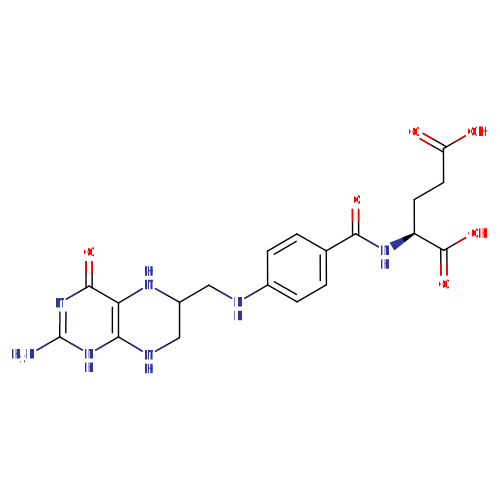
| Common Name | tetrahydrofolate |
|---|
| Description | Tetrahydrofolic acid, also known as (6S)-tetrahydrofolate or (6S)-thfa, belongs to the class of organic compounds known as glutamic acid and derivatives. Glutamic acid and derivatives are compounds containing glutamic acid or a derivative thereof resulting from reaction of glutamic acid at the amino group or the carboxy group, or from the replacement of any hydrogen of glycine by a heteroatom. Methotrexate acts on dihydrofolate reductase, like pyrimethamine or trimethoprim, as an inhibitor and thus reduces the amount of tetrahydrofolate made. Tetrahydrofolic acid is a drug which is used for nutritional supplementation, also for treating dietary shortage or imbalance. A shortage in tetrahydrofolic acid (FH4) can cause megaloblastic anemia. Tetrahydrofolic acid (THFA), or tetrahydrofolate, is a folic acid derivative. Tetrahydrofolic acid is a strong basic compound (based on its pKa). Tetrahydrofolic acid may be a unique S. Cerevisiae (yeast) metabolite. Within humans, tetrahydrofolic acid participates in a number of enzymatic reactions. In particular, tetrahydrofolic acid can be converted into dihydrofolic acid through its interaction with the enzyme dihydrofolate reductase. In addition, tetrahydrofolic acid and formic acid can be converted into 10-formyltetrahydrofolate through the action of the enzyme C-1-tetrahydrofolate synthase, cytoplasmic. Tetrahydrofolic acid is a cofactor in many reactions, especially in the synthesis (or anabolism) of amino acids and nucleic acids. Tetrahydrofolic acid is involved in the conversion of formiminoglutamic acid to glutamic acid; this may reduce the amount of histidine available for decarboxylation and protein synthesis, and hence the urinary histamine and formiminoglutamic acid may be decreased. 10-Formyltetrahydrofolate acts as a donor of a group with one carbon atom. In humans, tetrahydrofolic acid is involved in the metabolic disorder called the methylenetetrahydrofolate reductase deficiency (mthfrd) pathway. Outside of the human body, Tetrahydrofolic acid has been detected, but not quantified in, several different foods, such as teffs, common verbena, redcurrants, lettuces, and common sages. This could make tetrahydrofolic acid a potential biomarker for the consumption of these foods. Many bacteria use dihydropteroate synthetase to produce dihydropteroate, a molecule without function in humans. This may result in megaloblastic anemia. |
|---|
| Structure | NC1=NC(=O)C2=C(NCC(CNC3=CC=C(C=C3)C(=O)N[C@@H](CCC(O)=O)C(O)=O)N2)N1 InChI=1S/C19H23N7O6/c20-19-25-15-14(17(30)26-19)23-11(8-22-15)7-21-10-3-1-9(2-4-10)16(29)24-12(18(31)32)5-6-13(27)28/h1-4,11-12,21,23H,5-8H2,(H,24,29)(H,27,28)(H,31,32)(H4,20,22,25,26,30)/t11?,12-/m0/s1 |
|---|
| Synonyms | | Value | Source |
|---|
| (6S)-Tetrahydrofolate | ChEBI | | (6S)-Tetrahydrofolic acid | ChEBI | | (6S)-THFA | ChEBI | | 5,6,7,8-Tetrahydrofolate | ChEBI | | Tetrahydrofolate | ChEBI | | THF | ChEBI | | 5,6,7,8-Tetrahydrofolic acid | Generator | | 5,6,7,8-Tetrahydrofolic acid, (D-(-))-isomer | MeSH | | 5,6,7,8-Tetrahydrofolic acid, (L)-isomer | MeSH | | 5,6,7,8-Tetrahydrofolic acid, ion (2-)-isomer | MeSH | | Tetrahydropteroylglutamate | MeSH | | Tetrahydrofolic acid | ChEBI, KEGG |
|
|---|
| Chemical Formula | C19H23N7O6 |
|---|
| Average Mass | 445.4292 Da |
|---|
| Monoisotopic Mass | 445.17098 Da |
|---|
| IUPAC Name | (2S)-2-[(4-{[(2-amino-4-oxo-1,4,5,6,7,8-hexahydropteridin-6-yl)methyl]amino}phenyl)formamido]pentanedioic acid |
|---|
| Traditional Name | tetrahydrofolic acid |
|---|
| CAS Registry Number | Not Available |
|---|
| SMILES | NC1=NC(=O)C2=C(NCC(CNC3=CC=C(C=C3)C(=O)N[C@@H](CCC(O)=O)C(O)=O)N2)N1 |
|---|
| InChI Identifier | InChI=1S/C19H23N7O6/c20-19-25-15-14(17(30)26-19)23-11(8-22-15)7-21-10-3-1-9(2-4-10)16(29)24-12(18(31)32)5-6-13(27)28/h1-4,11-12,21,23H,5-8H2,(H,24,29)(H,27,28)(H,31,32)(H4,20,22,25,26,30)/t11?,12-/m0/s1 |
|---|
| InChI Key | MSTNYGQPCMXVAQ-KIYNQFGBSA-N |
|---|
| Experimental Spectra |
|---|
|
| Not Available | | Predicted Spectra |
|---|
|
| Not Available | | Chemical Shift Submissions |
|---|
|
| Not Available | | Species |
|---|
| Species of Origin | Not Available |
|---|
| Chemical Taxonomy |
|---|
| Description | Belongs to the class of organic compounds known as glutamic acid and derivatives. Glutamic acid and derivatives are compounds containing glutamic acid or a derivative thereof resulting from reaction of glutamic acid at the amino group or the carboxy group, or from the replacement of any hydrogen of glycine by a heteroatom. |
|---|
| Kingdom | Organic compounds |
|---|
| Super Class | Organic acids and derivatives |
|---|
| Class | Carboxylic acids and derivatives |
|---|
| Sub Class | Amino acids, peptides, and analogues |
|---|
| Direct Parent | Glutamic acid and derivatives |
|---|
| Alternative Parents | |
|---|
| Substituents | - Glutamic acid or derivatives
- N-acyl-alpha amino acid or derivatives
- N-acyl-alpha-amino acid
- Hippuric acid
- Hippuric acid or derivatives
- Pterin
- Aminobenzamide
- Aminobenzoic acid or derivatives
- Pteridine
- Benzamide
- Benzoic acid or derivatives
- Aniline or substituted anilines
- Benzoyl
- Phenylalkylamine
- Hydroxypyrimidine
- Secondary aliphatic/aromatic amine
- Benzenoid
- Pyrimidine
- Monocyclic benzene moiety
- Dicarboxylic acid or derivatives
- Heteroaromatic compound
- Amino acid
- Carboxamide group
- Secondary carboxylic acid amide
- Organoheterocyclic compound
- Azacycle
- Carboxylic acid
- Secondary amine
- Organic oxygen compound
- Organic nitrogen compound
- Carbonyl group
- Hydrocarbon derivative
- Amine
- Organic oxide
- Organopnictogen compound
- Organooxygen compound
- Organonitrogen compound
- Aromatic heteropolycyclic compound
|
|---|
| Molecular Framework | Aromatic heteropolycyclic compounds |
|---|
| External Descriptors | |
|---|
| Physical Properties |
|---|
| State | Not Available |
|---|
| Experimental Properties | | Property | Value | Reference |
|---|
| Melting Point | Not Available | Not Available | | Boiling Point | Not Available | Not Available | | Water Solubility | Not Available | Not Available | | LogP | Not Available | Not Available |
|
|---|
| Predicted Properties | |
|---|