| Record Information |
|---|
| Version | 2.0 |
|---|
| Created at | 2024-09-09 23:29:11 UTC |
|---|
| Updated at | 2024-09-09 23:29:11 UTC |
|---|
| NP-MRD ID | NP0334394 |
|---|
| Secondary Accession Numbers | None |
|---|
| Natural Product Identification |
|---|
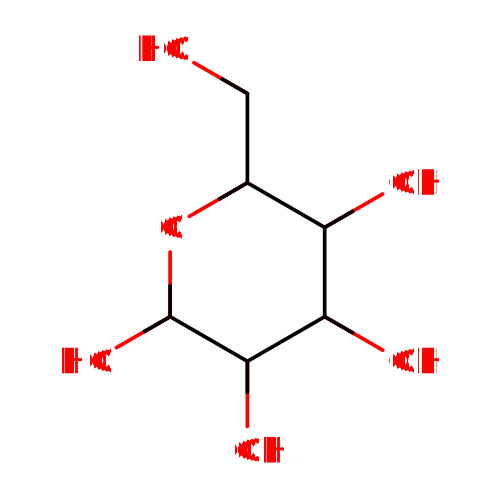
| Common Name | β-L-galactose |
|---|
| Description | D-glucopyranoside, also known as hexose or D-galactose, is a member of the class of compounds known as hexoses. Hexoses are monosaccharides in which the sugar unit is a is a six-carbon containing moeity. D-glucopyranoside is soluble (in water) and a very weakly acidic compound (based on its pKa). D-glucopyranoside can be found in a number of food items such as marzipan, olive, channel catfish, and rubus (blackberry, raspberry), which makes D-glucopyranoside a potential biomarker for the consumption of these food products. D-glucopyranoside exists in all living organisms, ranging from bacteria to humans. The name was originally given to plant products of this nature, in which the other part of the molecule was, in the greater number of cases, an aromatic aldehydic or phenolic compound (exceptions are sinigrin and jalapin or scammonin). It has now been extended to include synthetic ethers, such as those obtained by acting on alcoholic glucose solutions with hydrochloric acid, and also the polysaccharoses, e.G. Cane sugar, which appear to be ethers also. Although glucose is the most common sugar present in glucosides, many are known which yield rhamnose or iso-dulcite; these may be termed pentosides. Much attention has been given to the non-sugar parts (aglyca) of the molecules; the constitutions of many have been determined, and the compounds synthesized; and in some cases the preparation of the synthetic glucoside effected. |
|---|
| Structure | InChI=1/C6H12O6/c7-1-2-3(8)4(9)5(10)6(11)12-2/h2-11H,1H2 |
|---|
| Synonyms | | Value | Source |
|---|
| Starch phosphoric acid | Generator |
|
|---|
| Chemical Formula | C6H12O6 |
|---|
| Average Mass | 180.1560 Da |
|---|
| Monoisotopic Mass | 180.06339 Da |
|---|
| IUPAC Name | 6-(hydroxymethyl)oxane-2,3,4,5-tetrol |
|---|
| Traditional Name | d-galactose |
|---|
| CAS Registry Number | Not Available |
|---|
| SMILES | OCC1OC(O)C(O)C(O)C1O |
|---|
| InChI Identifier | InChI=1/C6H12O6/c7-1-2-3(8)4(9)5(10)6(11)12-2/h2-11H,1H2 |
|---|
| InChI Key | WQZGKKKJIJFFOK-UHFFFAOYNA-N |
|---|
| Experimental Spectra |
|---|
|
| Not Available | | Predicted Spectra |
|---|
|
| Not Available | | Chemical Shift Submissions |
|---|
|
| Not Available | | Species |
|---|
| Species of Origin | Not Available |
|---|
| Chemical Taxonomy |
|---|
| Description | This compound belongs to the class of organic compounds known as hexoses. These are monosaccharides in which the sugar unit is a is a six-carbon containing moeity. |
|---|
| Kingdom | Organic compounds |
|---|
| Super Class | Organic oxygen compounds |
|---|
| Class | Organooxygen compounds |
|---|
| Sub Class | Carbohydrates and carbohydrate conjugates |
|---|
| Direct Parent | Hexoses |
|---|
| Alternative Parents | |
|---|
| Substituents | - Hexose monosaccharide
- Oxane
- Secondary alcohol
- Hemiacetal
- Oxacycle
- Organoheterocyclic compound
- Polyol
- Hydrocarbon derivative
- Primary alcohol
- Alcohol
- Aliphatic heteromonocyclic compound
|
|---|
| Molecular Framework | Aliphatic heteromonocyclic compounds |
|---|
| External Descriptors | |
|---|
| Physical Properties |
|---|
| State | Not Available |
|---|
| Experimental Properties | | Property | Value | Reference |
|---|
| Melting Point | Not Available | Not Available | | Boiling Point | Not Available | Not Available | | Water Solubility | Not Available | Not Available | | LogP | Not Available | Not Available |
|
|---|
| Predicted Properties | |
|---|
| General References | - Liu Q, Zhou Y, Flores Castellanos J, Fettke J: The maltose-related starch degradation pathway promotes the formation of large and spherical transitory starch granules. Plant J. 2024 Sep 10. doi: 10.1111/tpj.17016. [PubMed:39254098 ]
- Mu Z, Zhang W, Chai DF, Lv Q, Tan X, Yuan R, Dong G: Preparation and characterization of slow-release urea fertilizer encapsulated by a blend of starch derivative and polyvinyl alcohol with desirable biodegradability and availability. Int J Biol Macromol. 2024 Jun;271(Pt 1):132693. doi: 10.1016/j.ijbiomac.2024.132693. Epub 2024 May 26. [PubMed:38806086 ]
- Haq F, Kiran M, Chinnam S, Farid A, Khan RU, Ullah G, Aljuwayid AM, Habila MA, Mubashir M: Synthesis of bioinspired sorbent and their exploitation for methylene blue remediation. Chemosphere. 2023 Apr;321:138000. doi: 10.1016/j.chemosphere.2023.138000. Epub 2023 Jan 29. [PubMed:36724851 ]
- Wang Q, Zhang H, Xu Y, Bao S, Liu C, Yang S: The molecular structure effects of starches and starch phosphates in the reverse flotation of quartz from hematite. Carbohydr Polym. 2023 Mar 1;303:120484. doi: 10.1016/j.carbpol.2022.120484. Epub 2022 Dec 21. [PubMed:36657853 ]
- Lu Y, Zhao P, Chen Y, Huang T, Liu Y, Ding D, Zhang G: A bio-based macromolecular phosphorus-containing active cotton flame retardant synthesized from starch. Carbohydr Polym. 2022 Dec 15;298:120076. doi: 10.1016/j.carbpol.2022.120076. Epub 2022 Sep 8. [PubMed:36241318 ]
- Yue S, Wang H, Xu H, Liu H, Yu W: Addition of amino acids modulates the in vitro digestibility of corn starch. Carbohydr Polym. 2022 Oct 1;293:119745. doi: 10.1016/j.carbpol.2022.119745. Epub 2022 Jun 21. [PubMed:35798435 ]
- Uitdewilligen JGAML, Wolters AMA, van Eck HJ, Visser RGF: Allelic variation for alpha-Glucan Water Dikinase is associated with starch phosphate content in tetraploid potato. Plant Mol Biol. 2022 Mar;108(4-5):469-480. doi: 10.1007/s11103-021-01236-7. Epub 2022 Jan 7. [PubMed:34994920 ]
- Wu M, Li Y, Li J, Xu S, Gu Z, Cheng L, Hong Y: Preparation and structural properties of starch phosphate modified by alkaline phosphatase. Carbohydr Polym. 2022 Jan 15;276:118803. doi: 10.1016/j.carbpol.2021.118803. Epub 2021 Oct 23. [PubMed:34823809 ]
- Dong G, Mu Z, Liu D, Shang L, Zhang W, Gao Y, Zhao M, Zhang X, Chen S, Wei M: Starch phosphate carbamate hydrogel based slow-release urea formulation with good water retentivity. Int J Biol Macromol. 2021 Nov 1;190:189-197. doi: 10.1016/j.ijbiomac.2021.08.234. Epub 2021 Sep 6. [PubMed:34499949 ]
- Zhang W, Mu Z, Dong G, Wei L, Bai L, Fu M, Zhao X, Han S, Wang S: Esterification modified starch by phosphates and urea via alcohol solvothermal route for its potential utilization for urea slow-releasing. Int J Biol Macromol. 2020 Nov 15;163:2448-2456. doi: 10.1016/j.ijbiomac.2020.09.186. Epub 2020 Sep 25. [PubMed:32987076 ]
- Bashir A, Manzoor T, Malik LA, Qureashi A, Pandith AH: Enhanced and Selective Adsorption of Zn(II), Pb(II), Cd(II), and Hg(II) Ions by a Dumbbell- and Flower-Shaped Potato Starch Phosphate Polymer: A Combined Experimental and DFT Calculation Study. ACS Omega. 2020 Mar 4;5(10):4853-4867. doi: 10.1021/acsomega.9b03607. eCollection 2020 Mar 17. [PubMed:32201771 ]
- Mdodana NT, Jewell JF, Phiri EE, Smith ML, Oberlander K, Mahmoodi S, Kossmann J, Lloyd JR: Mutations in Glucan, Water Dikinase Affect Starch Degradation and Gametophore Development in the Moss Physcomitrella patens. Sci Rep. 2019 Oct 22;9(1):15114. doi: 10.1038/s41598-019-51632-9. [PubMed:31641159 ]
- Khlestkin VK, Rozanova IV, Efimov VM, Khlestkina EK: Starch phosphorylation associated SNPs found by genome-wide association studies in the potato (Solanum tuberosum L.). BMC Genet. 2019 Mar 18;20(Suppl 1):29. doi: 10.1186/s12863-019-0729-9. [PubMed:30885119 ]
- Passauer L: Thermal characterization of ammonium starch phosphate carbamates for potential applications as bio-based flame-retardants. Carbohydr Polym. 2019 May 1;211:69-74. doi: 10.1016/j.carbpol.2019.01.100. Epub 2019 Jan 31. [PubMed:30824105 ]
- Wu Y, Li S, Song J, Jiang B, Chen S, Sun H, Li X: Acetylated Distarch Phosphate/Chitosan Films Reinforced with Sodium Laurate-Modified Nano-TiO(2) : Effects of Sodium Laurate Concentration. J Food Sci. 2018 Nov;83(11):2819-2826. doi: 10.1111/1750-3841.14354. Epub 2018 Oct 16. [PubMed:30325500 ]
|
|---|