| Record Information |
|---|
| Version | 2.0 |
|---|
| Created at | 2024-09-09 23:27:32 UTC |
|---|
| Updated at | 2024-09-09 23:27:33 UTC |
|---|
| NP-MRD ID | NP0334389 |
|---|
| Secondary Accession Numbers | None |
|---|
| Natural Product Identification |
|---|
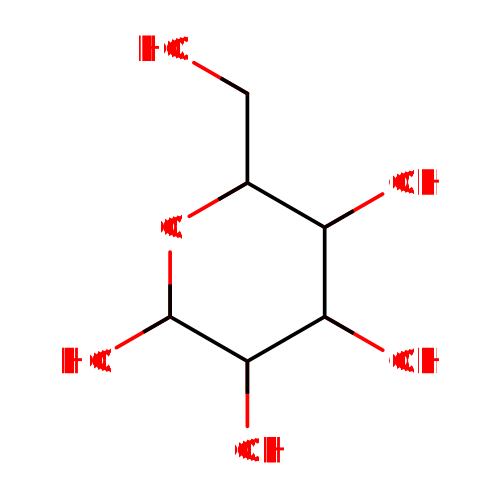
| Common Name | α-D-galactose |
|---|
| Description | D-allopyranose, also known as hexose, is a member of the class of compounds known as hexoses. Hexoses are monosaccharides in which the sugar unit is a is a six-carbon containing moeity. D-allopyranose is soluble (in water) and a very weakly acidic compound (based on its pKa). D-allopyranose can be found in a number of food items such as chinook salmon, chicory, biscuit, and mixed nuts, which makes D-allopyranose a potential biomarker for the consumption of these food products. D-allopyranose exists in all living organisms, ranging from bacteria to humans. D-allopyranose is an aldohexose sugar. It is a rare monosaccharide that occurs as a 6-O-cinnamyl glycoside in the leaves of the African shrub Protea rubropilosa. Extracts from the fresh-water alga Ochromas malhamensis contain this sugar but of unknown absolute configuration. It is soluble in water and practically insoluble in methanol. |
|---|
| Structure | InChI=1/C6H12O6/c7-1-2-3(8)4(9)5(10)6(11)12-2/h2-11H,1H2 |
|---|
| Synonyms | | Value | Source |
|---|
| Starch phosphoric acid | Generator |
|
|---|
| Chemical Formula | C6H12O6 |
|---|
| Average Mass | 180.1560 Da |
|---|
| Monoisotopic Mass | 180.06339 Da |
|---|
| IUPAC Name | 6-(hydroxymethyl)oxane-2,3,4,5-tetrol |
|---|
| Traditional Name | d-galactose |
|---|
| CAS Registry Number | Not Available |
|---|
| SMILES | OCC1OC(O)C(O)C(O)C1O |
|---|
| InChI Identifier | InChI=1/C6H12O6/c7-1-2-3(8)4(9)5(10)6(11)12-2/h2-11H,1H2 |
|---|
| InChI Key | WQZGKKKJIJFFOK-UHFFFAOYNA-N |
|---|
| Experimental Spectra |
|---|
|
| Not Available | | Predicted Spectra |
|---|
|
| Not Available | | Chemical Shift Submissions |
|---|
|
| Not Available | | Species |
|---|
| Species of Origin | Not Available |
|---|
| Chemical Taxonomy |
|---|
| Description | This compound belongs to the class of organic compounds known as hexoses. These are monosaccharides in which the sugar unit is a is a six-carbon containing moeity. |
|---|
| Kingdom | Organic compounds |
|---|
| Super Class | Organic oxygen compounds |
|---|
| Class | Organooxygen compounds |
|---|
| Sub Class | Carbohydrates and carbohydrate conjugates |
|---|
| Direct Parent | Hexoses |
|---|
| Alternative Parents | |
|---|
| Substituents | - Hexose monosaccharide
- Oxane
- Secondary alcohol
- Hemiacetal
- Oxacycle
- Organoheterocyclic compound
- Polyol
- Hydrocarbon derivative
- Primary alcohol
- Alcohol
- Aliphatic heteromonocyclic compound
|
|---|
| Molecular Framework | Aliphatic heteromonocyclic compounds |
|---|
| External Descriptors | |
|---|
| Physical Properties |
|---|
| State | Not Available |
|---|
| Experimental Properties | | Property | Value | Reference |
|---|
| Melting Point | Not Available | Not Available | | Boiling Point | Not Available | Not Available | | Water Solubility | Not Available | Not Available | | LogP | Not Available | Not Available |
|
|---|
| Predicted Properties | |
|---|
| External Links |
|---|
| HMDB ID | Not Available |
|---|
| DrugBank ID | Not Available |
|---|
| Phenol Explorer Compound ID | Not Available |
|---|
| FoodDB ID | Not Available |
|---|
| KNApSAcK ID | Not Available |
|---|
| Chemspider ID | Not Available |
|---|
| KEGG Compound ID | Not Available |
|---|
| BioCyc ID | Not Available |
|---|
| BiGG ID | Not Available |
|---|
| Wikipedia Link | Not Available |
|---|
| METLIN ID | Not Available |
|---|
| PubChem Compound | Not Available |
|---|
| PDB ID | Not Available |
|---|
| ChEBI ID | Not Available |
|---|
| Good Scents ID | Not Available |
|---|
| References |
|---|
| General References | - Liu Q, Zhou Y, Flores Castellanos J, Fettke J: The maltose-related starch degradation pathway promotes the formation of large and spherical transitory starch granules. Plant J. 2024 Sep 10. doi: 10.1111/tpj.17016. [PubMed:39254098 ]
- Mu Z, Zhang W, Chai DF, Lv Q, Tan X, Yuan R, Dong G: Preparation and characterization of slow-release urea fertilizer encapsulated by a blend of starch derivative and polyvinyl alcohol with desirable biodegradability and availability. Int J Biol Macromol. 2024 Jun;271(Pt 1):132693. doi: 10.1016/j.ijbiomac.2024.132693. Epub 2024 May 26. [PubMed:38806086 ]
- Haq F, Kiran M, Chinnam S, Farid A, Khan RU, Ullah G, Aljuwayid AM, Habila MA, Mubashir M: Synthesis of bioinspired sorbent and their exploitation for methylene blue remediation. Chemosphere. 2023 Apr;321:138000. doi: 10.1016/j.chemosphere.2023.138000. Epub 2023 Jan 29. [PubMed:36724851 ]
- Wang Q, Zhang H, Xu Y, Bao S, Liu C, Yang S: The molecular structure effects of starches and starch phosphates in the reverse flotation of quartz from hematite. Carbohydr Polym. 2023 Mar 1;303:120484. doi: 10.1016/j.carbpol.2022.120484. Epub 2022 Dec 21. [PubMed:36657853 ]
- Lu Y, Zhao P, Chen Y, Huang T, Liu Y, Ding D, Zhang G: A bio-based macromolecular phosphorus-containing active cotton flame retardant synthesized from starch. Carbohydr Polym. 2022 Dec 15;298:120076. doi: 10.1016/j.carbpol.2022.120076. Epub 2022 Sep 8. [PubMed:36241318 ]
- Yue S, Wang H, Xu H, Liu H, Yu W: Addition of amino acids modulates the in vitro digestibility of corn starch. Carbohydr Polym. 2022 Oct 1;293:119745. doi: 10.1016/j.carbpol.2022.119745. Epub 2022 Jun 21. [PubMed:35798435 ]
- Uitdewilligen JGAML, Wolters AMA, van Eck HJ, Visser RGF: Allelic variation for alpha-Glucan Water Dikinase is associated with starch phosphate content in tetraploid potato. Plant Mol Biol. 2022 Mar;108(4-5):469-480. doi: 10.1007/s11103-021-01236-7. Epub 2022 Jan 7. [PubMed:34994920 ]
|
|---|