| Record Information |
|---|
| Version | 2.0 |
|---|
| Created at | 2024-09-09 23:21:51 UTC |
|---|
| Updated at | 2024-09-09 23:21:52 UTC |
|---|
| NP-MRD ID | NP0334368 |
|---|
| Secondary Accession Numbers | None |
|---|
| Natural Product Identification |
|---|
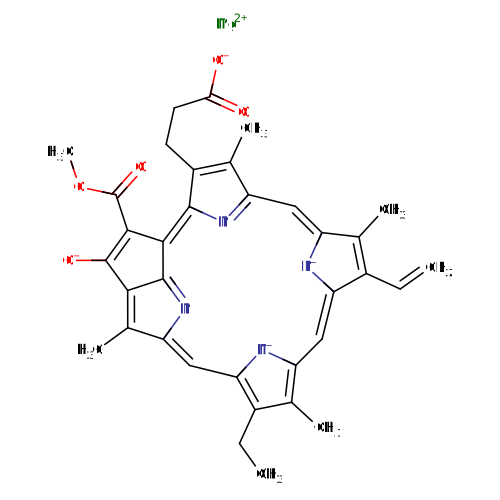
| Common Name | monovinyl protochlorophyllide a |
|---|
| Description | Monovinyl protochlorophyllide a is practically insoluble (in water) and a weakly acidic compound (based on its pKa). Monovinyl protochlorophyllide a can be found in a number of food items such as chinese cinnamon, rambutan, cloud ear fungus, and chanterelle, which makes monovinyl protochlorophyllide a a potential biomarker for the consumption of these food products. |
|---|
| Structure | [Mg++].[H]\C-1=C2\[N-]\C(=C([H])/C3=N/C(/C(CCC([O-])=O)=C3C)=C3\C4=N\C(=C([H])/C5=C(CC)C(C)=C-1[N-]5)\C(C)=C4C([O-])=C3C(=O)OC)C(C)=C2C=C InChI=1S/C35H34N4O5.Mg/c1-8-19-15(3)22-12-24-17(5)21(10-11-28(40)41)32(38-24)30-31(35(43)44-7)34(42)29-18(6)25(39-33(29)30)14-27-20(9-2)16(4)23(37-27)13-26(19)36-22;/h8,12-14H,1,9-11H2,2-7H3,(H4,36,37,38,39,40,41,42,43);/q;+2/p-4/b22-12-,23-13-,24-12-,25-14-,26-13-,27-14-,32-30-; |
|---|
| Synonyms | Not Available |
|---|
| Chemical Formula | C35H30MgN4O5 |
|---|
| Average Mass | 610.9540 Da |
|---|
| Monoisotopic Mass | 610.20776 Da |
|---|
| IUPAC Name | magnesium(2+) 22-(2-carboxylatoethyl)-16-ethenyl-11-ethyl-3-(methoxycarbonyl)-12,17,21,26-tetramethyl-7,23,24,25-tetraazahexacyclo[18.2.1.1^{5,8}.1^{10,13}.1^{15,18}.0^{2,6}]hexacosa-1,3,5(26),6,8,10,12,14,16,18,20(23),21-dodecaene-24,25-diid-4-olate |
|---|
| Traditional Name | magnesium(2+) 22-(2-carboxylatoethyl)-16-ethenyl-11-ethyl-3-(methoxycarbonyl)-12,17,21,26-tetramethyl-7,23,24,25-tetraazahexacyclo[18.2.1.1^{5,8}.1^{10,13}.1^{15,18}.0^{2,6}]hexacosa-1,3,5(26),6,8,10,12,14,16,18,20(23),21-dodecaene-24,25-diid-4-olate |
|---|
| CAS Registry Number | Not Available |
|---|
| SMILES | [Mg++].[H]\C-1=C2\[N-]\C(=C([H])/C3=N/C(/C(CCC([O-])=O)=C3C)=C3\C4=N\C(=C([H])/C5=C(CC)C(C)=C-1[N-]5)\C(C)=C4C([O-])=C3C(=O)OC)C(C)=C2C=C |
|---|
| InChI Identifier | InChI=1S/C35H34N4O5.Mg/c1-8-19-15(3)22-12-24-17(5)21(10-11-28(40)41)32(38-24)30-31(35(43)44-7)34(42)29-18(6)25(39-33(29)30)14-27-20(9-2)16(4)23(37-27)13-26(19)36-22;/h8,12-14H,1,9-11H2,2-7H3,(H4,36,37,38,39,40,41,42,43);/q;+2/p-4/b22-12-,23-13-,24-12-,25-14-,26-13-,27-14-,32-30-; |
|---|
| InChI Key | CHKPYPFKOKWPNZ-UAVVDGTISA-J |
|---|
| Experimental Spectra |
|---|
|
| Not Available | | Predicted Spectra |
|---|
|
| Not Available | | Chemical Shift Submissions |
|---|
|
| Not Available | | Species |
|---|
| Species of Origin | Not Available |
|---|
| Chemical Taxonomy |
|---|
| Description | This compound belongs to the class of organic compounds known as metallotetrapyrroles. These are polycyclic compounds containing a tetrapyrrole skeleton combined with a metal atom. |
|---|
| Kingdom | Organic compounds |
|---|
| Super Class | Organoheterocyclic compounds |
|---|
| Class | Tetrapyrroles and derivatives |
|---|
| Sub Class | Metallotetrapyrroles |
|---|
| Direct Parent | Metallotetrapyrroles |
|---|
| Alternative Parents | |
|---|
| Substituents | - Metallotetrapyrrole skeleton
- Diterpenoid
- Fatty acid ester
- Fatty acyl
- Substituted pyrrole
- Dicarboxylic acid or derivatives
- Heteroaromatic compound
- Vinylogous acid
- Alpha,beta-unsaturated carboxylic ester
- Enoate ester
- Methyl ester
- Secondary ketimine
- Pyrroline
- Azomethine
- Ketimine
- Carboxylic acid salt
- Carboxylic acid ester
- Azacycle
- Carbene-type 1,3-dipolar compound
- Carboxylic acid
- Carboxylic acid derivative
- Organic nitrogen compound
- Organic oxygen compound
- Organopnictogen compound
- Organic oxide
- Hydrocarbon derivative
- Organic salt
- Organooxygen compound
- Organonitrogen compound
- Imine
- Organic anion
- Aromatic heteropolycyclic compound
|
|---|
| Molecular Framework | Aromatic heteropolycyclic compounds |
|---|
| External Descriptors | Not Available |
|---|
| Physical Properties |
|---|
| State | Not Available |
|---|
| Experimental Properties | | Property | Value | Reference |
|---|
| Melting Point | Not Available | Not Available | | Boiling Point | Not Available | Not Available | | Water Solubility | Not Available | Not Available | | LogP | Not Available | Not Available |
|
|---|
| Predicted Properties | |
|---|