| Record Information |
|---|
| Version | 2.0 |
|---|
| Created at | 2024-09-09 23:06:40 UTC |
|---|
| Updated at | 2024-09-09 23:06:41 UTC |
|---|
| NP-MRD ID | NP0334311 |
|---|
| Secondary Accession Numbers | None |
|---|
| Natural Product Identification |
|---|
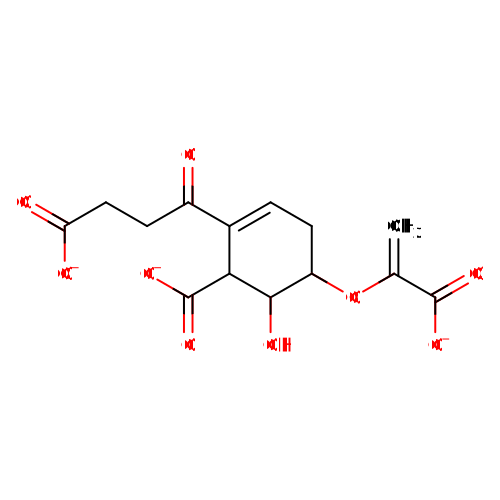
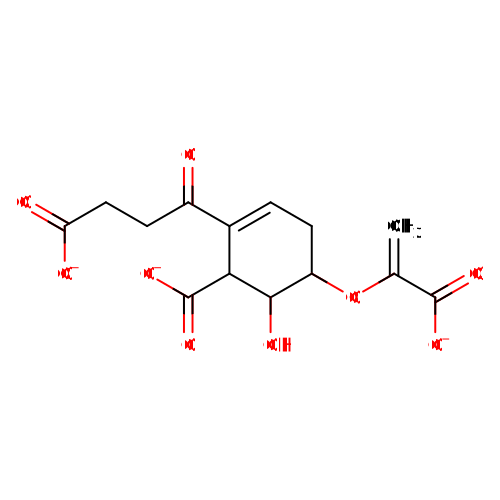
| Common Name | 2-succinyl-5-enolpyruvyl-6-hydroxy-3-cyclohexene-1-carboxylate |
|---|
| Description | 2-Succinyl-5-enolpyruvyl-6-hydroxy-3-cyclohexene-1-carboxylate belongs to tricarboxylic acids and derivatives class of compounds. Those are carboxylic acids containing exactly three carboxyl groups. 2-Succinyl-5-enolpyruvyl-6-hydroxy-3-cyclohexene-1-carboxylate is slightly soluble (in water) and a weakly acidic compound (based on its pKa). 2-Succinyl-5-enolpyruvyl-6-hydroxy-3-cyclohexene-1-carboxylate can be found in a number of food items such as feijoa, german camomile, sugar apple, and rapini, which makes 2-succinyl-5-enolpyruvyl-6-hydroxy-3-cyclohexene-1-carboxylate a potential biomarker for the consumption of these food products. |
|---|
| Structure | OC1C(CC=C(C1C([O-])=O)C(=O)CCC([O-])=O)OC(=C)C([O-])=O InChI=1/C14H16O9/c1-6(13(19)20)23-9-4-2-7(8(15)3-5-10(16)17)11(12(9)18)14(21)22/h2,9,11-12,18H,1,3-5H2,(H,16,17)(H,19,20)(H,21,22)/p-3 |
|---|
| Synonyms | | Value | Source |
|---|
| 2-Succinyl-5-enolpyruvyl-6-hydroxy-3-cyclohexene-1-carboxylic acid | Generator |
|
|---|
| Chemical Formula | C14H13O9 |
|---|
| Average Mass | 325.2510 Da |
|---|
| Monoisotopic Mass | 325.05760 Da |
|---|
| IUPAC Name | 5-[(1-carboxylatoeth-1-en-1-yl)oxy]-2-(3-carboxylatopropanoyl)-6-hydroxycyclohex-2-ene-1-carboxylate |
|---|
| Traditional Name | 5-[(1-carboxylatoeth-1-en-1-yl)oxy]-2-(3-carboxylatopropanoyl)-6-hydroxycyclohex-2-ene-1-carboxylate |
|---|
| CAS Registry Number | Not Available |
|---|
| SMILES | OC1C(CC=C(C1C([O-])=O)C(=O)CCC([O-])=O)OC(=C)C([O-])=O |
|---|
| InChI Identifier | InChI=1/C14H16O9/c1-6(13(19)20)23-9-4-2-7(8(15)3-5-10(16)17)11(12(9)18)14(21)22/h2,9,11-12,18H,1,3-5H2,(H,16,17)(H,19,20)(H,21,22)/p-3 |
|---|
| InChI Key | JKJGLRGLOMRXFN-UHFFFAOYNA-K |
|---|
| Experimental Spectra |
|---|
|
| Not Available | | Predicted Spectra |
|---|
|
| Not Available | | Chemical Shift Submissions |
|---|
|
| Not Available | | Species |
|---|
| Species of Origin | Not Available |
|---|
| Chemical Taxonomy |
|---|
| Description | This compound belongs to the class of organic compounds known as tricarboxylic acids and derivatives. These are carboxylic acids containing exactly three carboxyl groups. |
|---|
| Kingdom | Organic compounds |
|---|
| Super Class | Organic acids and derivatives |
|---|
| Class | Carboxylic acids and derivatives |
|---|
| Sub Class | Tricarboxylic acids and derivatives |
|---|
| Direct Parent | Tricarboxylic acids and derivatives |
|---|
| Alternative Parents | |
|---|
| Substituents | - Tricarboxylic acid or derivatives
- Gamma-keto acid
- Beta-hydroxy acid
- Hydroxy acid
- Keto acid
- Secondary alcohol
- Ketone
- Carboxylic acid
- Hydrocarbon derivative
- Organic oxide
- Alcohol
- Carbonyl group
- Organic oxygen compound
- Organooxygen compound
- Organic anion
- Aliphatic homomonocyclic compound
|
|---|
| Molecular Framework | Aliphatic homomonocyclic compounds |
|---|
| External Descriptors | |
|---|
| Physical Properties |
|---|
| State | Not Available |
|---|
| Experimental Properties | | Property | Value | Reference |
|---|
| Melting Point | Not Available | Not Available | | Boiling Point | Not Available | Not Available | | Water Solubility | Not Available | Not Available | | LogP | Not Available | Not Available |
|
|---|
| Predicted Properties | |
|---|
| General References | - Qin M, Song H, Dai X, Chen Y, Guo Z: Two active site arginines are critical determinants of substrate binding and catalysis in MenD: a thiamine-dependent enzyme in menaquinone biosynthesis. Biochem J. 2018 Nov 30;475(22):3651-3667. doi: 10.1042/BCJ20180548. [PubMed:30341164 ]
- Hailes HC, Rother D, Muller M, Westphal R, Ward JM, Pleiss J, Vogel C, Pohl M: Engineering stereoselectivity of ThDP-dependent enzymes. FEBS J. 2013 Dec;280(24):6374-94. doi: 10.1111/febs.12496. Epub 2013 Sep 13. [PubMed:24034356 ]
- Andrews FH, McLeish MJ: Using site-saturation mutagenesis to explore mechanism and substrate specificity in thiamin diphosphate-dependent enzymes. FEBS J. 2013 Dec;280(24):6395-411. doi: 10.1111/febs.12459. Epub 2013 Aug 23. [PubMed:23895593 ]
- Jiang M, Chen X, Guo ZF, Cao Y, Chen M, Guo Z: Identification and characterization of (1R,6R)-2-succinyl-6-hydroxy-2,4-cyclohexadiene-1-carboxylate synthase in the menaquinone biosynthesis of Escherichia coli. Biochemistry. 2008 Mar 18;47(11):3426-34. doi: 10.1021/bi7023755. Epub 2008 Feb 20. [PubMed:18284213 ]
- Jiang M, Chen M, Cao Y, Yang Y, Sze KH, Chen X, Guo Z: Determination of the stereochemistry of 2-succinyl-5-enolpyruvyl-6-hydroxy-3- cyclohexene-1-carboxylate, a key intermediate in menaquinone biosynthesis. Org Lett. 2007 Nov 8;9(23):4765-7. doi: 10.1021/ol702126m. Epub 2007 Oct 23. [PubMed:17956107 ]
|
|---|