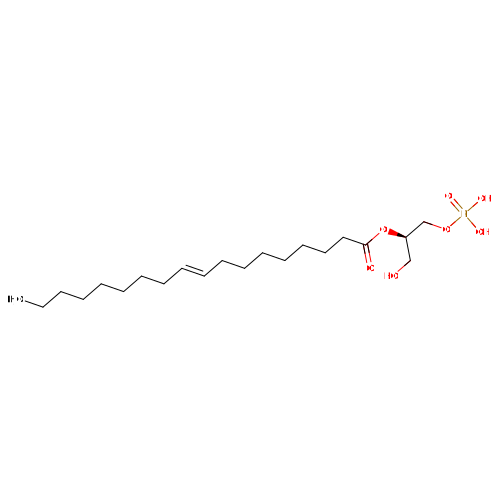
| Record Information |
|---|
| Version | 2.0 |
|---|
| Created at | 2024-09-09 22:40:43 UTC |
|---|
| Updated at | 2024-09-09 22:40:44 UTC |
|---|
| NP-MRD ID | NP0334215 |
|---|
| Secondary Accession Numbers | None |
|---|
| Natural Product Identification |
|---|
| Common Name | LPA(0:0/18:1(9Z)) |
|---|
| Description | LPA(0:0/18:1(9Z)) is a lysophosphatidic acid. It is a glycerophospholipid in which a phosphate moiety occupies a glycerol substitution site. Lysophosphatidic acids can have different combinations of fatty acids of varying lengths and saturation attached at the C-1 (sn-1) or C-2 (sn-2) position. Fatty acids containing 16 and 18 carbons are the most common. Lysophosphatidic acid is the simplest possible glycerophospholipid. It is the biosynthetic precursor of phosphatidic acid. Although it is present at very low levels only in animal tissues, it is extremely important biologically, influencing many biochemical processes. In particular, lysophosphatidic acid is an intercellular lipid mediator with growth factor-like activities, and is rapidly produced and released from activated platelets to influence target cells. 1-Palmitoyl lysophosphatidic acid is the major component of lysophosphatidic acid (LPA) in plasma, and is in a reduced ratio in individuals with gynecological cancers (PMID 11585410 ). LPA is a pluripotent lipid mediator controlling growth, motility, and differentiation, that has a strong influence on the chemotaxis and ultrastructure of human neutrophils (PMID 7416233 ). In serum and plasma, LPA is mainly converted from lysophospholipids, whereas in platelets and some cancer cells it is converted from phosphatidic acid. In each pathway, at least two phospholipase activities are required: Phospholipase A1 (PLA1)/PLA2 plus lysophospholipase D (lysoPLD) activities are involved in the first pathway and phospholipase D (PLD) plus PLA1/PLA2 activities are involved in the second pathway. (PMID 15271293 ) [HMDB] |
|---|
| Structure | [H]\C(CCCCCCCC)=C(\[H])CCCCCCCC(=O)O[C@]([H])(CO)COP(O)(O)=O InChI=1S/C21H41O7P/c1-2-3-4-5-6-7-8-9-10-11-12-13-14-15-16-17-21(23)28-20(18-22)19-27-29(24,25)26/h9-10,20,22H,2-8,11-19H2,1H3,(H2,24,25,26)/b10-9+/t20-/m1/s1 |
|---|
| Synonyms | | Value | Source |
|---|
| [(2R)-3-Hydroxy-2-[(9E)-octadec-9-enoyloxy]propoxy]phosphonate | Generator |
|
|---|
| Chemical Formula | C21H41O7P |
|---|
| Average Mass | 436.5260 Da |
|---|
| Monoisotopic Mass | 436.25899 Da |
|---|
| IUPAC Name | [(2R)-3-hydroxy-2-[(9E)-octadec-9-enoyloxy]propoxy]phosphonic acid |
|---|
| Traditional Name | (2R)-3-hydroxy-2-[(9E)-octadec-9-enoyloxy]propoxyphosphonic acid |
|---|
| CAS Registry Number | Not Available |
|---|
| SMILES | [H]\C(CCCCCCCC)=C(\[H])CCCCCCCC(=O)O[C@]([H])(CO)COP(O)(O)=O |
|---|
| InChI Identifier | InChI=1S/C21H41O7P/c1-2-3-4-5-6-7-8-9-10-11-12-13-14-15-16-17-21(23)28-20(18-22)19-27-29(24,25)26/h9-10,20,22H,2-8,11-19H2,1H3,(H2,24,25,26)/b10-9+/t20-/m1/s1 |
|---|
| InChI Key | ZOOLJLSXNRZLDH-SQUSKLHYSA-N |
|---|
| Experimental Spectra |
|---|
|
| Not Available | | Predicted Spectra |
|---|
|
| Not Available | | Chemical Shift Submissions |
|---|
|
| Not Available | | Species |
|---|
| Species of Origin | Not Available |
|---|
| Chemical Taxonomy |
|---|
| Description | Belongs to the class of organic compounds known as 2-acylglycerol-3-phosphates. These are lysophosphatidic acids where the glycerol is esterified with a fatty acid at O-2 position. |
|---|
| Kingdom | Organic compounds |
|---|
| Super Class | Lipids and lipid-like molecules |
|---|
| Class | Glycerophospholipids |
|---|
| Sub Class | Glycerophosphates |
|---|
| Direct Parent | 2-acylglycerol-3-phosphates |
|---|
| Alternative Parents | |
|---|
| Substituents | - 2-acylglycerol-3-phosphate
- Monoalkyl phosphate
- Fatty acid ester
- Fatty acyl
- Alkyl phosphate
- Phosphoric acid ester
- Organic phosphoric acid derivative
- Carboxylic acid ester
- Monocarboxylic acid or derivatives
- Carboxylic acid derivative
- Organic oxygen compound
- Organic oxide
- Hydrocarbon derivative
- Primary alcohol
- Organooxygen compound
- Carbonyl group
- Alcohol
- Aliphatic acyclic compound
|
|---|
| Molecular Framework | Aliphatic acyclic compounds |
|---|
| External Descriptors | Not Available |
|---|
| Physical Properties |
|---|
| State | Not Available |
|---|
| Experimental Properties | | Property | Value | Reference |
|---|
| Melting Point | Not Available | Not Available | | Boiling Point | Not Available | Not Available | | Water Solubility | Not Available | Not Available | | LogP | Not Available | Not Available |
|
|---|
| Predicted Properties | |
|---|