| Record Information |
|---|
| Version | 2.0 |
|---|
| Created at | 2024-09-09 22:35:12 UTC |
|---|
| Updated at | 2024-09-09 22:35:12 UTC |
|---|
| NP-MRD ID | NP0334194 |
|---|
| Secondary Accession Numbers | None |
|---|
| Natural Product Identification |
|---|
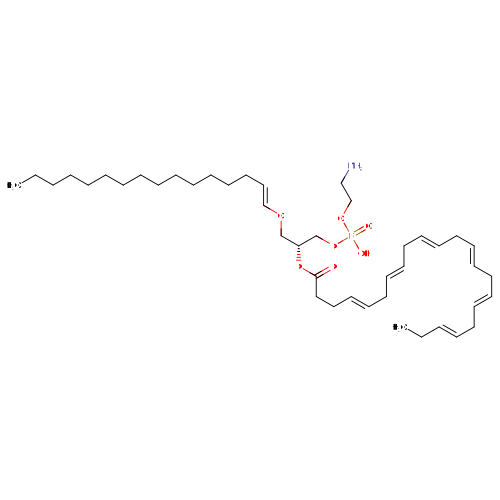
| Common Name | PE(O-16:1(1Z)/22:6(4Z,7Z,10Z,13Z,16Z,19Z)) |
|---|
| Description | A class of glycerophospholipid in which a phosphorylethanolamine moiety occupies a glycerol substitution site. As is the case with diacylglycerols, glycerophosphocholines can have many different combinations of fatty acids of varying lengths and saturation attached at the SN-1 and SN-2 positions. Fatty acids containing 16, 18 and 20 carbons are the most common. (LipidMAPS)
PE(dm16:0/22:6(4Z,7Z,10Z,13Z,16Z,19Z)) is a phosphatidylethanolamine (PE or GPEtn). It is a glycerophospholipid in which a phosphorylethanolamine moiety occupies a glycerol substitution site. As is the case with diacylglycerols, glycerophosphoethanolamines can have many different combinations of fatty acids of varying lengths and saturation attached at the C-1 and C-2 positions. Fatty acids containing 16, 18 and 20 carbons are the most common. PE(dm16:0/22:6(4Z,7Z,10Z,13Z,16Z,19Z)), in particular, consists of one chain of plasmalogen 16:0 At the C-1 position and one chain of docosahexaenoic acid at the C-2 position. The plasmalogen 16:0 Moiety is derived from animal fats, liver and kidney, while the docosahexaenoic acid moiety is derived from fish oils. Phospholipids, are ubiquitous in nature and are key components of the lipid bilayer of cells, as well as being involved in metabolism and signaling.
While most phospholipids have a saturated fatty acid on C-1 and an unsaturated fatty acid on C-2 of the glycerol backbone, the fatty acid distribution at the C-1 and C-2 positions of glycerol within phospholipids is continually in flux, owing to phospholipid degradation and the continuous phospholipid remodeling that occurs while these molecules are in membranes. PEs are neutral zwitterions at physiological pH. They mostly have palmitic or stearic acid on carbon 1 and a long chain unsaturated fatty acid (e.G. 18:2, 20:4 And 22:6) On carbon 2. PE synthesis can occur via two pathways. The first requires that ethanolamine be activated by phosphorylation and then coupled to CDP. The ethanolamine is then transferred from CDP-ethanolamine to phosphatidic acid to yield PE. The second involves the decarboxylation of PS.
Plasmalogens are glycerol ether phospholipids. They are of two types, alkyl ether (-O-CH2-) and alkenyl ether (-O-CH=CH-). Dihydroxyacetone phosphate (DHAP) serves as the glycerol precursor for the synthesis of plasmalogens. Three major classes of plasmalogens have been identified: Choline, ethanolamine and serine derivatives. Ethanolamine plasmalogen is prevalent in myelin. Choline plasmalogen is abundant in cardiac tissue. Usually, the highest proportion of the plasmalogen form is in the ethanolamine class with rather less in choline, and commonly little or none in other phospholipids such as phosphatidylinositol. In choline plasmalogens of most tissues, a higher proportion is often of the O-alkyl rather than the O-alkenyl form, but the reverse tends to be true in heart lipids. In animal tissues, the alkyl and alkenyl moieties in both non-polar and phospholipids tend to be rather simple in composition with 16:0, 18:0 And 18:1 (Double bond in position 9) predominating. Ether analogues of triacylglycerols, i.E. 1-Alkyldiacyl-sn-glycerols, are present at trace levels only if at all in most animal tissues, but they can be major components of some marine lipids. [HMDB] |
|---|
| Structure | [H]\C(CC)=C(\[H])C\C([H])=C(/[H])C\C([H])=C(/[H])C\C([H])=C(/[H])C\C([H])=C(/[H])C\C([H])=C(/[H])CCC(=O)O[C@]([H])(CO\C([H])=C(/[H])CCCCCCCCCCCCCC)COP(O)(=O)OCCN InChI=1S/C43H74NO7P/c1-3-5-7-9-11-13-15-17-19-20-21-22-23-24-26-28-30-32-34-36-43(45)51-42(41-50-52(46,47)49-39-37-44)40-48-38-35-33-31-29-27-25-18-16-14-12-10-8-6-4-2/h5,7,11,13,17,19,21-22,24,26,30,32,35,38,42H,3-4,6,8-10,12,14-16,18,20,23,25,27-29,31,33-34,36-37,39-41,44H2,1-2H3,(H,46,47)/b7-5+,13-11+,19-17+,22-21+,26-24+,32-30+,38-35+/t42-/m1/s1 |
|---|
| Synonyms | Not Available |
|---|
| Chemical Formula | C43H74NO7P |
|---|
| Average Mass | 748.0390 Da |
|---|
| Monoisotopic Mass | 747.52029 Da |
|---|
| IUPAC Name | (2-aminoethoxy)[(2R)-2-[(4E,7E,10E,13E,16E,19E)-docosa-4,7,10,13,16,19-hexaenoyloxy]-3-[(1E)-hexadec-1-en-1-yloxy]propoxy]phosphinic acid |
|---|
| Traditional Name | 2-aminoethoxy((2R)-2-[(4E,7E,10E,13E,16E,19E)-docosa-4,7,10,13,16,19-hexaenoyloxy]-3-[(1E)-hexadec-1-en-1-yloxy]propoxy)phosphinic acid |
|---|
| CAS Registry Number | Not Available |
|---|
| SMILES | [H]\C(CC)=C(\[H])C\C([H])=C(/[H])C\C([H])=C(/[H])C\C([H])=C(/[H])C\C([H])=C(/[H])C\C([H])=C(/[H])CCC(=O)O[C@]([H])(CO\C([H])=C(/[H])CCCCCCCCCCCCCC)COP(O)(=O)OCCN |
|---|
| InChI Identifier | InChI=1S/C43H74NO7P/c1-3-5-7-9-11-13-15-17-19-20-21-22-23-24-26-28-30-32-34-36-43(45)51-42(41-50-52(46,47)49-39-37-44)40-48-38-35-33-31-29-27-25-18-16-14-12-10-8-6-4-2/h5,7,11,13,17,19,21-22,24,26,30,32,35,38,42H,3-4,6,8-10,12,14-16,18,20,23,25,27-29,31,33-34,36-37,39-41,44H2,1-2H3,(H,46,47)/b7-5+,13-11+,19-17+,22-21+,26-24+,32-30+,38-35+/t42-/m1/s1 |
|---|
| InChI Key | WVGALBKSWOUIEZ-DLYXUNISSA-N |
|---|
| Experimental Spectra |
|---|
|
| Not Available | | Predicted Spectra |
|---|
|
| Not Available | | Chemical Shift Submissions |
|---|
|
| Not Available | | Species |
|---|
| Species of Origin | Not Available |
|---|
| Chemical Taxonomy |
|---|
| Description | Belongs to the class of organic compounds known as 1-(1z-alkenyl),2-acylglycerophosphoethanolamines. These are glycerophosphoethanolamines that carry exactly one acyl chain attached to the glycerol moiety through an ester linkage at the O2-position, and one 1Z-alkenyl chain attached through an ether linkage at the O1-position. |
|---|
| Kingdom | Organic compounds |
|---|
| Super Class | Lipids and lipid-like molecules |
|---|
| Class | Glycerophospholipids |
|---|
| Sub Class | Glycerophosphoethanolamines |
|---|
| Direct Parent | 1-(1Z-alkenyl),2-acylglycerophosphoethanolamines |
|---|
| Alternative Parents | |
|---|
| Substituents | - 1-(1z-alkenyl),2-acylglycerophosphoethanolamine
- Glycerol vinyl ether
- Phosphoethanolamine
- Dialkyl phosphate
- Fatty acid ester
- Fatty acyl
- Alkyl phosphate
- Phosphoric acid ester
- Organic phosphoric acid derivative
- Carboxylic acid ester
- Amino acid or derivatives
- Monocarboxylic acid or derivatives
- Carboxylic acid derivative
- Organic nitrogen compound
- Organic oxygen compound
- Organopnictogen compound
- Organic oxide
- Hydrocarbon derivative
- Primary amine
- Organooxygen compound
- Organonitrogen compound
- Primary aliphatic amine
- Carbonyl group
- Amine
- Aliphatic acyclic compound
|
|---|
| Molecular Framework | Aliphatic acyclic compounds |
|---|
| External Descriptors | Not Available |
|---|
| Physical Properties |
|---|
| State | Not Available |
|---|
| Experimental Properties | | Property | Value | Reference |
|---|
| Melting Point | Not Available | Not Available | | Boiling Point | Not Available | Not Available | | Water Solubility | Not Available | Not Available | | LogP | Not Available | Not Available |
|
|---|
| Predicted Properties | |
|---|