| Record Information |
|---|
| Version | 2.0 |
|---|
| Created at | 2024-09-09 22:16:22 UTC |
|---|
| Updated at | 2024-09-09 22:16:22 UTC |
|---|
| NP-MRD ID | NP0334119 |
|---|
| Secondary Accession Numbers | None |
|---|
| Natural Product Identification |
|---|
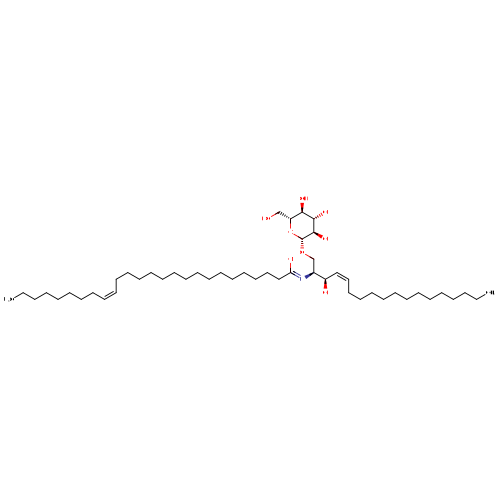
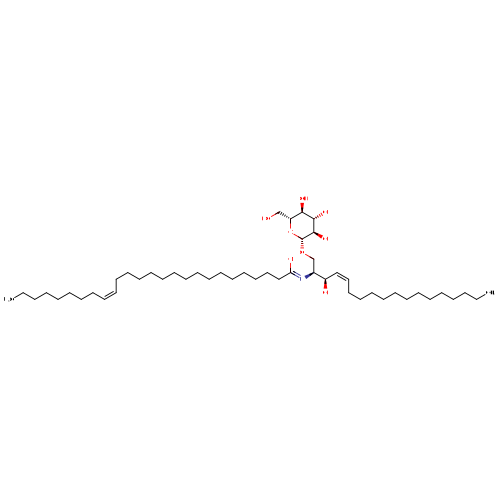
| Common Name | Glucosylceramide (d18:1/26:1(17Z)) |
|---|
| Description | A glycosphingolipid (ceramide and oligosaccharide)or oligoglycosylceramide with one or more sialic acids (i.E. N-acetylneuraminic acid) linked on the sugar chain. It is a component the cell plasma membrane which modulates cell signal transduction events. Gangliosides have been found to be highly important in immunology. Ganglioside GL1a carries a net-negative charge at pH 7.0 And is acidic. Gangliosides can amount to 6% of the weight of lipids from brain, but they are found at low levels in all animal tissues.
Cerebrosides are glycosphingolipids. There are four types of glycosphingolipids, the cerebrosides, sulfatides, globosides and gangliosides. Cerebrosides have a single sugar group linked to ceramide. The most common are galactocerebrosides (containing galactose), the least common are glucocerebrosides (containing glucose). Galactocerebrosides are found predominantly in neuronal cell membranes. In contrast glucocerebrosides are not normally found in membranes. Instead, they are typically intermediates in the synthesis or degradation of more complex glycosphingolipids. Galactocerebrosides are synthesized from ceramide and UDP-galactose. Excess lysosomal accumulation of glucocerebrosides is found in Gaucher disease. [HMDB] |
|---|
| Structure | [H][C@@](O)(\C=C\CCCCCCCCCCCCC)[C@]([H])(CO[C@]1([H])O[C@]([H])(CO)[C@@]([H])(O)[C@]([H])(O)[C@@]1([H])O)\N=C(/O)CCCCCCCCCCCCCCC\C=C\CCCCCCCC InChI=1S/C50H95NO8/c1-3-5-7-9-11-13-15-17-18-19-20-21-22-23-24-25-26-28-30-32-34-36-38-40-46(54)51-43(42-58-50-49(57)48(56)47(55)45(41-52)59-50)44(53)39-37-35-33-31-29-27-16-14-12-10-8-6-4-2/h17-18,37,39,43-45,47-50,52-53,55-57H,3-16,19-36,38,40-42H2,1-2H3,(H,51,54)/b18-17+,39-37+/t43-,44+,45+,47+,48-,49+,50+/m0/s1 |
|---|
| Synonyms | Not Available |
|---|
| Chemical Formula | C50H95NO8 |
|---|
| Average Mass | 838.3090 Da |
|---|
| Monoisotopic Mass | 837.70577 Da |
|---|
| IUPAC Name | (Z,17E)-N-[(2S,3R,4E)-3-hydroxy-1-{[(2R,3R,4S,5S,6R)-3,4,5-trihydroxy-6-(hydroxymethyl)oxan-2-yl]oxy}octadec-4-en-2-yl]hexacos-17-enimidic acid |
|---|
| Traditional Name | (Z,17E)-N-[(2S,3R,4E)-3-hydroxy-1-{[(2R,3R,4S,5S,6R)-3,4,5-trihydroxy-6-(hydroxymethyl)oxan-2-yl]oxy}octadec-4-en-2-yl]hexacos-17-enimidic acid |
|---|
| CAS Registry Number | Not Available |
|---|
| SMILES | [H][C@@](O)(\C=C\CCCCCCCCCCCCC)[C@]([H])(CO[C@]1([H])O[C@]([H])(CO)[C@@]([H])(O)[C@]([H])(O)[C@@]1([H])O)\N=C(/O)CCCCCCCCCCCCCCC\C=C\CCCCCCCC |
|---|
| InChI Identifier | InChI=1S/C50H95NO8/c1-3-5-7-9-11-13-15-17-18-19-20-21-22-23-24-25-26-28-30-32-34-36-38-40-46(54)51-43(42-58-50-49(57)48(56)47(55)45(41-52)59-50)44(53)39-37-35-33-31-29-27-16-14-12-10-8-6-4-2/h17-18,37,39,43-45,47-50,52-53,55-57H,3-16,19-36,38,40-42H2,1-2H3,(H,51,54)/b18-17+,39-37+/t43-,44+,45+,47+,48-,49+,50+/m0/s1 |
|---|
| InChI Key | LVROXDRMMJVBGH-MVCHRRFKSA-N |
|---|
| Experimental Spectra |
|---|
|
| Not Available | | Predicted Spectra |
|---|
|
| Not Available | | Chemical Shift Submissions |
|---|
|
| Not Available | | Species |
|---|
| Species of Origin | Not Available |
|---|
| Chemical Taxonomy |
|---|
| Description | Belongs to the class of organic compounds known as glycosphingolipids. These are sphingolipids containing a saccharide moiety glycosidically attached to the sphingoid base. Although saccharide moieties are mostly O-glycosidically linked to the ceramide moiety, other sphingolipids with glycosidic bonds of other types (e.G. S-,C-, or N-type) has been reported. |
|---|
| Kingdom | Organic compounds |
|---|
| Super Class | Lipids and lipid-like molecules |
|---|
| Class | Sphingolipids |
|---|
| Sub Class | Glycosphingolipids |
|---|
| Direct Parent | Glycosphingolipids |
|---|
| Alternative Parents | |
|---|
| Substituents | - Glycosphingolipid
- Fatty acyl glycoside of mono- or disaccharide
- Fatty acyl glycoside
- Alkyl glycoside
- Fatty acyl
- Oxane
- Monosaccharide
- Secondary alcohol
- Oxacycle
- Organoheterocyclic compound
- Organic 1,3-dipolar compound
- Propargyl-type 1,3-dipolar organic compound
- Carboximidic acid
- Organic nitrogen compound
- Organic oxygen compound
- Organopnictogen compound
- Hydrocarbon derivative
- Organooxygen compound
- Organonitrogen compound
- Alcohol
- Aliphatic heteromonocyclic compound
|
|---|
| Molecular Framework | Aliphatic heteromonocyclic compounds |
|---|
| External Descriptors | Not Available |
|---|
| Physical Properties |
|---|
| State | Not Available |
|---|
| Experimental Properties | | Property | Value | Reference |
|---|
| Melting Point | Not Available | Not Available | | Boiling Point | Not Available | Not Available | | Water Solubility | Not Available | Not Available | | LogP | Not Available | Not Available |
|
|---|
| Predicted Properties | |
|---|