| Record Information |
|---|
| Version | 2.0 |
|---|
| Created at | 2024-09-09 22:06:41 UTC |
|---|
| Updated at | 2024-09-09 22:06:44 UTC |
|---|
| NP-MRD ID | NP0334084 |
|---|
| Secondary Accession Numbers | None |
|---|
| Natural Product Identification |
|---|
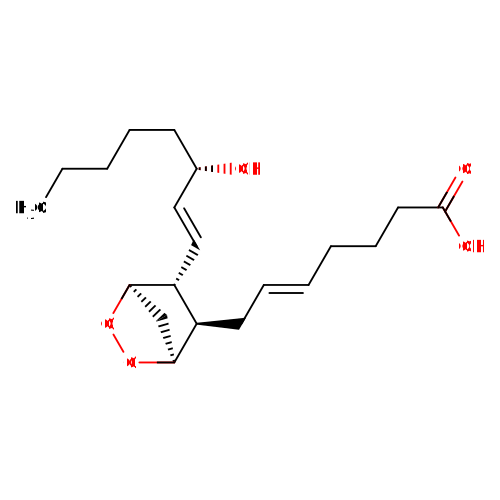
| Common Name | Prostaglandin H2 |
|---|
| Description | Prostaglandin H2 (PGH2) is the first intermediate in the biosynthesis of all prostaglandins. Prostaglandins are synthesized from arachidonic acid by the enzyme COX-1 and COX-2, which are also called PGH synthase 1 and 2. These enzymes generate a reactive intermediate PGH2 which has a reasonably long half-life (90-100 s) but is highly lipophilic. PGH2 is converted into the biologically active prostaglandins by prostaglandin isomerases, yielding PGE2, PGD2, and PGF2, or by thromboxane synthase to make TxA2 or by prostacyclin synthase to make PGI2. Most nonsteroidal anti-inflammatory drugs such as aspirin and indomethacin inhibit both PGH synthase 1 and 2. A key feature for eicosanoid transcellular biosynthesis is the export of PGH2 or LTA4 from the donor cell as well as the uptake of these reactive intermediates by the acceptor cell. Very little is known about either process despite the demonstrated importance of both events.
In cells, PGH2 rearranges nonenzymatically to LGs even in the presence of enzymes that use PGH2 as a substrate. When platelets form Thromboxane A2 (TXA2) from endogenous arachidonic acid (AA), PGH2 reaches concentrations very similar to those of TXA2 and high enough to produce strong platelet activation. Therefore, platelet activation by TXA2 appears to go along with an activation by PGH2. The agonism of PGH2 is limited by the formation of inhibitory prostaglandins, especially PGD2 at higher concentrations. That is why thromboxane synthase inhibitors in PRP and at a physiological HSA concentration do not augment platelet activation. (PMID: 2798452 , 15650407 , 16968946 )
Prostaglandins are eicosanoids. The eicosanoids consist of the prostaglandins (PGs), thromboxanes (TXs), leukotrienes (LTs) and lipoxins (LXs). The PGs and TXs are collectively identified as prostanoids. Prostaglandins were originally shown to be synthesized in the prostate gland, thromboxanes from platelets (thrombocytes) and leukotrienes from leukocytes, hence the derivation of their names. All mammalian cells except erythrocytes synthesize eicosanoids. These molecules are extremely potent, able to cause profound physiological effects at very dilute concentrations. All eicosanoids function locally at the site of synthesis, through receptor-mediated G-protein linked signaling pathways. [HMDB] |
|---|
| Structure | [H]\C(CCCC(O)=O)=C(\[H])C[C@@]1([H])[C@]2([H])C[C@@]([H])(OO2)[C@]1([H])C(\[H])=C(/[H])[C@@]([H])(O)CCCCC InChI=1S/C20H32O5/c1-2-3-6-9-15(21)12-13-17-16(18-14-19(17)25-24-18)10-7-4-5-8-11-20(22)23/h4,7,12-13,15-19,21H,2-3,5-6,8-11,14H2,1H3,(H,22,23)/b7-4+,13-12+/t15-,16+,17+,18-,19+/m0/s1 |
|---|
| Synonyms | | Value | Source |
|---|
| (5E)-7-[(1R,4S,5R,6R)-6-[(1E,3S)-3-Hydroxyoct-1-en-1-yl]-2,3-dioxabicyclo[2.2.1]heptan-5-yl]hept-5-enoate | Generator |
|
|---|
| Chemical Formula | C20H32O5 |
|---|
| Average Mass | 352.4710 Da |
|---|
| Monoisotopic Mass | 352.22497 Da |
|---|
| IUPAC Name | (5E)-7-[(1R,4S,5R,6R)-6-[(1E,3S)-3-hydroxyoct-1-en-1-yl]-2,3-dioxabicyclo[2.2.1]heptan-5-yl]hept-5-enoic acid |
|---|
| Traditional Name | (5E)-7-[(1R,4S,5R,6R)-6-[(1E,3S)-3-hydroxyoct-1-en-1-yl]-2,3-dioxabicyclo[2.2.1]heptan-5-yl]hept-5-enoic acid |
|---|
| CAS Registry Number | Not Available |
|---|
| SMILES | [H]\C(CCCC(O)=O)=C(\[H])C[C@@]1([H])[C@]2([H])C[C@@]([H])(OO2)[C@]1([H])C(\[H])=C(/[H])[C@@]([H])(O)CCCCC |
|---|
| InChI Identifier | InChI=1S/C20H32O5/c1-2-3-6-9-15(21)12-13-17-16(18-14-19(17)25-24-18)10-7-4-5-8-11-20(22)23/h4,7,12-13,15-19,21H,2-3,5-6,8-11,14H2,1H3,(H,22,23)/b7-4+,13-12+/t15-,16+,17+,18-,19+/m0/s1 |
|---|
| InChI Key | YIBNHAJFJUQSRA-UAAPODJFSA-N |
|---|
| Experimental Spectra |
|---|
|
| Not Available | | Predicted Spectra |
|---|
|
| Not Available | | Chemical Shift Submissions |
|---|
|
| Not Available | | Species |
|---|
| Species of Origin | Not Available |
|---|
| Chemical Taxonomy |
|---|
| Description | Belongs to the class of organic compounds known as prostaglandins and related compounds. These are unsaturated carboxylic acids consisting of a 20 carbon skeleton that also contains a five member ring, and are based upon the fatty acid arachidonic acid. |
|---|
| Kingdom | Organic compounds |
|---|
| Super Class | Lipids and lipid-like molecules |
|---|
| Class | Fatty Acyls |
|---|
| Sub Class | Eicosanoids |
|---|
| Direct Parent | Prostaglandins and related compounds |
|---|
| Alternative Parents | |
|---|
| Substituents | - Prostaglandin skeleton
- Long-chain fatty acid
- Hydroxy fatty acid
- Heterocyclic fatty acid
- Fatty acid
- Unsaturated fatty acid
- Ortho-dioxane
- Ortho-dioxolane
- Dialkyl peroxide
- Secondary alcohol
- Oxacycle
- Organoheterocyclic compound
- Monocarboxylic acid or derivatives
- Carboxylic acid
- Carboxylic acid derivative
- Organic oxygen compound
- Organic oxide
- Hydrocarbon derivative
- Organooxygen compound
- Carbonyl group
- Alcohol
- Aliphatic heteropolycyclic compound
|
|---|
| Molecular Framework | Aliphatic heteropolycyclic compounds |
|---|
| External Descriptors | Not Available |
|---|
| Physical Properties |
|---|
| State | Not Available |
|---|
| Experimental Properties | | Property | Value | Reference |
|---|
| Melting Point | Not Available | Not Available | | Boiling Point | Not Available | Not Available | | Water Solubility | Not Available | Not Available | | LogP | Not Available | Not Available |
|
|---|
| Predicted Properties | |
|---|