| Record Information |
|---|
| Version | 2.0 |
|---|
| Created at | 2024-09-09 21:49:12 UTC |
|---|
| Updated at | 2024-09-09 21:49:13 UTC |
|---|
| NP-MRD ID | NP0334048 |
|---|
| Secondary Accession Numbers | None |
|---|
| Natural Product Identification |
|---|
| Common Name | Disodium inosinate |
|---|
| Description | Flavour enhancer
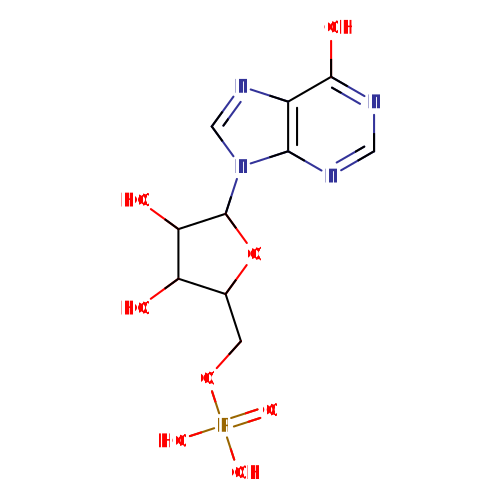
As it is a fairly expensive additive, it usually is not used independently of glutamic acid; if disodium inosinate is present in a list of ingredients but MSG does not appear to be, it is possible that glutamic acid is provided as part of another ingredient or is naturally occurring in another ingredient like tomatoes, Parmesan cheese or yeast extract. It is often added to foods in conjunction with disodium guanylate; the combination is known as disodium 5'-ribonucleotides.; Disodium inosinate (E631), chemical formula C10H11N2Na2O8P, is the disodium salt of inosinic acid. It is a food additive often found in instant noodles, potato chips, and a variety of other snacks. It is used as a flavor enhancer, in synergy with monosodium glutamate (also known as MSG; the sodium salt of glutamic acid) to provide the umami taste. It is mainly found in animals like pigs and fish. |
|---|
| Structure | OC1C(COP(O)(O)=O)OC(C1O)N1C=NC2=C1N=CN=C2O InChI=1/C10H13N4O8P/c15-6-4(1-21-23(18,19)20)22-10(7(6)16)14-3-13-5-8(14)11-2-12-9(5)17/h2-4,6-7,10,15-16H,1H2,(H,11,12,17)(H2,18,19,20) |
|---|
| Synonyms | | Value | Source |
|---|
| Disodium inosinic acid | Generator |
|
|---|
| Chemical Formula | C10H13N4O8P |
|---|
| Average Mass | 348.2080 Da |
|---|
| Monoisotopic Mass | 348.04710 Da |
|---|
| IUPAC Name | {[3,4-dihydroxy-5-(6-hydroxy-9H-purin-9-yl)oxolan-2-yl]methoxy}phosphonic acid |
|---|
| Traditional Name | inosinic acid |
|---|
| CAS Registry Number | Not Available |
|---|
| SMILES | OC1C(COP(O)(O)=O)OC(C1O)N1C=NC2=C1N=CN=C2O |
|---|
| InChI Identifier | InChI=1/C10H13N4O8P/c15-6-4(1-21-23(18,19)20)22-10(7(6)16)14-3-13-5-8(14)11-2-12-9(5)17/h2-4,6-7,10,15-16H,1H2,(H,11,12,17)(H2,18,19,20) |
|---|
| InChI Key | GRSZFWQUAKGDAV-UHFFFAOYNA-N |
|---|
| Experimental Spectra |
|---|
|
| Not Available | | Predicted Spectra |
|---|
|
| Not Available | | Chemical Shift Submissions |
|---|
|
| Not Available | | Species |
|---|
| Species of Origin | Not Available |
|---|
| Chemical Taxonomy |
|---|
| Description | This compound belongs to the class of organic compounds known as purine ribonucleoside monophosphates. These are nucleotides consisting of a purine base linked to a ribose to which one monophosphate group is attached. |
|---|
| Kingdom | Organic compounds |
|---|
| Super Class | Nucleosides, nucleotides, and analogues |
|---|
| Class | Purine nucleotides |
|---|
| Sub Class | Purine ribonucleotides |
|---|
| Direct Parent | Purine ribonucleoside monophosphates |
|---|
| Alternative Parents | |
|---|
| Substituents | - Purine ribonucleoside monophosphate
- Pentose phosphate
- Pentose-5-phosphate
- Glycosyl compound
- N-glycosyl compound
- 6-oxopurine
- Hypoxanthine
- Monosaccharide phosphate
- Pentose monosaccharide
- Imidazopyrimidine
- Purine
- Monoalkyl phosphate
- Pyrimidone
- Monosaccharide
- N-substituted imidazole
- Organic phosphoric acid derivative
- Phosphoric acid ester
- Alkyl phosphate
- Pyrimidine
- Tetrahydrofuran
- Azole
- Vinylogous amide
- Heteroaromatic compound
- Imidazole
- Secondary alcohol
- 1,2-diol
- Organoheterocyclic compound
- Azacycle
- Oxacycle
- Organooxygen compound
- Hydrocarbon derivative
- Organic oxide
- Organopnictogen compound
- Organic nitrogen compound
- Alcohol
- Organic oxygen compound
- Organonitrogen compound
- Aromatic heteropolycyclic compound
|
|---|
| Molecular Framework | Aromatic heteropolycyclic compounds |
|---|
| External Descriptors | Not Available |
|---|
| Physical Properties |
|---|
| State | Not Available |
|---|
| Experimental Properties | | Property | Value | Reference |
|---|
| Melting Point | Not Available | Not Available | | Boiling Point | Not Available | Not Available | | Water Solubility | Not Available | Not Available | | LogP | Not Available | Not Available |
|
|---|
| Predicted Properties | |
|---|
| General References | - Reis Rocha RA, Reis Rocha LC, Ribeiro MN, Lima Ribeiro AP, Alves da Rocha R, Souza Carneiro JD: Effect of the food matrix on the capacity of flavor enhancers in intensifying salty taste. J Food Sci. 2021 Mar;86(3):1022-1032. doi: 10.1111/1750-3841.15634. Epub 2021 Feb 21. [PubMed:33615480 ]
- Wang S, Lu D, Pang G: Construction of a Ginseng Root-Meristem Sensor and a Sensing Kinetics Study on the Main Nitrogen Nutrients. Sensors (Basel). 2021 Jan 20;21(3):681. doi: 10.3390/s21030681. [PubMed:33498310 ]
- Li J, Zhong F, Spence C, Xia Y: Synergistic effect of combining umami substances enhances perceived saltiness. Food Res Int. 2024 Aug;189:114516. doi: 10.1016/j.foodres.2024.114516. Epub 2024 May 10. [PubMed:38876587 ]
- Liu J, Cha YK, Choi Y, Lee SE, Wang G, Zhao S, Park TH, Liu Y, Hong S: Hydrogel-based Bioelectronic Tongue for the Evaluation of Umami Taste in Fermented Fish. ACS Sens. 2023 Jul 28;8(7):2750-2760. doi: 10.1021/acssensors.3c00646. Epub 2023 Jul 6. [PubMed:37409469 ]
- Lu D, Liu D, Liu Y, Wang X, Liu Y, Yuan S, Ren R, Pang G: Comparative Study on the Sensing Kinetics of Carbon and Nitrogen Nutrients in Cancer Tissues and Normal Tissues Based Electrochemical Biosensors. Molecules. 2023 Feb 2;28(3):1453. doi: 10.3390/molecules28031453. [PubMed:36771115 ]
|
|---|