| Record Information |
|---|
| Version | 2.0 |
|---|
| Created at | 2024-09-09 21:35:53 UTC |
|---|
| Updated at | 2024-09-09 21:35:53 UTC |
|---|
| NP-MRD ID | NP0333996 |
|---|
| Secondary Accession Numbers | None |
|---|
| Natural Product Identification |
|---|
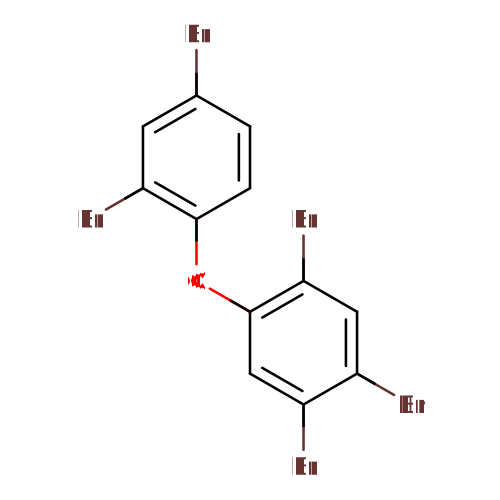
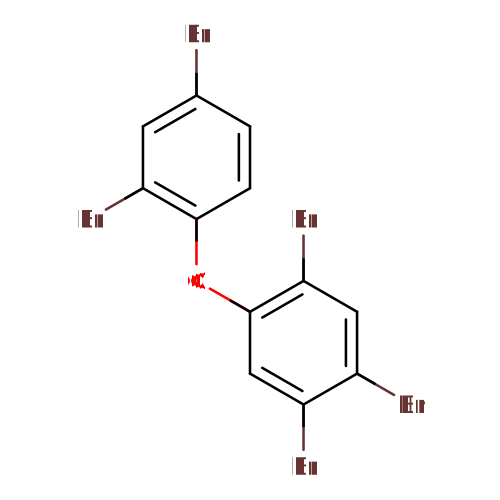
| Common Name | 1,2,4-Tribromo-5-(2,4-dibromophenoxy)benzene |
|---|
| Description | Classified as a Food Contaminant (code WG) in the DFC |
|---|
| Structure | BrC1=CC(Br)=C(OC2=C(Br)C=C(Br)C(Br)=C2)C=C1 InChI=1S/C12H5Br5O/c13-6-1-2-11(9(16)3-6)18-12-5-8(15)7(14)4-10(12)17/h1-5H |
|---|
| Synonyms | | Value | Source |
|---|
| 1,2,4-Tribromo-5-(2,4-dibromophenoxy)benzene | ChEBI | | 2,2',4,4',5-Pentabromodiphenyl ether | ChEBI | | BDE 99 | ChEBI | | BDE-99 | ChEBI | | PBDE 99 | ChEBI | | PBDE-99 | ChEBI | | 2,2',3,4,4'-Pentabromodiphenyl ether | HMDB | | 2,2',4,4',6-Pentabromodiphenyl ether | HMDB | | DE-71 | HMDB | | PBDE 85 | HMDB | | DE 71 | HMDB | | 2,2',4,4',5-PentaBDE | HMDB | | PBDE | HMDB | | PBDE 100 | HMDB | | Pentabromodiphenyl ether | HMDB | | Pentabromodiphenyl ether (mixed isomers) | MeSH |
|
|---|
| Chemical Formula | C12H5Br5O |
|---|
| Average Mass | 564.6880 Da |
|---|
| Monoisotopic Mass | 559.62573 Da |
|---|
| IUPAC Name | 1,2,4-tribromo-5-(2,4-dibromophenoxy)benzene |
|---|
| Traditional Name | pentabromodiphenyl ether |
|---|
| CAS Registry Number | Not Available |
|---|
| SMILES | BrC1=CC(Br)=C(OC2=C(Br)C=C(Br)C(Br)=C2)C=C1 |
|---|
| InChI Identifier | InChI=1S/C12H5Br5O/c13-6-1-2-11(9(16)3-6)18-12-5-8(15)7(14)4-10(12)17/h1-5H |
|---|
| InChI Key | WHPVYXDFIXRKLN-UHFFFAOYSA-N |
|---|
| Experimental Spectra |
|---|
|
| Not Available | | Predicted Spectra |
|---|
|
| Not Available | | Chemical Shift Submissions |
|---|
|
| Not Available | | Species |
|---|
| Species of Origin | Not Available |
|---|
| Chemical Taxonomy |
|---|
| Description | Belongs to the class of organic compounds known as bromodiphenyl ethers. Bromodiphenyl ethers are compounds that contain two benzene groups linked to each other via an ether bond, and where at least one ring is substituted with a bromo group. |
|---|
| Kingdom | Organic compounds |
|---|
| Super Class | Benzenoids |
|---|
| Class | Benzene and substituted derivatives |
|---|
| Sub Class | Diphenylethers |
|---|
| Direct Parent | Bromodiphenyl ethers |
|---|
| Alternative Parents | |
|---|
| Substituents | - Bromodiphenyl ether
- Diaryl ether
- Phenoxy compound
- Phenol ether
- Halobenzene
- Bromobenzene
- Aryl halide
- Aryl bromide
- Ether
- Organic oxygen compound
- Hydrocarbon derivative
- Organooxygen compound
- Organobromide
- Organohalogen compound
- Aromatic homomonocyclic compound
|
|---|
| Molecular Framework | Aromatic homomonocyclic compounds |
|---|
| External Descriptors | |
|---|
| Physical Properties |
|---|
| State | Not Available |
|---|
| Experimental Properties | | Property | Value | Reference |
|---|
| Melting Point | Not Available | Not Available | | Boiling Point | Not Available | Not Available | | Water Solubility | Not Available | Not Available | | LogP | Not Available | Not Available |
|
|---|
| Predicted Properties | |
|---|
| General References | - Winter V, Williams TD, Elliott JE: A three-generational study of In ovo exposure to PBDE-99 in the zebra finch. Environ Toxicol Chem. 2013 Mar;32(3):562-8. doi: 10.1002/etc.2102. [PubMed:23258742 ]
- Eng ML, Elliott JE, Williams TD: An assessment of the developmental toxicity of BDE-99 in the European starling using an integrated laboratory and field approach. Ecotoxicology. 2014 Oct;23(8):1505-16. doi: 10.1007/s10646-014-1292-9. Epub 2014 Aug 1. [PubMed:25081382 ]
- Erratico C, Currier H, Szeitz A, Bandiera S, Covaci A, Elliott J: Levels of PBDEs in plasma of juvenile starlings (Sturnus vulgaris) from British Columbia, Canada and assessment of PBDE metabolism by avian liver microsomes. Sci Total Environ. 2015 Jun 15;518-519:31-7. doi: 10.1016/j.scitotenv.2014.12.102. Epub 2015 Mar 3. [PubMed:25747361 ]
- Wang F, Ruan XJ, Zhang HY: BDE-99 (2,2',4,4',5-pentabromodiphenyl ether) triggers epithelial-mesenchymal transition in colorectal cancer cells via PI3K/Akt/Snail signaling pathway. Tumori. 2015 Mar-Apr;101(2):238-45. doi: 10.5301/tj.5000229. Epub 2015 Apr 9. [PubMed:25908029 ]
- Erratico C, Zheng X, Ryden A, Marsh G, Maho W, Covaci A: Human hydroxylated metabolites of BDE-47 and BDE-99 are glucuronidated and sulfated in vitro. Toxicol Lett. 2015 Jul 16;236(2):98-109. doi: 10.1016/j.toxlet.2015.05.003. Epub 2015 May 5. [PubMed:25956475 ]
|
|---|