| Record Information |
|---|
| Version | 2.0 |
|---|
| Created at | 2024-09-09 21:33:45 UTC |
|---|
| Updated at | 2024-09-09 21:33:45 UTC |
|---|
| NP-MRD ID | NP0333987 |
|---|
| Secondary Accession Numbers | None |
|---|
| Natural Product Identification |
|---|
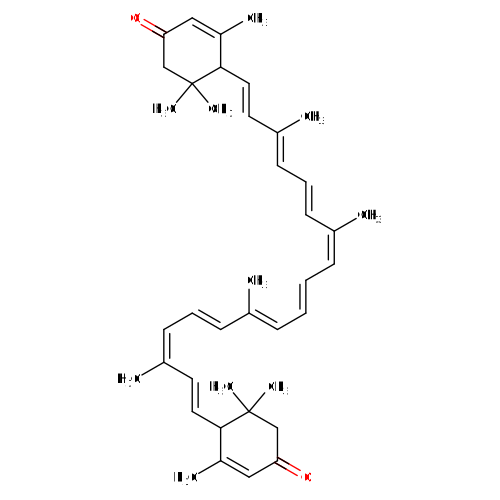
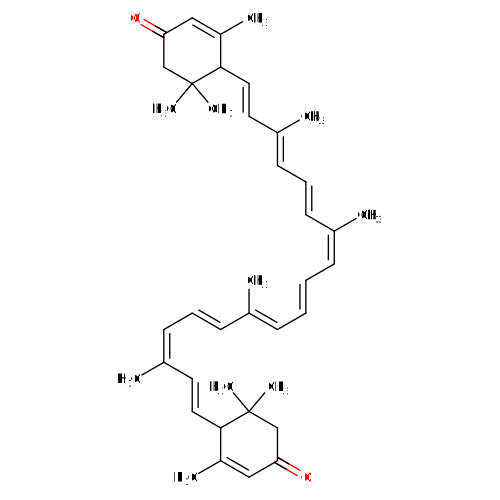
| Common Name | epsilon,epsilon-Carotene-3,3'-dione |
|---|
| Description | Constituent of Sebastes flavidus and other fishand is) also found in chitons
Carotene-3,3'-dione is a carotenoid found in human fluids.; Carotenoids are isoprenoid molecules that are widespread in nature and are typically seen as pigments in fruits, flowers, birds and crustacea. Animals are unable to synthesise carotenoids de novo, and rely upon the diet as a source of these compounds. Over recent years there has been considerable interest in dietary carotenoids with respect to their potential in alleviating age-related diseases in humans. This attention has been mirrored by significant advances in cloning most of the carotenoid genes and in the genetic manipulation of crop plants with the intention of increasing levels in the diet. Studies have shown an inverse relationship between the consumption of certain fruits and vegetables and the risk of epithelial cancer. Since carotenoids are among the micronutrients found in cancer preventive foods, detailed qualitative and quantitative determination of these compounds, particularly in fruits and vegetables and in human plasma, have recently become increasingly important. (PMID: 1416048 , 15003396 ) |
|---|
| Structure | [H]\C(=C(\[H])/C(/[H])=C(/C)\C(\[H])=C(/[H])\C(\[H])=C(/C)\C(\[H])=C(/[H])C1C(C)=CC(=O)CC1(C)C)\C(\[H])=C(/C)\C(\[H])=C(/[H])\C(\[H])=C(\C)C([H])=C([H])C1C(C)=CC(=O)CC1(C)C InChI=1/C40H52O2/c1-29(17-13-19-31(3)21-23-37-33(5)25-35(41)27-39(37,7)8)15-11-12-16-30(2)18-14-20-32(4)22-24-38-34(6)26-36(42)28-40(38,9)10/h11-26,37-38H,27-28H2,1-10H3/b12-11+,17-13+,18-14+,23-21+,24-22+,29-15-,30-16+,31-19+,32-20- |
|---|
| Synonyms | Not Available |
|---|
| Chemical Formula | C40H52O2 |
|---|
| Average Mass | 564.8540 Da |
|---|
| Monoisotopic Mass | 564.39673 Da |
|---|
| IUPAC Name | 3,5,5-trimethyl-4-[(3Z,5E,7E,9E,11Z,13E,15E,17E)-3,7,12,16-tetramethyl-18-(2,6,6-trimethyl-4-oxocyclohex-2-en-1-yl)octadeca-1,3,5,7,9,11,13,15,17-nonaen-1-yl]cyclohex-2-en-1-one |
|---|
| Traditional Name | 3,5,5-trimethyl-4-[(3Z,5E,7E,9E,11Z,13E,15E,17E)-3,7,12,16-tetramethyl-18-(2,6,6-trimethyl-4-oxocyclohex-2-en-1-yl)octadeca-1,3,5,7,9,11,13,15,17-nonaen-1-yl]cyclohex-2-en-1-one |
|---|
| CAS Registry Number | Not Available |
|---|
| SMILES | [H]\C(=C(\[H])/C(/[H])=C(/C)\C(\[H])=C(/[H])\C(\[H])=C(/C)\C(\[H])=C(/[H])C1C(C)=CC(=O)CC1(C)C)\C(\[H])=C(/C)\C(\[H])=C(/[H])\C(\[H])=C(\C)C([H])=C([H])C1C(C)=CC(=O)CC1(C)C |
|---|
| InChI Identifier | InChI=1/C40H52O2/c1-29(17-13-19-31(3)21-23-37-33(5)25-35(41)27-39(37,7)8)15-11-12-16-30(2)18-14-20-32(4)22-24-38-34(6)26-36(42)28-40(38,9)10/h11-26,37-38H,27-28H2,1-10H3/b12-11+,17-13+,18-14+,23-21+,24-22+,29-15-,30-16+,31-19+,32-20- |
|---|
| InChI Key | IMFOMPZKWQBDLQ-NRERWQMGNA-N |
|---|
| Experimental Spectra |
|---|
|
| Not Available | | Predicted Spectra |
|---|
|
| Not Available | | Chemical Shift Submissions |
|---|
|
| Not Available | | Species |
|---|
| Species of Origin | Not Available |
|---|
| Chemical Taxonomy |
|---|
| Description | This compound belongs to the class of organic compounds known as xanthophylls. These are carotenoids containing an oxygenated carotene backbone. Carotenes are characterized by the presence of two end-groups (mostly cyclohexene rings, but also cyclopentene rings or acyclic groups) linked by a long branched alkyl chain. Carotenes belonging form a subgroup of the carotenoids family. Xanthophylls arise by oxygenation of the carotene backbone. |
|---|
| Kingdom | Organic compounds |
|---|
| Super Class | Lipids and lipid-like molecules |
|---|
| Class | Prenol lipids |
|---|
| Sub Class | Tetraterpenoids |
|---|
| Direct Parent | Xanthophylls |
|---|
| Alternative Parents | |
|---|
| Substituents | - Xanthophyll
- Cyclohexenone
- Alpha,beta-unsaturated ketone
- Enone
- Acryloyl-group
- Cyclic ketone
- Ketone
- Organic oxygen compound
- Organic oxide
- Hydrocarbon derivative
- Organooxygen compound
- Aliphatic homomonocyclic compound
|
|---|
| Molecular Framework | Aliphatic homomonocyclic compounds |
|---|
| External Descriptors | Not Available |
|---|
| Physical Properties |
|---|
| State | Not Available |
|---|
| Experimental Properties | | Property | Value | Reference |
|---|
| Melting Point | Not Available | Not Available | | Boiling Point | Not Available | Not Available | | Water Solubility | Not Available | Not Available | | LogP | Not Available | Not Available |
|
|---|
| Predicted Properties | |
|---|
| General References | - Khachik F, Beecher GR, Goli MB, Lusby WR, Smith JC Jr: Separation and identification of carotenoids and their oxidation products in the extracts of human plasma. Anal Chem. 1992 Sep 15;64(18):2111-22. doi: 10.1021/ac00042a016. [PubMed:1416048 ]
- Nagao A, Maoka T, Ono H, Kotake-Nara E, Kobayashi M, Tomita M: A 3-hydroxy beta-end group in xanthophylls is preferentially oxidized to a 3-oxo epsilon-end group in mammals. J Lipid Res. 2015 Feb;56(2):449-62. doi: 10.1194/jlr.P055459. Epub 2014 Dec 12. [PubMed:25502844 ]
- Yonekura L, Kobayashi M, Terasaki M, Nagao A: Keto-carotenoids are the major metabolites of dietary lutein and fucoxanthin in mouse tissues. J Nutr. 2010 Oct;140(10):1824-31. doi: 10.3945/jn.110.126466. Epub 2010 Aug 25. [PubMed:20739451 ]
- Hudon J, Anciaes M, Bertacche V, Stradi R: Plumage carotenoids of the Pin-tailed Manakin (Ilicura militaris): evidence for the endogenous production of rhodoxanthin from a colour variant. Comp Biochem Physiol B Biochem Mol Biol. 2007 Jul;147(3):402-11. doi: 10.1016/j.cbpb.2007.02.004. Epub 2007 Feb 24. [PubMed:17400013 ]
- Khachik F, de Moura FF, Chew EY, Douglass LW, Ferris FL 3rd, Kim J, Thompson DJ: The effect of lutein and zeaxanthin supplementation on metabolites of these carotenoids in the serum of persons aged 60 or older. Invest Ophthalmol Vis Sci. 2006 Dec;47(12):5234-42. doi: 10.1167/iovs.06-0504. [PubMed:17122108 ]
|
|---|