Np mrd loader

Record Information
Version2.0
Created at2024-09-09 21:30:47 UTC
Updated at2024-09-09 21:30:48 UTC
NP-MRD IDNP0333975
Secondary Accession NumbersNone
Natural Product Identification
Common NameSyringomycin
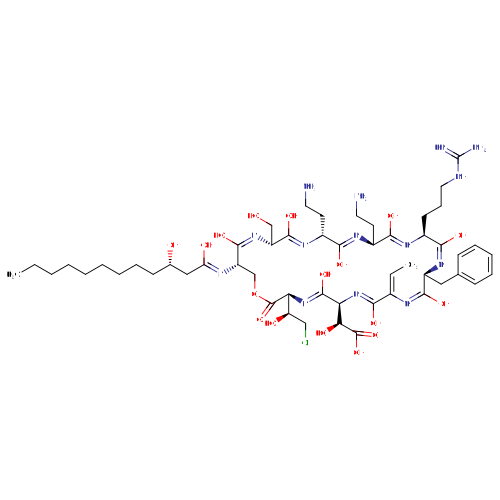
DescriptionProduction by a sugar cane isolate of Pseudomonas syringae pv. Syringae Syringomycin is a general name given to a class of lipodepsinonapeptide molecules which are secreted by the plant pathogen Pseudomonas syringae. Lipodepsinonapeptides comprise a closed ring of nine nonribosomally-synthesized amino acids bonded to a fatty acid hydrocarbon tail. A commonly-encountered pathovar (pv) of P. Syringae is P. Syringae pv syringae which secretes a number of closely-related forms of the molecule. Syringomycins are virulence determinants which means that their secretion is required for the manifestation of disease symptoms on a number of stone fruit crop plants.
Structure
Thumb
SynonymsNot Available
Chemical FormulaC53H85ClN14O17
Average Mass1225.7900 Da
Monoisotopic Mass1224.59056 Da
IUPAC Name(2S)-2-[(3S,4Z,6S,7Z,9E,10E,12S,13E,15S,16Z,18S,19Z,21R,22Z,24R,25E,27S)-18,21-bis(2-aminoethyl)-12-benzyl-15-(3-carbamimidamidopropyl)-3-[(1S)-2-chloro-1-hydroxyethyl]-27-[(Z)-[(3S)-1,3-dihydroxydodecylidene]amino]-9-ethylidene-5,8,11,14,17,20,23,26-octahydroxy-24-(hydroxymethyl)-2-oxo-1-oxa-4,7,10,13,16,19,22,25-octaazacyclooctacosa-4,7,10,13,16,19,22,25-octaen-6-yl]-2-hydroxyacetic acid
Traditional Name(S)-[(3S,4Z,6S,7Z,9E,10E,12S,13E,15S,16Z,18S,19Z,21R,22Z,24R,25E,27S)-18,21-bis(2-aminoethyl)-12-benzyl-15-(3-carbamimidamidopropyl)-3-[(1S)-2-chloro-1-hydroxyethyl]-27-[(Z)-[(3S)-1,3-dihydroxydodecylidene]amino]-9-ethylidene-5,8,11,14,17,20,23,26-octahydroxy-24-(hydroxymethyl)-2-oxo-1-oxa-4,7,10,13,16,19,22,25-octaazacyclooctacosa-4,7,10,13,16,19,22,25-octaen-6-yl](hydroxy)acetic acid
CAS Registry NumberNot Available
SMILES
[H]\C(C)=C1/N=C(O)\[C@]([H])(CC2=CC=CC=C2)\N=C(O)/[C@]([H])(CCCNC(N)=N)\N=C(O)\[C@]([H])(CCN)\N=C(O)\[C@@]([H])(CCN)\N=C(O)\[C@@]([H])(CO)\N=C(O)/[C@]([H])(COC(=O)[C@@]([H])(\N=C(O)\[C@@]([H])(/N=C/1\O)[C@]([H])(O)C(O)=O)[C@]([H])(O)CCl)\N=C(/O)C[C@@]([H])(O)CCCCCCCCC
InChI Identifier
InChI=1S/C53H85ClN14O17/c1-3-5-6-7-8-9-13-17-30(70)25-39(72)60-37-28-85-52(84)40(38(71)26-54)67-50(81)41(42(73)51(82)83)68-43(74)31(4-2)61-47(78)35(24-29-15-11-10-12-16-29)65-44(75)32(18-14-23-59-53(57)58)62-45(76)33(19-21-55)63-46(77)34(20-22-56)64-48(79)36(27-69)66-49(37)80/h4,10-12,15-16,30,32-38,40-42,69-71,73H,3,5-9,13-14,17-28,55-56H2,1-2H3,(H,60,72)(H,61,78)(H,62,76)(H,63,77)(H,64,79)(H,65,75)(H,66,80)(H,67,81)(H,68,74)(H,82,83)(H4,57,58,59)/b31-4+/t30-,32-,33-,34+,35-,36+,37-,38+,40-,41-,42-/m0/s1
InChI KeyZQVJBRJGDVZANE-UYFKPPDASA-N
Experimental Spectra
Not Available
Predicted Spectra
Not Available
Chemical Shift Submissions
Not Available
Species
Species of OriginNot Available
Chemical Taxonomy
Description Belongs to the class of organic compounds known as cyclic depsipeptides. These are natural or synthetic compounds having sequences of amino and hydroxy carboxylic acid residues (usually α-amino and α-hydroxy acids) connected in a ring. The residues are commonly but not necessarily regularly alternating.
KingdomOrganic compounds
Super ClassOrganic acids and derivatives
ClassPeptidomimetics
Sub ClassDepsipeptides
Direct ParentCyclic depsipeptides
Alternative Parents
Substituents
  • Cyclic depsipeptide
  • Macrolactam
  • Alpha-amino acid ester
  • Alpha-amino acid or derivatives
  • Benzenoid
  • Hydroxy acid
  • Dicarboxylic acid or derivatives
  • Monocyclic benzene moiety
  • Alpha-hydroxy acid
  • Cyclic carboximidic acid
  • Amino acid
  • Secondary alcohol
  • Lactone
  • Halohydrin
  • Guanidine
  • Chlorohydrin
  • Carboxylic acid ester
  • Amino acid or derivatives
  • Oxacycle
  • Azacycle
  • Organoheterocyclic compound
  • Organic 1,3-dipolar compound
  • Propargyl-type 1,3-dipolar organic compound
  • Carboximidamide
  • Polyol
  • Carboxylic acid
  • Carboxylic acid derivative
  • Carboximidic acid derivative
  • Carboximidic acid
  • Organic nitrogen compound
  • Organic oxygen compound
  • Organopnictogen compound
  • Organic oxide
  • Hydrocarbon derivative
  • Primary amine
  • Primary alcohol
  • Organooxygen compound
  • Organonitrogen compound
  • Organochloride
  • Organohalogen compound
  • Primary aliphatic amine
  • Imine
  • Carbonyl group
  • Amine
  • Alkyl halide
  • Alkyl chloride
  • Alcohol
  • Aromatic heteromonocyclic compound
Molecular FrameworkAromatic heteromonocyclic compounds
External DescriptorsNot Available
Physical Properties
StateNot Available
Experimental Properties
PropertyValueReference
Melting PointNot AvailableNot Available
Boiling PointNot AvailableNot Available
Water SolubilityNot AvailableNot Available
LogPNot AvailableNot Available
Predicted Properties
PropertyValueSource
logP-0.43ChemAxon
pKa (Strongest Acidic)2.29ChemAxon
pKa (Strongest Basic)11.91ChemAxon
Physiological Charge3ChemAxon
Hydrogen Acceptor Count30ChemAxon
Hydrogen Donor Count19ChemAxon
Polar Surface Area551.77 ŲChemAxon
Rotatable Bond Count26ChemAxon
Refractivity318.36 m³·mol⁻¹ChemAxon
Polarizability124.94 ųChemAxon
Number of Rings2ChemAxon
BioavailabilityNoChemAxon
Rule of FiveNoChemAxon
Ghose FilterNoChemAxon
Veber's RuleNoChemAxon
MDDR-like RuleNoChemAxon
HMDB IDNot Available
DrugBank IDNot Available
Phenol Explorer Compound IDNot Available
FoodDB IDNot Available
KNApSAcK IDNot Available
Chemspider IDNot Available
KEGG Compound IDNot Available
BioCyc IDNot Available
BiGG IDNot Available
Wikipedia LinkSyringomycin E
METLIN IDNot Available
PubChem CompoundNot Available
PDB IDNot Available
ChEBI IDNot Available
Good Scents IDNot Available
References
General References
  1. Maguvu TE, Frias RJ, Hernandez-Rosas AI, Shipley E, Dardani G, Nouri MT, Yaghmour MA, Trouillas FP: Pathogenicity, phylogenomic, and comparative genomic study of Pseudomonas syringae sensu lato affecting sweet cherry in California. Microbiol Spectr. 2024 Oct 3;12(10):e0132424. doi: 10.1128/spectrum.01324-24. Epub 2024 Sep 3. [PubMed:39225473 ]
  2. Sarkar R, Adhikary K, Banerjee A, Ganguly K, Sarkar R, Mohanty S, Dhua R, Bhattacharya K, Ahuja D, Pal S, Maiti R: Novel targets and improved immunotherapeutic techniques with an emphasis on antimycosal drug resistance for the treatment and management of mycosis. Heliyon. 2024 Aug 6;10(16):e35835. doi: 10.1016/j.heliyon.2024.e35835. eCollection 2024 Aug 30. [PubMed:39224344 ]
  3. Vadillo-Dieguez A, Zeng Z, Mansfield JW, Grinberg NF, Lynn SC, Gregg A, Connell J, Harrison RJ, Jackson RW, Hulin MT: Genetic dissection of the tissue-specific roles of type III effectors and phytotoxins in the pathogenicity of Pseudomonas syringae pv. syringae to cherry. Mol Plant Pathol. 2024 Apr;25(4):e13451. doi: 10.1111/mpp.13451. [PubMed:38590135 ]
  4. Swiatczak J, Kalwasinska A, Brzezinska MS: Plant growth-promoting rhizobacteria: Peribacillus frigoritolerans 2RO30 and Pseudomonas sivasensis 2RO45 for their effect on canola growth under controlled as well as natural conditions. Front Plant Sci. 2024 Jan 8;14:1233237. doi: 10.3389/fpls.2023.1233237. eCollection 2023. [PubMed:38259930 ]
  5. Tomita S, Kuroda K, Narihiro T: A small step to discover candidate biological control agents from preexisting bioresources by using novel nonribosomal peptide synthetases hidden in activated sludge metagenomes. PLoS One. 2023 Nov 27;18(11):e0294843. doi: 10.1371/journal.pone.0294843. eCollection 2023. [PubMed:38011171 ]
  6. Lee S, Cheon W, Kwon HT, Lee Y, Kim J, Balaraju K, Jeon Y: Identification and Characterization of Pseudomonas syringae pv. syringae, a Causative Bacterium of Apple Canker in Korea. Plant Pathol J. 2023 Feb;39(1):88-107. doi: 10.5423/PPJ.OA.08.2022.0121. Epub 2023 Feb 1. [PubMed:36760052 ]
  7. Novoderezhkin VI, Rokitskaya TI, Kotova EA, Antonenko YN: Synchronization of opening and closing of two gramicidin A channels pulled together by a linker: possible relevance to channel clustering. Phys Chem Chem Phys. 2023 Feb 1;25(5):3752-3757. doi: 10.1039/d2cp04884a. [PubMed:36644888 ]
  8. Tarakanov RI, Ignatov AN, Dzhalilov FS: Genetic and phenotypical diversity of Pseudomonas syringae population in the Russian Federation. Braz J Biol. 2022 Oct 21;84:e264224. doi: 10.1590/1519-6984.264224. eCollection 2022. [PubMed:36287527 ]
  9. Bricout A, Morris CE, Chandeysson C, Duban M, Boistel C, Chataigne G, Lecouturier D, Jacques P, Leclere V, Rochex A: The Diversity of Lipopeptides in the Pseudomonas syringae Complex Parallels Phylogeny and Sheds Light on Structural Diversification during Evolutionary History. Microbiol Spectr. 2022 Dec 21;10(6):e0145622. doi: 10.1128/spectrum.01456-22. Epub 2022 Oct 26. [PubMed:36287007 ]
  10. Ivanovic M, Prokic A, Gasic K, Menkovic J, Kuzmanovic N, Zlatkovic N, Obradovic A: Characterization of Pseudomonas syringae Strains Associated with Shoot Blight of Raspberry and Blackberry in Serbia. Plant Dis. 2023 Mar;107(3):826-833. doi: 10.1094/PDIS-06-22-1425-RE. Epub 2023 Mar 7. [PubMed:35952382 ]