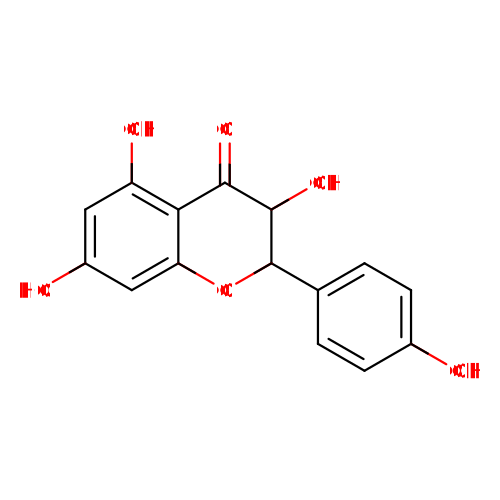
| Record Information |
|---|
| Version | 2.0 |
|---|
| Created at | 2024-09-09 21:24:07 UTC |
|---|
| Updated at | 2024-09-09 21:24:08 UTC |
|---|
| NP-MRD ID | NP0333951 |
|---|
| Secondary Accession Numbers | None |
|---|
| Natural Product Identification |
|---|
| Common Name | Dihydrokaempferol |
|---|
| Description | Dihydrokaempferol, also known as aromadendrin, is a member of the class of compounds known as flavanonols. Flavanonols are compounds containing a flavan-3-one moiety, with a structure characterized by a 2-phenyl-3,4-dihydro-2H-1-benzopyran bearing a hydroxyl group and a ketone at the carbon C2 and C3, respectively. Dihydrokaempferol is practically insoluble (in water) and a very weakly acidic compound (based on its pKa). Dihydrokaempferol can be found in european plum and tea, which makes dihydrokaempferol a potential biomarker for the consumption of these food products. Aromadendrin (aromodedrin or dihydrokaempferol) is a flavanonol, a type of flavonoid. It can be found in the wood of Pinus sibirica. |
|---|
| Structure | OC1C(OC2=CC(O)=CC(O)=C2C1=O)C1=CC=C(O)C=C1 InChI=1/C15H12O6/c16-8-3-1-7(2-4-8)15-14(20)13(19)12-10(18)5-9(17)6-11(12)21-15/h1-6,14-18,20H |
|---|
| Synonyms | Not Available |
|---|
| Chemical Formula | C15H12O6 |
|---|
| Average Mass | 288.2550 Da |
|---|
| Monoisotopic Mass | 288.06339 Da |
|---|
| IUPAC Name | 3,5,7-trihydroxy-2-(4-hydroxyphenyl)-3,4-dihydro-2H-1-benzopyran-4-one |
|---|
| Traditional Name | aromadendrin |
|---|
| CAS Registry Number | Not Available |
|---|
| SMILES | OC1C(OC2=CC(O)=CC(O)=C2C1=O)C1=CC=C(O)C=C1 |
|---|
| InChI Identifier | InChI=1/C15H12O6/c16-8-3-1-7(2-4-8)15-14(20)13(19)12-10(18)5-9(17)6-11(12)21-15/h1-6,14-18,20H |
|---|
| InChI Key | PADQINQHPQKXNL-UHFFFAOYNA-N |
|---|
| Experimental Spectra |
|---|
|
| Not Available | | Predicted Spectra |
|---|
|
| Not Available | | Chemical Shift Submissions |
|---|
|
| Not Available | | Species |
|---|
| Species of Origin | Not Available |
|---|
| Chemical Taxonomy |
|---|
| Description | This compound belongs to the class of organic compounds known as flavanonols. These are compounds containing a flavan-3-one moiety, with a structure characterized by a 2-phenyl-3,4-dihydro-2H-1-benzopyran bearing a hydroxyl group and a ketone at the carbon C2 and C3, respectively. |
|---|
| Kingdom | Organic compounds |
|---|
| Super Class | Phenylpropanoids and polyketides |
|---|
| Class | Flavonoids |
|---|
| Sub Class | Flavans |
|---|
| Direct Parent | Flavanonols |
|---|
| Alternative Parents | |
|---|
| Substituents | - 3-hydroxyflavonoid
- 4'-hydroxyflavonoid
- 5-hydroxyflavonoid
- 7-hydroxyflavonoid
- Flavanonol
- Hydroxyflavonoid
- Chromone
- Chromane
- Benzopyran
- 1-benzopyran
- Aryl alkyl ketone
- Aryl ketone
- 1-hydroxy-4-unsubstituted benzenoid
- 1-hydroxy-2-unsubstituted benzenoid
- Alkyl aryl ether
- Phenol
- Monocyclic benzene moiety
- Benzenoid
- Vinylogous acid
- Secondary alcohol
- Ketone
- Polyol
- Ether
- Organoheterocyclic compound
- Oxacycle
- Organic oxide
- Organic oxygen compound
- Alcohol
- Hydrocarbon derivative
- Organooxygen compound
- Aromatic heteropolycyclic compound
|
|---|
| Molecular Framework | Aromatic heteropolycyclic compounds |
|---|
| External Descriptors | Not Available |
|---|
| Physical Properties |
|---|
| State | Not Available |
|---|
| Experimental Properties | | Property | Value | Reference |
|---|
| Melting Point | Not Available | Not Available | | Boiling Point | Not Available | Not Available | | Water Solubility | Not Available | Not Available | | LogP | Not Available | Not Available |
|
|---|
| Predicted Properties | |
|---|
| General References | - Choudhary N, Pucker B: Conserved amino acid residues and gene expression patterns associated with the substrate preferences of the competing enzymes FLS and DFR. PLoS One. 2024 Aug 28;19(8):e0305837. doi: 10.1371/journal.pone.0305837. eCollection 2024. [PubMed:39196921 ]
- Zhu S, Cui M, Zhao Q: Characterization of the 2ODD genes of DOXC subfamily and its members involved in flavonoids biosynthesis in Scutellaria baicalensis. BMC Plant Biol. 2024 Aug 26;24(1):804. doi: 10.1186/s12870-024-05519-1. [PubMed:39183318 ]
- Ding Y, Shen J, Li H, Sun Y, Jiang T, Kong X, Han R, Zhao C, Zhang X, Zhao X: Physiological and molecular mechanism of Populus pseudo-cathayana x Populus deltoides response to Hyphantria cunea. Pestic Biochem Physiol. 2024 Jun;202:105969. doi: 10.1016/j.pestbp.2024.105969. Epub 2024 May 26. [PubMed:38879313 ]
- Chen Q, Song D, Sun X, Tian Y, Yan Z, Min T, Wang H, Wang L: Functional Characterization of F3H Gene and Optimization of Dihydrokaempferol Biosynthesis in Saccharomyces cerevisiae. Molecules. 2024 May 8;29(10):2196. doi: 10.3390/molecules29102196. [PubMed:38792058 ]
- Shahzadi Z, Yousaf Z, Anjum I, Bilal M, Yasin H, Aftab A, Booker A, Ullah R, Bari A: Network pharmacology and molecular docking: combined computational approaches to explore the antihypertensive potential of Fabaceae species. Bioresour Bioprocess. 2024 May 20;11(1):53. doi: 10.1186/s40643-024-00764-6. [PubMed:38767701 ]
- Zhang L, Zengin G, Ozfidan-Konakci C, Yildiztugay E, Arikan B, Ekim R, Koyukan B, Elbasan F, Lucini L: Exogenous curcumin mitigates As stress in spinach plants: A biochemical and metabolomics investigation. Plant Physiol Biochem. 2024 Jun;211:108713. doi: 10.1016/j.plaphy.2024.108713. Epub 2024 May 8. [PubMed:38739963 ]
- Zhang X, Wu D, Zhang L, Zhang H, Yang L, Wei L, Mei H, Luo L, Jiang Z, Huang C: Predicting the potential mechanism of radix chimonanthi pracecocis in treating osteoarthritis by network pharmacology analysis combined with experimental validation. J Ethnopharmacol. 2024 Sep 15;331:118231. doi: 10.1016/j.jep.2024.118231. Epub 2024 May 6. [PubMed:38718891 ]
- Medini F, Ksouri R, Msaada K, Legault J: Phenolic compounds from Limonium densiflorum: a multifaceted approach to antioxidant, anti-inflammatory, anticancer, and anti-influenza activities. Int J Environ Health Res. 2024 Apr 24:1-11. doi: 10.1080/09603123.2024.2342572. [PubMed:38656221 ]
- Zhang X, Geng A, Cao D, Dugarjaviin M: Identification of mulberry leaf flavonoids and evaluating their protective effects on H(2)O(2)-induced oxidative damage in equine skeletal muscle satellite cells. Front Mol Biosci. 2024 Apr 8;11:1353387. doi: 10.3389/fmolb.2024.1353387. eCollection 2024. [PubMed:38650596 ]
- Jian JZ, Lang TQ, Zhang W, Feng YQ, Luo GY: [A new nor-neolignan compound identified from Itea yunnanensis]. Zhongguo Zhong Yao Za Zhi. 2024 Mar;49(6):1564-1569. doi: 10.19540/j.cnki.cjcmm.20231208.201. [PubMed:38621940 ]
|
|---|