| Record Information |
|---|
| Version | 2.0 |
|---|
| Created at | 2024-08-01 18:56:01 UTC |
|---|
| Updated at | 2026-02-28 10:58:58 UTC |
|---|
| NP-MRD ID | NP0333692 |
|---|
| Natural Product DOI | https://doi.org/10.57994/3171 |
|---|
| Secondary Accession Numbers | None |
|---|
| Natural Product Identification |
|---|
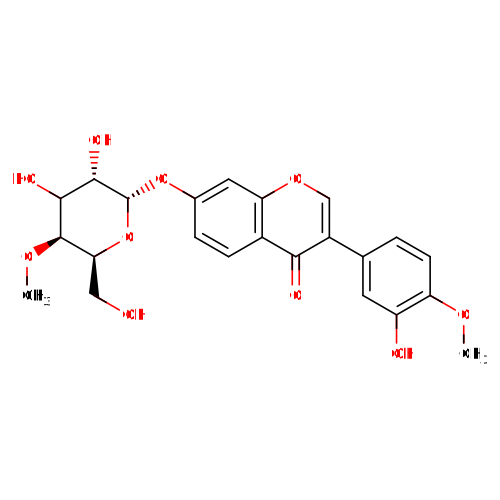
| Common Name | 3′-hydroxy-4′-methoxyisoflavone-7-O-β-D-(4′′-O-methyl) glucopyranoside |
|---|
| Description | 3′-Hydroxy-4′-methoxyisoflavone-7-O-β-D-(4′′-O-methyl) glucopyranoside belongs to the class of organic compounds known as isoflavonoid o-glycosides. These are o-glycosylated derivatives of isoflavonoids, which are natural products derived from 3-phenylchromen-4-one. 3′-hydroxy-4′-methoxyisoflavone-7-O-β-D-(4′′-O-methyl) glucopyranoside was first documented in 2024 (PMID: 38740342). Based on a literature review very few articles have been published on 3′-hydroxy-4′-methoxyisoflavone-7-O-β-D-(4′′-O-methyl) glucopyranoside. |
|---|
| Structure | CO[C@@H]1[C@H](CO)O[C@@H](OC2=CC=C3C(=O)C(=COC3=C2)C2=CC=C(OC)C(O)=C2)[C@@H](O)C1O InChI=1S/C23H24O10/c1-29-16-6-3-11(7-15(16)25)14-10-31-17-8-12(4-5-13(17)19(14)26)32-23-21(28)20(27)22(30-2)18(9-24)33-23/h3-8,10,18,20-25,27-28H,9H2,1-2H3/t18-,20?,21-,22+,23+/m0/s1 |
|---|
| Synonyms | Not Available |
|---|
| Chemical Formula | C23H24O10 |
|---|
| Average Mass | 460.4350 Da |
|---|
| Monoisotopic Mass | 460.13695 Da |
|---|
| IUPAC Name | 7-{[(2S,3S,5S,6S)-3,4-dihydroxy-6-(hydroxymethyl)-5-methoxyoxan-2-yl]oxy}-3-(3-hydroxy-4-methoxyphenyl)-4H-chromen-4-one |
|---|
| Traditional Name | 7-{[(2S,3S,5S,6S)-3,4-dihydroxy-6-(hydroxymethyl)-5-methoxyoxan-2-yl]oxy}-3-(3-hydroxy-4-methoxyphenyl)chromen-4-one |
|---|
| CAS Registry Number | Not Available |
|---|
| SMILES | CO[C@@H]1[C@H](CO)O[C@@H](OC2=CC=C3C(=O)C(=COC3=C2)C2=CC=C(OC)C(O)=C2)[C@@H](O)C1O |
|---|
| InChI Identifier | InChI=1S/C23H24O10/c1-29-16-6-3-11(7-15(16)25)14-10-31-17-8-12(4-5-13(17)19(14)26)32-23-21(28)20(27)22(30-2)18(9-24)33-23/h3-8,10,18,20-25,27-28H,9H2,1-2H3/t18-,20?,21-,22+,23+/m0/s1 |
|---|
| InChI Key | XRCQYODQEDLSQH-XKYYZAJSSA-N |
|---|
| Experimental Spectra |
|---|
|
| | Spectrum Type | Description | Depositor Email | Depositor Organization | Depositor | Deposition Date | View |
|---|
| | Predicted Spectra |
|---|
|
| Not Available | | Chemical Shift Submissions |
|---|
|
| | Spectrum Type | Description | Depositor Email | Depositor Organization | Depositor | Deposition Date | View |
|---|
| 1D NMR | 1H NMR Spectrum (1D, 600, C2D6OS, simulated) | [email protected] | Shandong University of Traditional Chinese Medicine | Huixin Cheng | 2024-08-01 | View Spectrum |
| | Species |
|---|
| Species of Origin | | Species Name | Source | Reference |
|---|
| Co-culture 'Astragalus membranaceus' & 'Cordyceps kyushuensis' | | | | Co-culture 'Astragalus membranaceus' & 'Cordyceps kyushuensis' | | |
|
|---|
| Chemical Taxonomy |
|---|
| Description | This compound belongs to the class of organic compounds known as isoflavonoid o-glycosides. These are o-glycosylated derivatives of isoflavonoids, which are natural products derived from 3-phenylchromen-4-one. |
|---|
| Kingdom | Organic compounds |
|---|
| Super Class | Phenylpropanoids and polyketides |
|---|
| Class | Isoflavonoids |
|---|
| Sub Class | Isoflavonoid O-glycosides |
|---|
| Direct Parent | Isoflavonoid O-glycosides |
|---|
| Alternative Parents | |
|---|
| Substituents | - Isoflavonoid-7-o-glycoside
- Isoflavonoid o-glycoside
- 3'-hydroxy,4'-methoxyisoflavonoid
- Hydroxyisoflavonoid
- Isoflavone
- Fatty acyl glycoside of mono- or disaccharide
- Fatty acyl glycoside
- Alkyl glycoside
- Chromone
- 1-benzopyran
- Methoxyphenol
- Benzopyran
- Fatty alcohol
- Phenoxy compound
- Methoxybenzene
- Phenol ether
- Anisole
- 1-hydroxy-4-unsubstituted benzenoid
- 1-hydroxy-2-unsubstituted benzenoid
- Pyranone
- Phenol
- Dihydropyranone
- Alkyl aryl ether
- Fatty acyl
- Alpha-branched alpha,beta-unsaturated-ketone
- Benzenoid
- Pyran
- Oxane
- Monosaccharide
- Monocyclic benzene moiety
- Heteroaromatic compound
- Alpha,beta-unsaturated ketone
- Enone
- Acryloyl-group
- Secondary alcohol
- Ketone
- Oxacycle
- Organoheterocyclic compound
- Ether
- Dialkyl ether
- Organic oxygen compound
- Organic oxide
- Hydrocarbon derivative
- Organooxygen compound
- Alcohol
- Aromatic heteropolycyclic compound
|
|---|
| Molecular Framework | Aromatic heteropolycyclic compounds |
|---|
| External Descriptors | Not Available |
|---|
| Physical Properties |
|---|
| State | Not Available |
|---|
| Experimental Properties | | Property | Value | Reference |
|---|
| Melting Point | Not Available | Not Available | | Boiling Point | Not Available | Not Available | | Water Solubility | Not Available | Not Available | | LogP | Not Available | Not Available |
|
|---|
| Predicted Properties | |
|---|