| Record Information |
|---|
| Version | 2.0 |
|---|
| Created at | 2024-05-01 17:55:04 UTC |
|---|
| Updated at | 2024-09-03 04:20:33 UTC |
|---|
| NP-MRD ID | NP0332878 |
|---|
| Natural Product DOI | https://doi.org/10.57994/2157 |
|---|
| Secondary Accession Numbers | None |
|---|
| Natural Product Identification |
|---|
| Common Name | 4-Dehydroxymelleolide F |
|---|
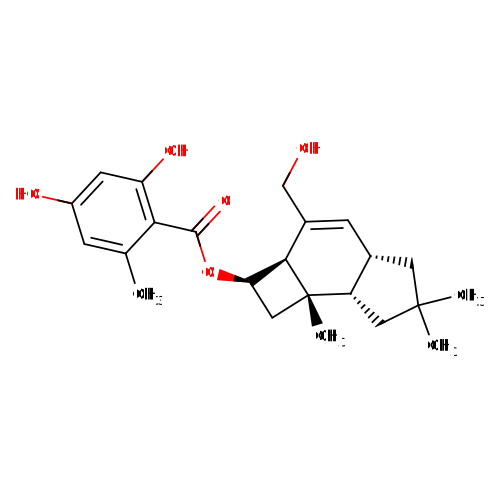
| Description | 4-Dehydroxymelleolide F belongs to the class of organic compounds known as melleolides and analogues. Melleolides and analogues are compounds with a structure characterized by the presence of a 2-hydroxy-4-methoxy-6-methylbenzoic acid derivative linked to a 3,6,6,7b-tetramethyl-cyclobuta[e]indene moiety. 4-Dehydroxymelleolide F was first documented in 2024 (PMID: 38390787). Based on a literature review very few articles have been published on 4-Dehydroxymelleolide F. |
|---|
| Structure | [H][C@@]12[C@@H](C[C@]1(C)[C@@]1([H])CC(C)(C)C[C@@]1([H])C=C2CO)OC(=O)C1=C(C)C=C(O)C=C1O InChI=1S/C23H30O5/c1-12-5-15(25)7-17(26)19(12)21(27)28-18-10-23(4)16-9-22(2,3)8-13(16)6-14(11-24)20(18)23/h5-7,13,16,18,20,24-26H,8-11H2,1-4H3/t13-,16+,18-,20-,23-/m1/s1 |
|---|
| Synonyms | Not Available |
|---|
| Chemical Formula | C23H30O5 |
|---|
| Average Mass | 386.4880 Da |
|---|
| Monoisotopic Mass | 386.20932 Da |
|---|
| IUPAC Name | (2R,2aR,4aS,7aS,7bR)-3-(hydroxymethyl)-6,6,7b-trimethyl-1H,2H,2aH,4aH,5H,6H,7H,7aH,7bH-cyclobuta[e]inden-2-yl 2,4-dihydroxy-6-methylbenzoate |
|---|
| Traditional Name | (2R,2aR,4aS,7aS,7bR)-3-(hydroxymethyl)-6,6,7b-trimethyl-1H,2H,2aH,4aH,5H,7H,7aH-cyclobuta[e]inden-2-yl 2,4-dihydroxy-6-methylbenzoate |
|---|
| CAS Registry Number | Not Available |
|---|
| SMILES | [H][C@@]12[C@@H](C[C@]1(C)[C@@]1([H])CC(C)(C)C[C@@]1([H])C=C2CO)OC(=O)C1=C(C)C=C(O)C=C1O |
|---|
| InChI Identifier | InChI=1S/C23H30O5/c1-12-5-15(25)7-17(26)19(12)21(27)28-18-10-23(4)16-9-22(2,3)8-13(16)6-14(11-24)20(18)23/h5-7,13,16,18,20,24-26H,8-11H2,1-4H3/t13-,16+,18-,20-,23-/m1/s1 |
|---|
| InChI Key | GXPYMWBOQVLJGA-JQISRXLJSA-N |
|---|
| Experimental Spectra |
|---|
|
| | Spectrum Type | Description | Depositor Email | Depositor Organization | Depositor | Deposition Date | View |
|---|
| HSQC NMR | [1H, 13C] NMR Spectrum (2D, 500 MHz, C3D6O, experimental) | sebastian.pfuetze@helmholtz-hzi.de | Helmholtz-centre for infection research | Sebastian Pfütze | 2024-05-01 | View Spectrum | | COSY NMR | [1H, 1H] NMR Spectrum (2D, 500 MHz, C3D6O, experimental) | sebastian.pfuetze@helmholtz-hzi.de | Helmholtz-centre for infection research | Sebastian Pfütze | 2024-05-01 | View Spectrum | | ROESY NMR | [1H, 1H] NMR Spectrum (2D, 500 MHz, C3D6O, experimental) | sebastian.pfuetze@helmholtz-hzi.de | Helmholtz-centre for infection research | Sebastian Pfütze | 2024-05-01 | View Spectrum | | HMBC NMR | [1H, 13C] NMR Spectrum (2D, 500 MHz, C3D6O, experimental) | sebastian.pfuetze@helmholtz-hzi.de | Helmholtz-centre for infection research | Sebastian Pfütze | 2024-05-01 | View Spectrum | | 1D NMR | 1H NMR Spectrum (1D, 500 MHz, C3D6O, experimental) | sebastian.pfuetze@helmholtz-hzi.de | Helmholtz-centre for infection research | Sebastian Pfütze | 2024-05-01 | View Spectrum | | 1D NMR | 13C NMR Spectrum (1D, 126 MHz, C3D6O, experimental) | sebastian.pfuetze@helmholtz-hzi.de | Helmholtz-centre for infection research | Sebastian Pfütze | 2024-05-01 | View Spectrum |
| | Predicted Spectra |
|---|
|
| | Spectrum Type | Description | Depositor ID | Depositor Organization | Depositor | Deposition Date | View |
|---|
| | Chemical Shift Submissions |
|---|
|
| Not Available | | Species |
|---|
| Species of Origin | |
|---|
| Chemical Taxonomy |
|---|
| Description | Belongs to the class of organic compounds known as melleolides and analogues. Melleolides and analogues are compounds with a structure characterized by the presence of a 2-hydroxy-4-methoxy-6-methylbenzoic acid derivative linked to a 3,6,6,7b-tetramethyl-cyclobuta[e]indene moiety. |
|---|
| Kingdom | Organic compounds |
|---|
| Super Class | Lipids and lipid-like molecules |
|---|
| Class | Prenol lipids |
|---|
| Sub Class | Sesquiterpenoids |
|---|
| Direct Parent | Melleolides and analogues |
|---|
| Alternative Parents | |
|---|
| Substituents | - Melleolide-skeleton
- P-hydroxybenzoic acid alkyl ester
- P-hydroxybenzoic acid ester
- O-hydroxybenzoic acid ester
- Dihydroxybenzoic acid
- Benzoate ester
- Salicylic acid or derivatives
- Benzoic acid or derivatives
- M-cresol
- Resorcinol
- Benzoyl
- 1-hydroxy-4-unsubstituted benzenoid
- 1-hydroxy-2-unsubstituted benzenoid
- Toluene
- Phenol
- Monocyclic benzene moiety
- Benzenoid
- Vinylogous acid
- Carboxylic acid ester
- Monocarboxylic acid or derivatives
- Carboxylic acid derivative
- Alcohol
- Organooxygen compound
- Primary alcohol
- Hydrocarbon derivative
- Organic oxide
- Organic oxygen compound
- Aromatic homopolycyclic compound
|
|---|
| Molecular Framework | Aromatic homopolycyclic compounds |
|---|
| External Descriptors | Not Available |
|---|
| Physical Properties |
|---|
| State | Not Available |
|---|
| Experimental Properties | | Property | Value | Reference |
|---|
| Melting Point | Not Available | Not Available | | Boiling Point | Not Available | Not Available | | Water Solubility | Not Available | Not Available | | LogP | Not Available | Not Available |
|
|---|
| Predicted Properties | |
|---|