Np mrd loader

Record Information
Version2.0
Created at2022-09-12 16:03:59 UTC
Updated at2022-09-12 16:03:59 UTC
NP-MRD IDNP0330581
Secondary Accession NumbersNone
Natural Product Identification
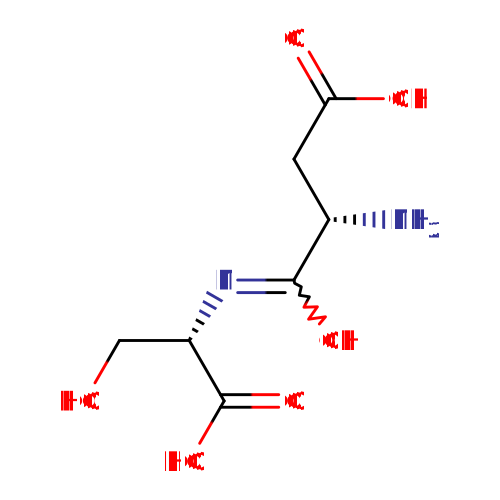
Common Name(3s)-3-amino-3-{[(1s)-1-carboxy-2-hydroxyethyl]-c-hydroxycarbonimidoyl}propanoic acid
DescriptionAsp-Ser, also known as D-S or L-asp-L-ser, belongs to the class of organic compounds known as dipeptides. These are organic compounds containing a sequence of exactly two alpha-amino acids joined by a peptide bond. Asp-Ser is a secondary metabolite. Secondary metabolites are metabolically or physiologically non-essential metabolites that may serve a role as defense or signalling molecules. In some cases they are simply molecules that arise from the incomplete metabolism of other secondary metabolites. (3s)-3-amino-3-{[(1s)-1-carboxy-2-hydroxyethyl]-c-hydroxycarbonimidoyl}propanoic acid is found in Trypanosoma brucei. (3s)-3-amino-3-{[(1s)-1-carboxy-2-hydroxyethyl]-c-hydroxycarbonimidoyl}propanoic acid was first documented in 2022 (PMID: 35948545). Based on a literature review a small amount of articles have been published on Asp-Ser (PMID: 35885886) (PMID: 35777567) (PMID: 35334366) (PMID: 35304505).
Structure
Thumb
Synonyms
ValueSource
D-SChEBI
DSChEBI
L-Asp-L-serChEBI
Chemical FormulaC7H12N2O6
Average Mass220.1810 Da
Monoisotopic Mass220.06954 Da
IUPAC NameNot Available
Traditional NameNot Available
CAS Registry NumberNot Available
SMILES
N[C@@H](CC(O)=O)C(O)=N[C@@H](CO)C(O)=O
InChI Identifier
InChI=1S/C7H12N2O6/c8-3(1-5(11)12)6(13)9-4(2-10)7(14)15/h3-4,10H,1-2,8H2,(H,9,13)(H,11,12)(H,14,15)/t3-,4-/m0/s1
InChI KeyDWBZEJHQQIURML-IMJSIDKUSA-N
Experimental Spectra
Not Available
Predicted Spectra
Not Available
Chemical Shift Submissions
Not Available
Species
Species of Origin
Species NameSourceReference
Trypanosoma bruceiLOTUS Database
Chemical Taxonomy
Description Belongs to the class of organic compounds known as dipeptides. These are organic compounds containing a sequence of exactly two alpha-amino acids joined by a peptide bond.
KingdomOrganic compounds
Super ClassOrganic acids and derivatives
ClassCarboxylic acids and derivatives
Sub ClassAmino acids, peptides, and analogues
Direct ParentDipeptides
Alternative Parents
Substituents
  • Alpha-dipeptide
  • Aspartic acid or derivatives
  • N-acyl-alpha-amino acid
  • N-acyl-alpha amino acid or derivatives
  • N-acyl-l-alpha-amino acid
  • Alpha-amino acid amide
  • Serine or derivatives
  • Alpha-amino acid or derivatives
  • Beta-hydroxy acid
  • Fatty acyl
  • Fatty acid
  • Dicarboxylic acid or derivatives
  • Fatty amide
  • Hydroxy acid
  • N-acyl-amine
  • Amino acid
  • Secondary carboxylic acid amide
  • Amino acid or derivatives
  • Carboxamide group
  • Carboxylic acid
  • Alcohol
  • Primary aliphatic amine
  • Organonitrogen compound
  • Organooxygen compound
  • Primary alcohol
  • Primary amine
  • Hydrocarbon derivative
  • Carbonyl group
  • Organic oxide
  • Organopnictogen compound
  • Amine
  • Organic oxygen compound
  • Organic nitrogen compound
  • Aliphatic acyclic compound
Molecular FrameworkAliphatic acyclic compounds
External Descriptors
Physical Properties
StateNot Available
Experimental Properties
PropertyValueReference
Melting PointNot AvailableNot Available
Boiling PointNot AvailableNot Available
Water SolubilityNot AvailableNot Available
LogPNot AvailableNot Available
Predicted Properties
PropertyValueSource
HMDB IDNot Available
DrugBank IDNot Available
Phenol Explorer Compound IDNot Available
FoodDB IDNot Available
KNApSAcK IDNot Available
Chemspider ID8140107
KEGG Compound IDNot Available
BioCyc IDNot Available
BiGG IDNot Available
Wikipedia LinkNot Available
METLIN IDNot Available
PubChem Compound9964514
PDB IDNot Available
ChEBI ID73454
Good Scents IDNot Available
References
General References
  1. Park HB, Hwang S, Baek KH: USP7 regulates the ERK1/2 signaling pathway through deubiquitinating Raf-1 in lung adenocarcinoma. Cell Death Dis. 2022 Aug 10;13(8):698. doi: 10.1038/s41419-022-05136-6. [PubMed:35948545 ]
  2. Jiao Y, Zhang J, Pan C: Genome-Wide Analysis of the GDSL Genes in Pecan (Carya illinoensis K. Koch): Phylogeny, Structure, Promoter Cis-Elements, Co-Expression Networks, and Response to Salt Stresses. Genes (Basel). 2022 Jun 21;13(7). pii: genes13071103. doi: 10.3390/genes13071103. [PubMed:35885886 ]
  3. Giangeri G, Morlino MS, De Bernardini N, Ji M, Bosaro M, Pirillo V, Antoniali P, Molla G, Raga R, Treu L, Campanaro S: Preliminary investigation of microorganisms potentially involved in microplastics degradation using an integrated metagenomic and biochemical approach. Sci Total Environ. 2022 Oct 15;843:157017. doi: 10.1016/j.scitotenv.2022.157017. Epub 2022 Jun 28. [PubMed:35777567 ]
  4. Dowari P, Kumar Baroi M, Das T, Kanti Das B, Das S, Chowdhuri S, Garg A, Debnath A, Das D: Development of a hydrolase mimicking peptide amphiphile and its immobilization on silica surface for stereoselective and enhanced catalysis. J Colloid Interface Sci. 2022 Jul 15;618:98-110. doi: 10.1016/j.jcis.2022.03.076. Epub 2022 Mar 19. [PubMed:35334366 ]
  5. Kheeree N, Kuptawach K, Puthong S, Sangtanoo P, Srimongkol P, Boonserm P, Reamtong O, Choowongkomon K, Karnchanatat A: Discovery of calcium-binding peptides derived from defatted lemon basil seeds with enhanced calcium uptake in human intestinal epithelial cells, Caco-2. Sci Rep. 2022 Mar 18;12(1):4659. doi: 10.1038/s41598-022-08380-0. [PubMed:35304505 ]
  6. LOTUS database [Link]