| Record Information |
|---|
| Version | 2.0 |
|---|
| Created at | 2022-09-12 15:12:06 UTC |
|---|
| Updated at | 2022-09-12 15:12:07 UTC |
|---|
| NP-MRD ID | NP0330137 |
|---|
| Secondary Accession Numbers | None |
|---|
| Natural Product Identification |
|---|
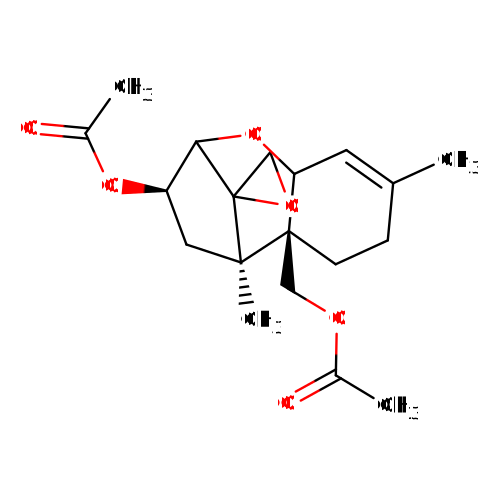
| Common Name | (1'r,2'r,10'r)-10'-(acetyloxy)-1',5'-dimethyl-8'-oxaspiro[oxirane-2,12'-tricyclo[7.2.1.0²,⁷]dodecan]-5'-en-2'-ylmethyl acetate |
|---|
| Description | Calonectrin belongs to the class of organic compounds known as trichothecenes. These are sesquiterpene mycotoxins structurally characterized by the presence of an epoxide ring and a benzopyran derivative with a variant number of hydroxyl, acetyl, or other substituents. The most important structural features causing the biological activities of trichothecenes are the 12,13-epoxy ring, the presence of hydroxyl or acetyl groups at appropriate positions on the trichothecene nucleus and the structure and position of the side-chain. (1'r,2'r,10'r)-10'-(acetyloxy)-1',5'-dimethyl-8'-oxaspiro[oxirane-2,12'-tricyclo[7.2.1.0²,⁷]dodecan]-5'-en-2'-ylmethyl acetate is found in Fusarium culmorum and Fusarium sporotrichioides. (1'r,2'r,10'r)-10'-(acetyloxy)-1',5'-dimethyl-8'-oxaspiro[oxirane-2,12'-tricyclo[7.2.1.0²,⁷]dodecan]-5'-en-2'-ylmethyl acetate was first documented in 2004 (PMID: 15066795). Based on a literature review a small amount of articles have been published on Calonectrin (PMID: 16604118) (PMID: 27120196) (PMID: 24434906) (PMID: 22095495). |
|---|
| Structure | CC(=O)OC[C@]12CCC(C)=CC1OC1[C@@H](C[C@@]2(C)C11CO1)OC(C)=O InChI=1S/C19H26O6/c1-11-5-6-18(9-22-12(2)20)15(7-11)25-16-14(24-13(3)21)8-17(18,4)19(16)10-23-19/h7,14-16H,5-6,8-10H2,1-4H3/t14-,15?,16?,17-,18-,19?/m1/s1 |
|---|
| Synonyms | Not Available |
|---|
| Chemical Formula | C19H26O6 |
|---|
| Average Mass | 350.4110 Da |
|---|
| Monoisotopic Mass | 350.17294 Da |
|---|
| IUPAC Name | [(1'R,2'R,10'R)-10'-(acetyloxy)-1',5'-dimethyl-8'-oxaspiro[oxirane-2,12'-tricyclo[7.2.1.0^{2,7}]dodecan]-5'-en-2'-yl]methyl acetate |
|---|
| Traditional Name | (1'R,2'R,10'R)-10'-(acetyloxy)-1',5'-dimethyl-8'-oxaspiro[oxirane-2,12'-tricyclo[7.2.1.0^{2,7}]dodecan]-5'-en-2'-ylmethyl acetate |
|---|
| CAS Registry Number | Not Available |
|---|
| SMILES | CC(=O)OC[C@]12CCC(C)=CC1OC1[C@@H](C[C@@]2(C)C11CO1)OC(C)=O |
|---|
| InChI Identifier | InChI=1S/C19H26O6/c1-11-5-6-18(9-22-12(2)20)15(7-11)25-16-14(24-13(3)21)8-17(18,4)19(16)10-23-19/h7,14-16H,5-6,8-10H2,1-4H3/t14-,15?,16?,17-,18-,19?/m1/s1 |
|---|
| InChI Key | IGDIDZAQDRAJRB-GRGGRPSZSA-N |
|---|
| Experimental Spectra |
|---|
|
| Not Available | | Predicted Spectra |
|---|
|
| | Spectrum Type | Description | Depositor ID | Depositor Organization | Depositor | Deposition Date | View |
|---|
| 1D NMR | 13C NMR Spectrum (1D, 25 MHz, H2O, predicted) | Wishart Lab | Wishart Lab | David Wishart | 2021-06-20 | View Spectrum | | 1D NMR | 1H NMR Spectrum (1D, 100 MHz, H2O, predicted) | Wishart Lab | Wishart Lab | David Wishart | 2021-06-20 | View Spectrum | | 1D NMR | 13C NMR Spectrum (1D, 252 MHz, H2O, predicted) | Wishart Lab | Wishart Lab | David Wishart | 2021-06-20 | View Spectrum | | 1D NMR | 1H NMR Spectrum (1D, 1000 MHz, H2O, predicted) | Wishart Lab | Wishart Lab | David Wishart | 2021-06-20 | View Spectrum | | 1D NMR | 13C NMR Spectrum (1D, 50 MHz, H2O, predicted) | Wishart Lab | Wishart Lab | David Wishart | 2021-06-20 | View Spectrum | | 1D NMR | 1H NMR Spectrum (1D, 200 MHz, H2O, predicted) | Wishart Lab | Wishart Lab | David Wishart | 2021-06-20 | View Spectrum | | 1D NMR | 13C NMR Spectrum (1D, 75 MHz, H2O, predicted) | Wishart Lab | Wishart Lab | David Wishart | 2021-06-20 | View Spectrum | | 1D NMR | 1H NMR Spectrum (1D, 300 MHz, H2O, predicted) | Wishart Lab | Wishart Lab | David Wishart | 2021-06-20 | View Spectrum | | 1D NMR | 13C NMR Spectrum (1D, 101 MHz, H2O, predicted) | Wishart Lab | Wishart Lab | David Wishart | 2021-06-20 | View Spectrum | | 1D NMR | 1H NMR Spectrum (1D, 400 MHz, H2O, predicted) | Wishart Lab | Wishart Lab | David Wishart | 2021-06-20 | View Spectrum | | 1D NMR | 13C NMR Spectrum (1D, 126 MHz, H2O, predicted) | Wishart Lab | Wishart Lab | David Wishart | 2021-06-20 | View Spectrum | | 1D NMR | 1H NMR Spectrum (1D, 500 MHz, H2O, predicted) | Wishart Lab | Wishart Lab | David Wishart | 2021-06-20 | View Spectrum | | 1D NMR | 13C NMR Spectrum (1D, 151 MHz, H2O, predicted) | Wishart Lab | Wishart Lab | David Wishart | 2021-06-20 | View Spectrum | | 1D NMR | 1H NMR Spectrum (1D, 600 MHz, H2O, predicted) | Wishart Lab | Wishart Lab | David Wishart | 2021-06-20 | View Spectrum | | 1D NMR | 13C NMR Spectrum (1D, 176 MHz, H2O, predicted) | Wishart Lab | Wishart Lab | David Wishart | 2021-06-20 | View Spectrum | | 1D NMR | 1H NMR Spectrum (1D, 700 MHz, H2O, predicted) | Wishart Lab | Wishart Lab | David Wishart | 2021-06-20 | View Spectrum | | 1D NMR | 13C NMR Spectrum (1D, 201 MHz, H2O, predicted) | Wishart Lab | Wishart Lab | David Wishart | 2021-06-20 | View Spectrum | | 1D NMR | 1H NMR Spectrum (1D, 800 MHz, H2O, predicted) | Wishart Lab | Wishart Lab | David Wishart | 2021-06-20 | View Spectrum | | 1D NMR | 13C NMR Spectrum (1D, 226 MHz, H2O, predicted) | Wishart Lab | Wishart Lab | David Wishart | 2021-06-20 | View Spectrum | | 1D NMR | 1H NMR Spectrum (1D, 900 MHz, H2O, predicted) | Wishart Lab | Wishart Lab | David Wishart | 2021-06-20 | View Spectrum |
| | Chemical Shift Submissions |
|---|
|
| Not Available | | Species |
|---|
| Species of Origin | |
|---|
| Chemical Taxonomy |
|---|
| Description | Belongs to the class of organic compounds known as trichothecenes. These are sesquiterpene mycotoxins structurally characterized by the presence of an epoxide ring and a benzopyran derivative with a variant number of hydroxyl, acetyl, or other substituents. The most important structural features causing the biological activities of trichothecenes are the 12,13-epoxy ring, the presence of hydroxyl or acetyl groups at appropriate positions on the trichothecene nucleus and the structure and position of the side-chain. |
|---|
| Kingdom | Organic compounds |
|---|
| Super Class | Lipids and lipid-like molecules |
|---|
| Class | Prenol lipids |
|---|
| Sub Class | Sesquiterpenoids |
|---|
| Direct Parent | Trichothecenes |
|---|
| Alternative Parents | |
|---|
| Substituents | - Trichothecene skeleton
- Oxepane
- Oxane
- Dicarboxylic acid or derivatives
- Carboxylic acid ester
- Oxacycle
- Organoheterocyclic compound
- Ether
- Oxirane
- Dialkyl ether
- Carboxylic acid derivative
- Organic oxygen compound
- Organic oxide
- Hydrocarbon derivative
- Organooxygen compound
- Carbonyl group
- Aliphatic heteropolycyclic compound
|
|---|
| Molecular Framework | Aliphatic heteropolycyclic compounds |
|---|
| External Descriptors | Not Available |
|---|
| Physical Properties |
|---|
| State | Not Available |
|---|
| Experimental Properties | | Property | Value | Reference |
|---|
| Melting Point | Not Available | Not Available | | Boiling Point | Not Available | Not Available | | Water Solubility | Not Available | Not Available | | LogP | Not Available | Not Available |
|
|---|
| Predicted Properties | |
|---|
| General References | - McCormick SP, Alexander NJ, Proctor RH: Heterologous expression of two trichothecene P450 genes in Fusarium verticillioides. Can J Microbiol. 2006 Mar;52(3):220-6. doi: 10.1139/w05-124. [PubMed:16604118 ]
- Maeda K, Tanaka A, Sugiura R, Koshino H, Tokai T, Sato M, Nakajima Y, Tanahashi Y, Kanamaru K, Kobayashi T, Nishiuchi T, Fujimura M, Takahashi-Ando N, Kimura M: Hydroxylations of trichothecene rings in the biosynthesis of Fusarium trichothecenes: evolution of alternative pathways in the nivalenol chemotype. Environ Microbiol. 2016 Nov;18(11):3798-3811. doi: 10.1111/1462-2920.13338. Epub 2016 Jun 27. [PubMed:27120196 ]
- Fruhmann P, Hametner C, Mikula H, Adam G, Krska R, Frohlich J: Stereoselective Luche reduction of deoxynivalenol and three of its acetylated derivatives at C8. Toxins (Basel). 2014 Jan 10;6(1):325-36. doi: 10.3390/toxins6010325. [PubMed:24434906 ]
- Kadota T, Kimura M, Hirano S, Tajima O, Nakajima T, Kamata Y, Sugita-Konishi Y: Development of a simultaneous liquid chromatography/tandem mass spectrometric method for the determination of type B trichothecenes, their derivatives, and precursors in wheat. Rapid Commun Mass Spectrom. 2011 Dec 15;25(23):3481-90. doi: 10.1002/rcm.5250. [PubMed:22095495 ]
- McCormick SP, Harris LJ, Alexander NJ, Ouellet T, Saparno A, Allard S, Desjardins AE: Tri1 in Fusarium graminearum encodes a P450 oxygenase. Appl Environ Microbiol. 2004 Apr;70(4):2044-51. doi: 10.1128/AEM.70.4.2044-2051.2004. [PubMed:15066795 ]
- LOTUS database [Link]
|
|---|