| Record Information |
|---|
| Version | 2.0 |
|---|
| Created at | 2022-09-12 14:50:23 UTC |
|---|
| Updated at | 2022-09-12 14:50:23 UTC |
|---|
| NP-MRD ID | NP0329950 |
|---|
| Secondary Accession Numbers | None |
|---|
| Natural Product Identification |
|---|
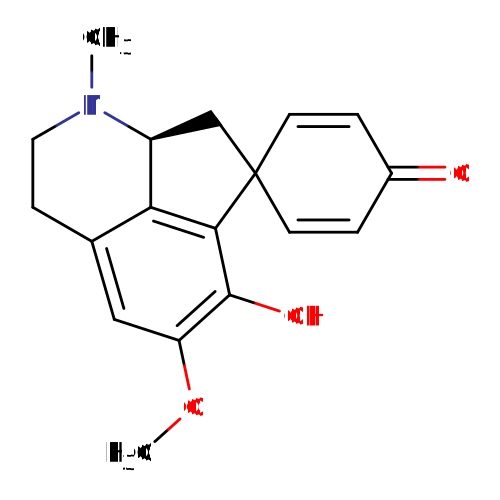
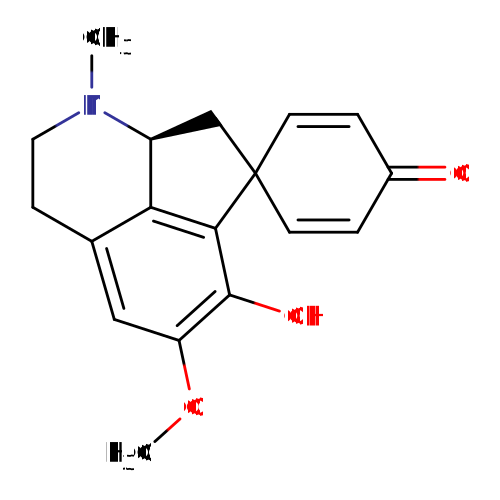
| Common Name | (4's)-11'-hydroxy-10'-methoxy-5'-methyl-5'-azaspiro[cyclohexane-1,2'-tricyclo[6.3.1.0⁴,¹²]dodecane]-1'(11'),2,5,8'(12'),9'-pentaen-4-one |
|---|
| Description | Glaziovina belongs to the class of organic compounds known as proaporphines. These are benzylisoquinoline derivatives characterized by the presence of a spirocyclohexane ring that can occur in various oxidation levels, from cyclohexadienone to cyclohexanol. (4's)-11'-hydroxy-10'-methoxy-5'-methyl-5'-azaspiro[cyclohexane-1,2'-tricyclo[6.3.1.0⁴,¹²]dodecane]-1'(11'),2,5,8'(12'),9'-pentaen-4-one is found in Cissampelos capensis, Croton bonplandianus, Hypserpa nitida, Liriodendron tulipifera, Neostenanthera gabonensis, Pachygone ovata, Stephania cephalantha and Xylopia parviflora. Based on a literature review very few articles have been published on Glaziovina. |
|---|
| Structure | COC1=CC2=C3[C@H](CC4(C=CC(=O)C=C4)C3=C1O)N(C)CC2 InChI=1S/C18H19NO3/c1-19-8-5-11-9-14(22-2)17(21)16-15(11)13(19)10-18(16)6-3-12(20)4-7-18/h3-4,6-7,9,13,21H,5,8,10H2,1-2H3/t13-/m0/s1 |
|---|
| Synonyms | Not Available |
|---|
| Chemical Formula | C18H19NO3 |
|---|
| Average Mass | 297.3540 Da |
|---|
| Monoisotopic Mass | 297.13649 Da |
|---|
| IUPAC Name | (4'S)-11'-hydroxy-10'-methoxy-5'-methyl-5'-azaspiro[cyclohexane-1,2'-tricyclo[6.3.1.0^{4,12}]dodecane]-1'(11'),2,5,8'(12'),9'-pentaen-4-one |
|---|
| Traditional Name | (4'S)-11'-hydroxy-10'-methoxy-5'-methyl-5'-azaspiro[cyclohexane-1,2'-tricyclo[6.3.1.0^{4,12}]dodecane]-1'(11'),2,5,8'(12'),9'-pentaen-4-one |
|---|
| CAS Registry Number | Not Available |
|---|
| SMILES | COC1=CC2=C3[C@H](CC4(C=CC(=O)C=C4)C3=C1O)N(C)CC2 |
|---|
| InChI Identifier | InChI=1S/C18H19NO3/c1-19-8-5-11-9-14(22-2)17(21)16-15(11)13(19)10-18(16)6-3-12(20)4-7-18/h3-4,6-7,9,13,21H,5,8,10H2,1-2H3/t13-/m0/s1 |
|---|
| InChI Key | PNJUPRNTSWJWAX-ZDUSSCGKSA-N |
|---|
| Experimental Spectra |
|---|
|
| Not Available | | Predicted Spectra |
|---|
|
| Not Available | | Chemical Shift Submissions |
|---|
|
| Not Available | | Species |
|---|
| Species of Origin | |
|---|
| Chemical Taxonomy |
|---|
| Description | Belongs to the class of organic compounds known as proaporphines. These are benzylisoquinoline derivatives characterized by the presence of a spirocyclohexane ring that can occur in various oxidation levels, from cyclohexadienone to cyclohexanol. |
|---|
| Kingdom | Organic compounds |
|---|
| Super Class | Alkaloids and derivatives |
|---|
| Class | Proaporphines |
|---|
| Sub Class | Not Available |
|---|
| Direct Parent | Proaporphines |
|---|
| Alternative Parents | |
|---|
| Substituents | - Proaporphine
- Tetrahydroisoquinoline
- Indane
- Anisole
- Alkyl aryl ether
- Aralkylamine
- Benzenoid
- Ketone
- Tertiary amine
- Cyclic ketone
- Tertiary aliphatic amine
- Ether
- Azacycle
- Organoheterocyclic compound
- Organooxygen compound
- Organonitrogen compound
- Amine
- Hydrocarbon derivative
- Organopnictogen compound
- Carbonyl group
- Organic nitrogen compound
- Organic oxide
- Organic oxygen compound
- Aromatic heteropolycyclic compound
|
|---|
| Molecular Framework | Aromatic heteropolycyclic compounds |
|---|
| External Descriptors | Not Available |
|---|
| Physical Properties |
|---|
| State | Not Available |
|---|
| Experimental Properties | | Property | Value | Reference |
|---|
| Melting Point | Not Available | Not Available | | Boiling Point | Not Available | Not Available | | Water Solubility | Not Available | Not Available | | LogP | Not Available | Not Available |
|
|---|
| Predicted Properties | |
|---|