| Record Information |
|---|
| Version | 2.0 |
|---|
| Created at | 2022-09-12 13:46:17 UTC |
|---|
| Updated at | 2022-09-12 13:46:18 UTC |
|---|
| NP-MRD ID | NP0329417 |
|---|
| Secondary Accession Numbers | None |
|---|
| Natural Product Identification |
|---|
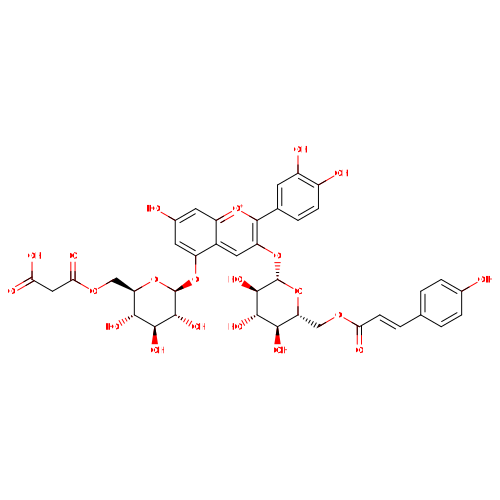
| Common Name | 5-{[(2s,3r,4s,5s,6r)-6-{[(2-carboxyacetyl)oxy]methyl}-3,4,5-trihydroxyoxan-2-yl]oxy}-2-(3,4-dihydroxyphenyl)-7-hydroxy-3-{[(2s,3r,4s,5s,6r)-3,4,5-trihydroxy-6-({[3-(4-hydroxyphenyl)prop-2-enoyl]oxy}methyl)oxan-2-yl]oxy}-1λ⁴-chromen-1-ylium |
|---|
| Description | Malonylshisonin belongs to the class of organic compounds known as anthocyanidin 3-o-6-p-coumaroyl glycosides. These are anthocyanidin 3-O-glycosides where the carbohydrate moiety is esterified at the C6 position with a p-coumaric acid. P-coumaric acid is an organic derivative of cinnamic acid, that carries a hydroxyl group at the 4-position of the benzene ring. Thus, malonylshisonin is considered to be a flavonoid. Malonylshisonin is a primary metabolite. Primary metabolites are metabolically or physiologically essential metabolites. They are directly involved in an organism’s growth, development or reproduction. 5-{[(2s,3r,4s,5s,6r)-6-{[(2-carboxyacetyl)oxy]methyl}-3,4,5-trihydroxyoxan-2-yl]oxy}-2-(3,4-dihydroxyphenyl)-7-hydroxy-3-{[(2s,3r,4s,5s,6r)-3,4,5-trihydroxy-6-({[3-(4-hydroxyphenyl)prop-2-enoyl]oxy}methyl)oxan-2-yl]oxy}-1λ⁴-chromen-1-ylium is found in Perilla frutescens. 5-{[(2s,3r,4s,5s,6r)-6-{[(2-carboxyacetyl)oxy]methyl}-3,4,5-trihydroxyoxan-2-yl]oxy}-2-(3,4-dihydroxyphenyl)-7-hydroxy-3-{[(2s,3r,4s,5s,6r)-3,4,5-trihydroxy-6-({[3-(4-hydroxyphenyl)prop-2-enoyl]oxy}methyl)oxan-2-yl]oxy}-1λ⁴-chromen-1-ylium was first documented in 2008 (PMID: 19127243). Based on a literature review a small amount of articles have been published on Malonylshisonin (PMID: 24891158) (PMID: 35583245) (PMID: 25050247) (PMID: 21351722). |
|---|
| Structure | O[C@@H]1[C@@H](COC(=O)CC(O)=O)O[C@@H](OC2=C3C=C(O[C@@H]4O[C@H](COC(=O)C=CC5=CC=C(O)C=C5)[C@@H](O)[C@H](O)[C@H]4O)C(=[O+]C3=CC(O)=C2)C2=CC=C(O)C(O)=C2)[C@H](O)[C@H]1O InChI=1S/C39H38O21/c40-18-5-1-16(2-6-18)3-8-29(46)54-14-26-31(48)34(51)36(53)39(60-26)58-25-12-20-23(56-37(25)17-4-7-21(42)22(43)9-17)10-19(41)11-24(20)57-38-35(52)33(50)32(49)27(59-38)15-55-30(47)13-28(44)45/h1-12,26-27,31-36,38-39,48-53H,13-15H2,(H4-,40,41,42,43,44,45,46)/p+1/t26-,27-,31-,32-,33+,34+,35-,36-,38-,39-/m1/s1 |
|---|
| Synonyms | Not Available |
|---|
| Chemical Formula | C39H39O21 |
|---|
| Average Mass | 843.7190 Da |
|---|
| Monoisotopic Mass | 843.19783 Da |
|---|
| IUPAC Name | 5-{[(2S,3R,4S,5S,6R)-6-{[(2-carboxyacetyl)oxy]methyl}-3,4,5-trihydroxyoxan-2-yl]oxy}-2-(3,4-dihydroxyphenyl)-7-hydroxy-3-{[(2S,3R,4S,5S,6R)-3,4,5-trihydroxy-6-({[3-(4-hydroxyphenyl)prop-2-enoyl]oxy}methyl)oxan-2-yl]oxy}-1lambda4-chromen-1-ylium |
|---|
| Traditional Name | 5-{[(2S,3R,4S,5S,6R)-6-{[(2-carboxyacetyl)oxy]methyl}-3,4,5-trihydroxyoxan-2-yl]oxy}-2-(3,4-dihydroxyphenyl)-7-hydroxy-3-{[(2S,3R,4S,5S,6R)-3,4,5-trihydroxy-6-({[3-(4-hydroxyphenyl)prop-2-enoyl]oxy}methyl)oxan-2-yl]oxy}-1lambda4-chromen-1-ylium |
|---|
| CAS Registry Number | Not Available |
|---|
| SMILES | O[C@@H]1[C@@H](COC(=O)CC(O)=O)O[C@@H](OC2=C3C=C(O[C@@H]4O[C@H](COC(=O)C=CC5=CC=C(O)C=C5)[C@@H](O)[C@H](O)[C@H]4O)C(=[O+]C3=CC(O)=C2)C2=CC=C(O)C(O)=C2)[C@H](O)[C@H]1O |
|---|
| InChI Identifier | InChI=1S/C39H38O21/c40-18-5-1-16(2-6-18)3-8-29(46)54-14-26-31(48)34(51)36(53)39(60-26)58-25-12-20-23(56-37(25)17-4-7-21(42)22(43)9-17)10-19(41)11-24(20)57-38-35(52)33(50)32(49)27(59-38)15-55-30(47)13-28(44)45/h1-12,26-27,31-36,38-39,48-53H,13-15H2,(H4-,40,41,42,43,44,45,46)/p+1/t26-,27-,31-,32-,33+,34+,35-,36-,38-,39-/m1/s1 |
|---|
| InChI Key | HCZDGTUAMVKZNE-KMKFZPLVSA-O |
|---|
| Experimental Spectra |
|---|
|
| Not Available | | Predicted Spectra |
|---|
|
| Not Available | | Chemical Shift Submissions |
|---|
|
| Not Available | | Species |
|---|
| Species of Origin | |
|---|
| Chemical Taxonomy |
|---|
| Description | Belongs to the class of organic compounds known as anthocyanidin 3-o-6-p-coumaroyl glycosides. These are anthocyanidin 3-O-glycosides where the carbohydrate moiety is esterified at the C6 position with a p-coumaric acid. P-coumaric acid is an organic derivative of cinnamic acid, that carries a hydroxyl group at the 4-position of the benzene ring. |
|---|
| Kingdom | Organic compounds |
|---|
| Super Class | Phenylpropanoids and polyketides |
|---|
| Class | Flavonoids |
|---|
| Sub Class | Flavonoid glycosides |
|---|
| Direct Parent | Anthocyanidin 3-O-6-p-coumaroyl glycosides |
|---|
| Alternative Parents | |
|---|
| Substituents | - Anthocyanidin 3-o-6-p-coumaroyl-glycoside
- Anthocyanin
- Anthocyanidin-3-o-glycoside
- Anthocyanidin-5-o-glycoside
- Flavonoid-3-o-glycoside
- Hydroxyflavonoid
- 3'-hydroxyflavonoid
- 4'-hydroxyflavonoid
- 7-hydroxyflavonoid
- Anthocyanidin
- Phenolic glycoside
- Coumaric acid ester
- Cinnamic acid or derivatives
- Coumaric acid or derivatives
- Cinnamic acid ester
- Hydroxycinnamic acid or derivatives
- Glycosyl compound
- O-glycosyl compound
- 1-benzopyran
- Benzopyran
- Tricarboxylic acid or derivatives
- Catechol
- Styrene
- 1-hydroxy-2-unsubstituted benzenoid
- Phenol
- 1-hydroxy-4-unsubstituted benzenoid
- Fatty acid ester
- Oxane
- 1,3-dicarbonyl compound
- Monosaccharide
- Monocyclic benzene moiety
- Benzenoid
- Fatty acyl
- Heteroaromatic compound
- Alpha,beta-unsaturated carboxylic ester
- Enoate ester
- Carboxylic acid ester
- Secondary alcohol
- Carboxylic acid derivative
- Organoheterocyclic compound
- Oxacycle
- Acetal
- Carboxylic acid
- Polyol
- Carbonyl group
- Hydrocarbon derivative
- Organic oxide
- Organic oxygen compound
- Alcohol
- Organooxygen compound
- Organic cation
- Aromatic heteropolycyclic compound
|
|---|
| Molecular Framework | Aromatic heteropolycyclic compounds |
|---|
| External Descriptors | |
|---|
| Physical Properties |
|---|
| State | Not Available |
|---|
| Experimental Properties | | Property | Value | Reference |
|---|
| Melting Point | Not Available | Not Available | | Boiling Point | Not Available | Not Available | | Water Solubility | Not Available | Not Available | | LogP | Not Available | Not Available |
|
|---|
| Predicted Properties | |
|---|
| General References | - Asada T, Koi Y, Arakawa R, Zhu F, Sadaoka M, Tamura H: Isolation techniques for anthocyanidin 3,5-diglucosides and their related chemicals using supramolecules technique, and two solid-phase extraction cartridges. J Chromatogr A. 2014 Jul 18;1351:21-8. doi: 10.1016/j.chroma.2014.05.039. Epub 2014 May 22. [PubMed:24891158 ]
- Kurniati D, Umeda R, Kagawa N, Goto E, Wakabayashi R, Shimada K, Hirai S, Egashira Y: Protective effect of UV-irradiated red perilla (Perilla frutescens (L.) Britton) on carbon tetrachloride-induced liver injury in mice. Biosci Biotechnol Biochem. 2022 Jun 25;86(7):932-937. doi: 10.1093/bbb/zbac067. [PubMed:35583245 ]
- Asif M: Phytochemical study of polyphenols in Perilla Frutescens as an antioxidant. Avicenna J Phytomed. 2012 Fall;2(4):169-78. [PubMed:25050247 ]
- Hu XD, Sun AD, Zhang DQ: Separation of anthocyanins from Perilla frutescens by high speed countercurrent chromatography. Zhong Yao Cai. 2010 Oct;33(10):1586-8. [PubMed:21351722 ]
- Meng L, Lozano YF, Gaydou EM, Li B: Antioxidant activities of polyphenols extracted from Perilla frutescens varieties. Molecules. 2008 Dec 31;14(1):133-40. doi: 10.3390/molecules14010133. [PubMed:19127243 ]
- LOTUS database [Link]
|
|---|