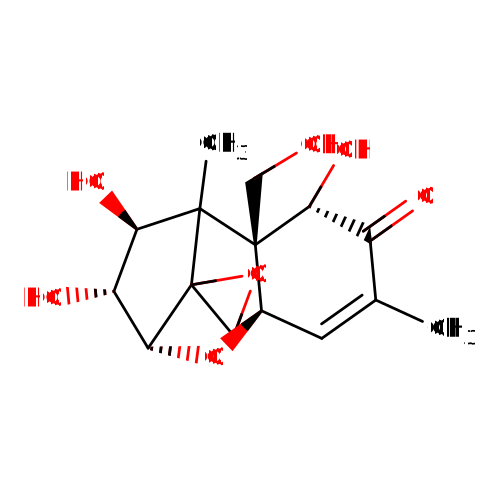
| Record Information |
|---|
| Version | 2.0 |
|---|
| Created at | 2022-09-12 13:13:56 UTC |
|---|
| Updated at | 2022-09-12 13:13:56 UTC |
|---|
| NP-MRD ID | NP0329132 |
|---|
| Secondary Accession Numbers | None |
|---|
| Natural Product Identification |
|---|
| Common Name | (2'r,3's,7'r,9'r,10'r,11's)-3',10',11'-trihydroxy-2'-(hydroxymethyl)-1',5'-dimethyl-8'-oxaspiro[oxirane-2,12'-tricyclo[7.2.1.0²,⁷]dodecan]-5'-en-4'-one |
|---|
| Description | NIVALENOL belongs to the class of organic compounds known as trichothecenes. These are sesquiterpene mycotoxins structurally characterized by the presence of an epoxide ring and a benzopyran derivative with a variant number of hydroxyl, acetyl, or other substituents. The most important structural features causing the biological activities of trichothecenes are the 12,13-epoxy ring, the presence of hydroxyl or acetyl groups at appropriate positions on the trichothecene nucleus and the structure and position of the side-chain. (2'r,3's,7'r,9'r,10'r,11's)-3',10',11'-trihydroxy-2'-(hydroxymethyl)-1',5'-dimethyl-8'-oxaspiro[oxirane-2,12'-tricyclo[7.2.1.0²,⁷]dodecan]-5'-en-4'-one is found in Fusarium culmorum, Fusarium graminearum and Fusarium tricinctum. (2'r,3's,7'r,9'r,10'r,11's)-3',10',11'-trihydroxy-2'-(hydroxymethyl)-1',5'-dimethyl-8'-oxaspiro[oxirane-2,12'-tricyclo[7.2.1.0²,⁷]dodecan]-5'-en-4'-one was first documented in 2022 (PMID: 36006203). Based on a literature review a small amount of articles have been published on NIVALENOL (PMID: 36122196) (PMID: 36006189) (PMID: 35878201) (PMID: 35878194). |
|---|
| Structure | CC1=C[C@H]2O[C@@H]3[C@H](O)[C@@H](O)C(C)(C33CO3)[C@@]2(CO)[C@H](O)C1=O InChI=1S/C15H20O7/c1-6-3-7-14(4-16,11(20)8(6)17)13(2)10(19)9(18)12(22-7)15(13)5-21-15/h3,7,9-12,16,18-20H,4-5H2,1-2H3/t7-,9-,10-,11-,12-,13?,14-,15?/m1/s1 |
|---|
| Synonyms | Not Available |
|---|
| Chemical Formula | C15H20O7 |
|---|
| Average Mass | 312.3180 Da |
|---|
| Monoisotopic Mass | 312.12090 Da |
|---|
| IUPAC Name | (2'R,3'S,7'R,9'R,10'R,11'S)-3',10',11'-trihydroxy-2'-(hydroxymethyl)-1',5'-dimethyl-8'-oxaspiro[oxirane-2,12'-tricyclo[7.2.1.0^{2,7}]dodecan]-5'-en-4'-one |
|---|
| Traditional Name | (2'R,3'S,7'R,9'R,10'R,11'S)-3',10',11'-trihydroxy-2'-(hydroxymethyl)-1',5'-dimethyl-8'-oxaspiro[oxirane-2,12'-tricyclo[7.2.1.0^{2,7}]dodecan]-5'-en-4'-one |
|---|
| CAS Registry Number | Not Available |
|---|
| SMILES | CC1=C[C@H]2O[C@@H]3[C@H](O)[C@@H](O)C(C)(C33CO3)[C@@]2(CO)[C@H](O)C1=O |
|---|
| InChI Identifier | InChI=1S/C15H20O7/c1-6-3-7-14(4-16,11(20)8(6)17)13(2)10(19)9(18)12(22-7)15(13)5-21-15/h3,7,9-12,16,18-20H,4-5H2,1-2H3/t7-,9-,10-,11-,12-,13?,14-,15?/m1/s1 |
|---|
| InChI Key | UKOTXHQERFPCBU-NVRDWZTOSA-N |
|---|
| Experimental Spectra |
|---|
|
| Not Available | | Predicted Spectra |
|---|
|
| | Spectrum Type | Description | Depositor ID | Depositor Organization | Depositor | Deposition Date | View |
|---|
| 1D NMR | 13C NMR Spectrum (1D, 25 MHz, H2O, predicted) | Wishart Lab | Wishart Lab | David Wishart | 2021-06-20 | View Spectrum | | 1D NMR | 1H NMR Spectrum (1D, 100 MHz, H2O, predicted) | Wishart Lab | Wishart Lab | David Wishart | 2021-06-20 | View Spectrum | | 1D NMR | 13C NMR Spectrum (1D, 252 MHz, H2O, predicted) | Wishart Lab | Wishart Lab | David Wishart | 2021-06-20 | View Spectrum | | 1D NMR | 1H NMR Spectrum (1D, 1000 MHz, H2O, predicted) | Wishart Lab | Wishart Lab | David Wishart | 2021-06-20 | View Spectrum | | 1D NMR | 13C NMR Spectrum (1D, 50 MHz, H2O, predicted) | Wishart Lab | Wishart Lab | David Wishart | 2021-06-20 | View Spectrum | | 1D NMR | 1H NMR Spectrum (1D, 200 MHz, H2O, predicted) | Wishart Lab | Wishart Lab | David Wishart | 2021-06-20 | View Spectrum | | 1D NMR | 13C NMR Spectrum (1D, 75 MHz, H2O, predicted) | Wishart Lab | Wishart Lab | David Wishart | 2021-06-20 | View Spectrum | | 1D NMR | 1H NMR Spectrum (1D, 300 MHz, H2O, predicted) | Wishart Lab | Wishart Lab | David Wishart | 2021-06-20 | View Spectrum | | 1D NMR | 13C NMR Spectrum (1D, 101 MHz, H2O, predicted) | Wishart Lab | Wishart Lab | David Wishart | 2021-06-20 | View Spectrum | | 1D NMR | 1H NMR Spectrum (1D, 400 MHz, H2O, predicted) | Wishart Lab | Wishart Lab | David Wishart | 2021-06-20 | View Spectrum | | 1D NMR | 13C NMR Spectrum (1D, 126 MHz, H2O, predicted) | Wishart Lab | Wishart Lab | David Wishart | 2021-06-20 | View Spectrum | | 1D NMR | 1H NMR Spectrum (1D, 500 MHz, H2O, predicted) | Wishart Lab | Wishart Lab | David Wishart | 2021-06-20 | View Spectrum | | 1D NMR | 13C NMR Spectrum (1D, 151 MHz, H2O, predicted) | Wishart Lab | Wishart Lab | David Wishart | 2021-06-20 | View Spectrum | | 1D NMR | 1H NMR Spectrum (1D, 600 MHz, H2O, predicted) | Wishart Lab | Wishart Lab | David Wishart | 2021-06-20 | View Spectrum | | 1D NMR | 13C NMR Spectrum (1D, 176 MHz, H2O, predicted) | Wishart Lab | Wishart Lab | David Wishart | 2021-06-20 | View Spectrum | | 1D NMR | 1H NMR Spectrum (1D, 700 MHz, H2O, predicted) | Wishart Lab | Wishart Lab | David Wishart | 2021-06-20 | View Spectrum | | 1D NMR | 13C NMR Spectrum (1D, 201 MHz, H2O, predicted) | Wishart Lab | Wishart Lab | David Wishart | 2021-06-20 | View Spectrum | | 1D NMR | 1H NMR Spectrum (1D, 800 MHz, H2O, predicted) | Wishart Lab | Wishart Lab | David Wishart | 2021-06-20 | View Spectrum | | 1D NMR | 13C NMR Spectrum (1D, 226 MHz, H2O, predicted) | Wishart Lab | Wishart Lab | David Wishart | 2021-06-20 | View Spectrum | | 1D NMR | 1H NMR Spectrum (1D, 900 MHz, H2O, predicted) | Wishart Lab | Wishart Lab | David Wishart | 2021-06-20 | View Spectrum |
| | Chemical Shift Submissions |
|---|
|
| Not Available | | Species |
|---|
| Species of Origin | |
|---|
| Chemical Taxonomy |
|---|
| Description | Belongs to the class of organic compounds known as trichothecenes. These are sesquiterpene mycotoxins structurally characterized by the presence of an epoxide ring and a benzopyran derivative with a variant number of hydroxyl, acetyl, or other substituents. The most important structural features causing the biological activities of trichothecenes are the 12,13-epoxy ring, the presence of hydroxyl or acetyl groups at appropriate positions on the trichothecene nucleus and the structure and position of the side-chain. |
|---|
| Kingdom | Organic compounds |
|---|
| Super Class | Lipids and lipid-like molecules |
|---|
| Class | Prenol lipids |
|---|
| Sub Class | Sesquiterpenoids |
|---|
| Direct Parent | Trichothecenes |
|---|
| Alternative Parents | |
|---|
| Substituents | - Trichothecene skeleton
- Cyclohexenone
- Oxepane
- Oxane
- Cyclic alcohol
- Cyclic ketone
- Secondary alcohol
- Ketone
- Oxacycle
- Organoheterocyclic compound
- Polyol
- Ether
- Oxirane
- Dialkyl ether
- Organic oxygen compound
- Organic oxide
- Hydrocarbon derivative
- Primary alcohol
- Organooxygen compound
- Carbonyl group
- Alcohol
- Aliphatic heteropolycyclic compound
|
|---|
| Molecular Framework | Aliphatic heteropolycyclic compounds |
|---|
| External Descriptors | Not Available |
|---|
| Physical Properties |
|---|
| State | Not Available |
|---|
| Experimental Properties | | Property | Value | Reference |
|---|
| Melting Point | Not Available | Not Available | | Boiling Point | Not Available | Not Available | | Water Solubility | Not Available | Not Available | | LogP | Not Available | Not Available |
|
|---|
| Predicted Properties | |
|---|
| General References | - Dong F, Chen X, Lei X, Wu D, Zhang Y, Lee YW, Mokoena MP, Olaniran AO, Li Y, Shen G, Liu X, Xu JH, Shi JR: Effect of Crop Rotation on Fusarium Mycotoxins and Fusarium Species in Cereals in Sichuan Province (China). Plant Dis. 2023 Apr;107(4):1060-1066. doi: 10.1094/PDIS-01-22-0024-RE. Epub 2023 Apr 10. [PubMed:36122196 ]
- Janaviciene S, Suproniene S, Kadziene G, Pavlenko R, Berzina Z, Bartkevics V: Toxigenicity of F. graminearum Residing on Host Plants Alternative to Wheat as Influenced by Environmental Conditions. Toxins (Basel). 2022 Aug 8;14(8):541. doi: 10.3390/toxins14080541. [PubMed:36006203 ]
- Kumar P, Mahato DK, Gupta A, Pandey S, Paul V, Saurabh V, Pandey AK, Selvakumar R, Barua S, Kapri M, Kumar M, Kaur C, Tripathi AD, Gamlath S, Kamle M, Varzakas T, Agriopoulou S: Nivalenol Mycotoxin Concerns in Foods: An Overview on Occurrence, Impact on Human and Animal Health and Its Detection and Management Strategies. Toxins (Basel). 2022 Jul 31;14(8):527. doi: 10.3390/toxins14080527. [PubMed:36006189 ]
- Islam MN, Banik M, Sura S, Tucker JR, Wang X: Implications of Crop Rotation and Fungicide on Fusarium and Mycotoxin Spectra in Manitoba Barley, 2017-2019. Toxins (Basel). 2022 Jul 6;14(7):463. doi: 10.3390/toxins14070463. [PubMed:35878201 ]
- Schiwek S, Alhussein M, Rodemann C, Budragchaa T, Beule L, von Tiedemann A, Karlovsky P: Fusarium culmorum Produces NX-2 Toxin Simultaneously with Deoxynivalenol and 3-Acetyl-Deoxynivalenol or Nivalenol. Toxins (Basel). 2022 Jul 2;14(7):456. doi: 10.3390/toxins14070456. [PubMed:35878194 ]
- LOTUS database [Link]
|
|---|