| Record Information |
|---|
| Version | 2.0 |
|---|
| Created at | 2022-09-12 10:39:30 UTC |
|---|
| Updated at | 2022-09-12 10:39:31 UTC |
|---|
| NP-MRD ID | NP0327772 |
|---|
| Secondary Accession Numbers | None |
|---|
| Natural Product Identification |
|---|
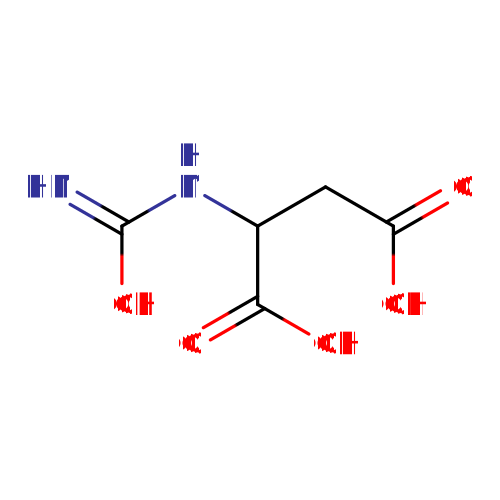
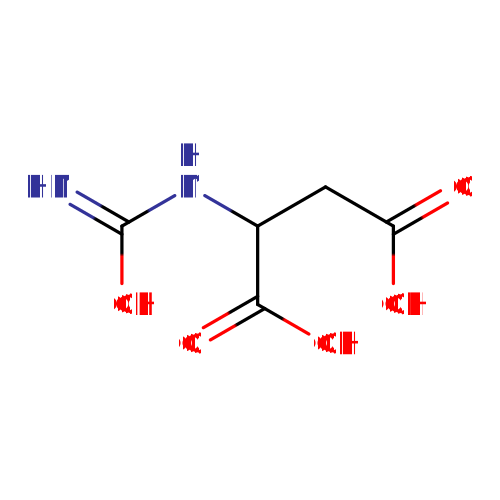
| Common Name | carbamoyl aspartic acid |
|---|
| Description | N-carbamoylaspartic acid, also known as 2-ureidobutanedioic acid or ureidosuccinic acid, belongs to the class of organic compounds known as aspartic acid and derivatives. Aspartic acid and derivatives are compounds containing an aspartic acid or a derivative thereof resulting from reaction of aspartic acid at the amino group or the carboxy group, or from the replacement of any hydrogen of glycine by a heteroatom. carbamoyl aspartic acid is found in Arabidopsis thaliana. carbamoyl aspartic acid was first documented in 1952 (PMID: 14920504). N-carbamoylaspartic acid is an extremely weak basic (essentially neutral) compound (based on its pKa) (PMID: 131912) (PMID: 13831) (PMID: 13882306) (PMID: 14367323). |
|---|
| Structure | InChI=1S/C5H8N2O5/c6-5(12)7-2(4(10)11)1-3(8)9/h2H,1H2,(H,8,9)(H,10,11)(H3,6,7,12) |
|---|
| Synonyms | | Value | Source |
|---|
| 2-Ureidobutanedioic acid | ChEBI | | Carbamylaspartic acid | ChEBI | | N-(Aminocarbonyl)-DL-aspartic acid | ChEBI | | Ureidosuccinic acid | ChEBI | | 2-Ureidobutanedioate | Generator | | Carbamylaspartate | Generator | | N-(Aminocarbonyl)-DL-aspartate | Generator | | Ureidosuccinate | Generator | | N-Carbamoylaspartate | Generator | | N-Carbamoyl-D-aspartic acid | MeSH | | N-Carbamoyl-L-aspartic acid | MeSH | | N-Carbamoylaspartic acid | MeSH | | Carbamyl-DL-aspartate | MeSH | | Ureidosuccinic acid, (D)-isomer | MeSH | | Ureidosuccinic acid, (L)-isomer | MeSH | | Ureidosuccinic acid, cobalt (+2), (1:1) salt,(L)-isomer | MeSH | | Ureidosuccinic acid, maganeese (+2), (1:1) salt | MeSH | | Ureidosuccinic acid, zinc (1:1) salt, (L)-isomer | MeSH |
|
|---|
| Chemical Formula | C5H8N2O5 |
|---|
| Average Mass | 176.1280 Da |
|---|
| Monoisotopic Mass | 176.04332 Da |
|---|
| IUPAC Name | 2-(carbamoylamino)butanedioic acid |
|---|
| Traditional Name | ureidosuccinic acid |
|---|
| CAS Registry Number | Not Available |
|---|
| SMILES | OC(=O)CC(NC(O)=N)C(O)=O |
|---|
| InChI Identifier | InChI=1S/C5H8N2O5/c6-5(12)7-2(4(10)11)1-3(8)9/h2H,1H2,(H,8,9)(H,10,11)(H3,6,7,12) |
|---|
| InChI Key | HLKXYZVTANABHZ-UHFFFAOYSA-N |
|---|
| Experimental Spectra |
|---|
|
| Not Available | | Predicted Spectra |
|---|
|
| Not Available | | Chemical Shift Submissions |
|---|
|
| Not Available | | Species |
|---|
| Species of Origin | |
|---|
| Chemical Taxonomy |
|---|
| Description | Belongs to the class of organic compounds known as aspartic acid and derivatives. Aspartic acid and derivatives are compounds containing an aspartic acid or a derivative thereof resulting from reaction of aspartic acid at the amino group or the carboxy group, or from the replacement of any hydrogen of glycine by a heteroatom. |
|---|
| Kingdom | Organic compounds |
|---|
| Super Class | Organic acids and derivatives |
|---|
| Class | Carboxylic acids and derivatives |
|---|
| Sub Class | Amino acids, peptides, and analogues |
|---|
| Direct Parent | Aspartic acid and derivatives |
|---|
| Alternative Parents | |
|---|
| Substituents | - Aspartic acid or derivatives
- Dicarboxylic acid or derivatives
- Fatty acid
- Isourea
- Carboximidamide
- Carboxylic acid
- Carboximidic acid derivative
- Organic oxide
- Organic nitrogen compound
- Hydrocarbon derivative
- Carbonyl group
- Organooxygen compound
- Organonitrogen compound
- Imine
- Organopnictogen compound
- Organic oxygen compound
- Aliphatic acyclic compound
|
|---|
| Molecular Framework | Aliphatic acyclic compounds |
|---|
| External Descriptors | |
|---|
| Physical Properties |
|---|
| State | Not Available |
|---|
| Experimental Properties | | Property | Value | Reference |
|---|
| Melting Point | Not Available | Not Available | | Boiling Point | Not Available | Not Available | | Water Solubility | Not Available | Not Available | | LogP | Not Available | Not Available |
|
|---|
| Predicted Properties | |
|---|
| General References | - Golovinsky EV, Maneva LS, Angelov II, Veljanova KD, Sniker DJ, Stankevich EK: Antibacterial and antitumor activity of some derivatives of ureidosuccinic acid. Neoplasma. 1976;23(1):43-6. [PubMed:131912 ]
- Greth ML, Chevallier MR, Lacroute F: Ureidosuccinic acid permeation in Saccharomyces cerevisiae. Biochim Biophys Acta. 1977 Feb 14;465(1):138-51. doi: 10.1016/0005-2736(77)90362-5. [PubMed:13831 ]
- CROKAERT R: [Carbamoyl derivatives of amino acids of biological importance. II. N-Carbamoylaspartic acid. Separation technics and determination in urine in rat and man]. Bull Soc Chim Biol (Paris). 1961;43:1331-8. [PubMed:13882306 ]
- ANDERSON EP, YEN CY, MANDEL HG, SMITH PK: Ureidosuccinic acid as a precursor of nucleic acid pyrimidines in normal and tumor-bearing mice. J Biol Chem. 1955 Apr;213(2):625-33. [PubMed:14367323 ]
- SPICER DS, LIEBERT KV, WRIGHT LD, HUFF JW: Study of ureidosuccinic acid and related compounds in pyrimidine synthesis by Lactobacillus bulgaricus 09. Proc Soc Exp Biol Med. 1952 Apr;79(4):587-8. doi: 10.3181/00379727-79-19455. [PubMed:14920504 ]
- LOTUS database [Link]
|
|---|